Biggest SOP Mistakes Students Make (And How to Avoid Them)
Introduction
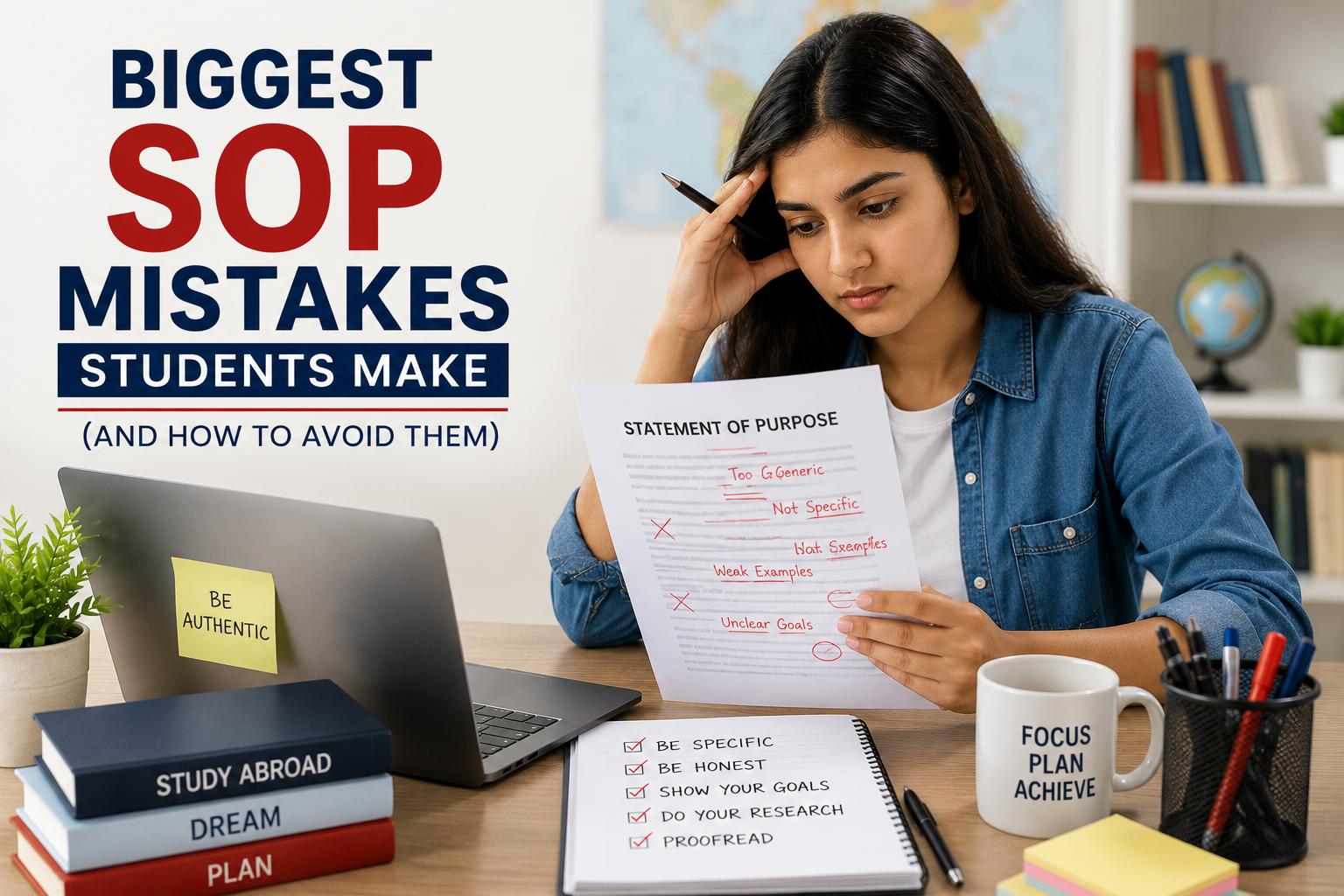
The Statement of Purpose (SOP) is one of the most important documents in a study abroad application.
It gives universities an opportunity to understand:
- Your academic background
- Career goals
- Motivation for the course
- Reasons for choosing the university
However, many students unknowingly make mistakes that weaken their applications.
A well-written SOP can strengthen your profile, while a poor SOP can create a negative impression.
Why SOP Mistakes Matter
Admission committees read thousands of SOPs every year.
When they see:
- Generic content
- Weak structure
- Poor explanations
your application may become less memorable.
Avoiding common mistakes can significantly improve the quality of your SOP.
Mistake 1: Copy-Pasting SOPs from the Internet
This is one of the most common mistakes.
Many students download SOP samples and copy large sections directly.
Universities often review thousands of applications and can easily identify generic content.
A copied SOP:
- Looks unoriginal
- Reduces credibility
- Fails to represent your real story
Your SOP should reflect your own journey and goals.
Mistake 2: Writing Generic Statements
Statements such as:
"I have always dreamed of studying abroad."
or
"I am passionate about learning."
appear in countless SOPs.
These statements do not tell the university anything specific about you.
Instead, explain:
- What sparked your interest
- How your experiences influenced your goals
- Why you chose the field
Specific examples make your SOP stronger.
Mistake 3: Focusing Too Much on Personal Stories
A short personal story can be effective.
However, some students spend most of the SOP discussing childhood experiences without connecting them to academics or career goals.
Universities are primarily interested in:
- Academic readiness
- Professional development
- Future plans
Keep personal stories relevant and concise.
Mistake 4: Not Explaining Course Selection Clearly
Many SOPs mention the chosen course but fail to explain why it was selected.
Universities want to understand:
- Why you chose the field
- How it relates to your background
- How it supports your career goals
A clear connection between your past and future is important.
Mistake 5: Poor Research About the University
Some students simply write:
"This university has an excellent reputation."
This is too generic.
Instead, discuss:
- Specific modules
- Research opportunities
- Faculty expertise
- Academic strengths
Demonstrating research shows genuine interest.
Mistake 6: Making the SOP a Resume
Your SOP should not repeat everything already listed in your CV.
Instead of listing achievements, explain:
- Their significance
- What you learned
- How they influenced your academic journey
The SOP should provide context, not duplicate information.
Mistake 7: Weak Career Goals
Many students write vague goals such as:
"I want a successful career."
Universities prefer clear objectives.
Discuss:
- Short-term goals
- Long-term goals
- Industry interests
- Future contributions
Specific goals make your application more convincing.
Mistake 8: Grammar and Language Errors
Even strong content can lose impact if it contains:
- Spelling mistakes
- Grammar issues
- Poor sentence structure
Proofreading is essential.
Consider reviewing your SOP multiple times before submission.
Mistake 9: Making the SOP Too Long
Long SOPs often lose focus.
Admission officers have limited time.
A concise and well-organized SOP is usually more effective than an unnecessarily lengthy document.
Follow university guidelines carefully.
Mistake 10: Using AI Content Without Personalization
AI tools can help generate ideas.
However, submitting generic AI-generated content without editing can make the SOP sound impersonal.
Your SOP should include:
- Your experiences
- Your achievements
- Your goals
Authenticity matters.
How to Write a Better SOP
To improve your SOP:
- Start early
- Create multiple drafts
- Use clear language
- Focus on your journey
- Research the university properly
- Proofread carefully
A thoughtful SOP often stands out more than a complicated one.
The Real Truth
Most SOP rejections are not caused by poor English.
They are caused by:
- Lack of clarity
- Generic content
- Weak motivation
- Poor structure
Universities want to understand who you are, what you want to achieve, and why their program is the right fit for you.
A genuine and well-structured SOP can make a significant difference.
Frequently Asked Questions (FAQs)
1. What is the biggest SOP mistake?
Copying content from samples or the internet.
2. Can AI write my entire SOP?
AI can assist, but your SOP should always be personalized.
3. How long should an SOP be?
Most universities prefer around 1–2 pages unless specified otherwise.
4. Should I include personal stories?
Yes, but only if they are relevant to your academic and career goals.
5. Do universities check for copied SOPs?
Many universities can identify generic or copied content.
6. What makes an SOP strong?
Clarity, authenticity, structure, and well-defined goals.
Verified by Edulx Germany Specialists
Have questions about your profile or APS verification? Book a free 1-on-1 session with our Pune counsellors.