Cash vs Card: Managing Money Abroad
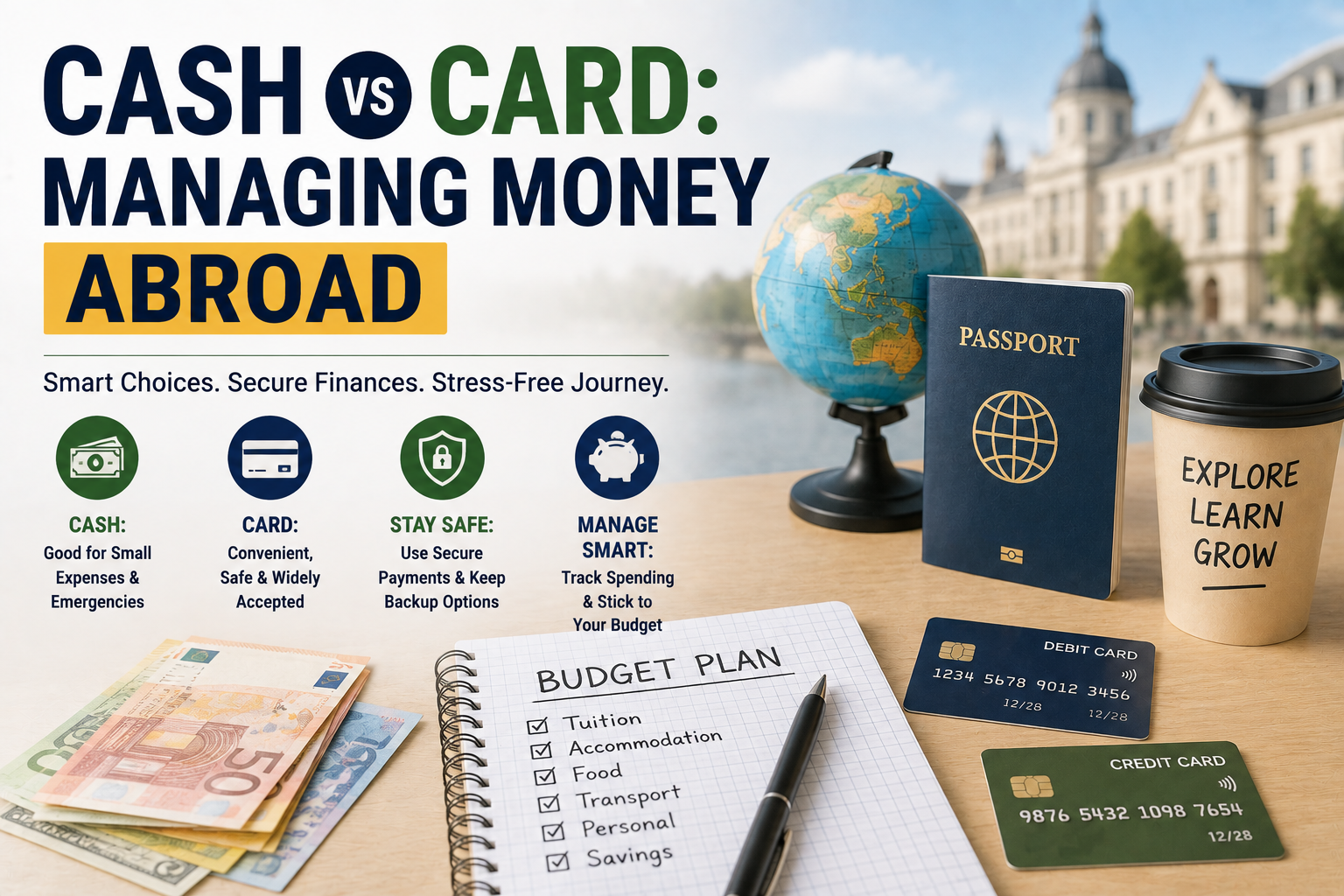
Cash vs Card: Managing Money Abroad – What Should Students Know?
Moving abroad for higher education means learning how to manage your money in a completely new environment.
One of the first questions many international students have is:
Should I carry cash, use a card, or rely on digital payments?
The answer isn't necessarily one or the other.
For most students, having a combination of payment methods can provide convenience, flexibility, and a backup option in case something goes wrong.
From paying rent and groceries to buying public transport tickets or enjoying a meal with friends, understanding how payments work in your destination country can make your transition much easier.
Cash vs Card: What's the Difference?
Both cash and cards have their advantages.
Cash
Cash means carrying physical currency and using notes or coins for purchases.
It can be useful for:
- Small purchases
- Local shops
- Public markets
- Places that don't accept cards
- Emergency situations
Cards
Cards can include:
- Debit cards
- Credit cards
- Prepaid travel cards
They are generally convenient for everyday purchases and can reduce the need to carry large amounts of physical cash.
Advantages of Carrying Cash Abroad
1. Useful for Small Purchases
Some small businesses or vendors may prefer cash, particularly in certain locations.
Having some local currency can be convenient when you first arrive.
2. Helpful During Emergencies
If your card is blocked, lost, or temporarily unavailable, cash can act as a backup.
This is particularly useful during your first few days in a new country.
3. No Card Machine Required
Cash doesn't depend on:
- Internet connectivity
- Card terminals
- Battery
- Bank systems
This can be useful in places where electronic payments aren't readily available.
Disadvantages of Carrying Too Much Cash
Carrying large amounts of cash also comes with risks.
Risk of Loss or Theft
If your wallet is lost or stolen, recovering physical cash can be difficult.
Difficult to Track Spending
Cash transactions may be harder to monitor unless you record them.
Currency Conversion
Exchanging large amounts of currency can involve exchange-rate differences and fees.
For these reasons, students should generally avoid carrying unnecessary amounts of cash.
Advantages of Using Cards Abroad
1. Convenient
Cards can be used for many everyday expenses, including:
- Groceries
- Restaurants
- Online shopping
- Transportation
- University-related payments
2. Easier Expense Tracking
Card transactions usually appear in your banking app or account statement.
This can help you monitor your monthly budget.
3. Less Physical Cash
You don't need to carry large amounts of money with you.
This can make everyday travel more convenient.
4. Useful for Online Payments
International students often need to make online payments for:
- Accommodation
- Flights
- Subscriptions
- University services
- Shopping
Cards can be useful for these transactions.
Disadvantages of Using Cards Abroad
Cards aren't perfect either.
You may encounter:
- Foreign transaction fees
- Currency conversion charges
- ATM fees
- Card restrictions
- Merchant surcharges
- Temporary card blocks
Before travelling, check your bank's international transaction policies.
Debit Card vs Credit Card
Students may use either debit or credit cards depending on their financial situation.
Debit Card
Money is generally deducted directly from your linked bank account.
Advantages:
- Helps control spending
- No need to borrow money
- Convenient for everyday purchases
Credit Card
Purchases are charged against a credit limit and paid later according to the card's terms.
Advantages:
- Useful as an emergency backup
- Can be convenient for certain bookings
- May offer additional benefits depending on the card
However, students should understand interest charges, fees, and repayment requirements before using credit.
Should You Carry Cash When You First Arrive?
Yes, having some local currency can be useful when you arrive.
You may need money for:
- Airport transportation
- Food
- Small purchases
- Emergency expenses
- Initial transportation
- Temporary accommodation expenses
However, avoid carrying unnecessarily large amounts.
Your exact cash needs depend on your destination and arrival arrangements.
How Much Cash Should You Carry?
There is no universal amount that works for every student.
Instead, consider:
- Your destination
- Arrival time
- Airport transport
- Accommodation arrangements
- Whether cards are widely accepted
- Availability of ATMs
Carry enough for your initial needs and keep the rest of your funds securely accessible through your bank accounts or cards.
Keep More Than One Payment Option
One of the smartest approaches is to have a backup.
For example:
Primary: Debit card
Backup: Second card
Emergency: Small amount of local cash
This reduces the risk of being completely without access to money if your primary card stops working.
Notify Your Bank Before Travelling
Before leaving your home country, check whether your bank requires you to activate international transactions or notify them about overseas usage.
Also verify:
- International transaction settings
- ATM withdrawal limits
- Daily spending limits
- Foreign transaction fees
- Currency conversion charges
- Card expiry date
These simple checks can prevent payment problems after arrival.
Understand Currency Conversion
When you use an Indian card abroad, your transaction may be converted from the local currency into INR.
The final amount can depend on:
- Exchange rate
- Card network
- Bank charges
- Foreign transaction fees
- Taxes or applicable charges
Always check your bank's current terms rather than assuming that the exchange rate shown on a search engine will be the exact rate applied to your transaction.
Be Careful With Dynamic Currency Conversion
You may sometimes be asked whether you want to pay in:
Local currency or Indian rupees.
This is known as dynamic currency conversion.
The conversion offered by the merchant or ATM may not always be the most favourable.
Before accepting, understand the exchange rate and additional charges.
Using ATMs Abroad
ATMs can be convenient, but fees may apply.
Before withdrawing money, check:
- Your bank's international ATM charges
- Local ATM fees
- Withdrawal limits
- Currency conversion rates
Use reputable ATMs and be aware of your surroundings.
Keep Your Cards Secure
A few simple habits can improve financial security.
Never Share Your PIN
Don't share your PIN with anyone.
Enable Transaction Alerts
Turn on banking notifications so you can identify unfamiliar transactions quickly.
Protect Your Card Details
Avoid sharing card numbers, CVV information, or banking credentials unnecessarily.
Use Secure Websites
When making online payments, ensure you're using legitimate websites and secure connections.
What If Your Card Is Lost or Stolen?
If you lose your card:
- Contact your bank immediately.
- Block or freeze the card through your banking app if available.
- Report unauthorised transactions.
- Use your backup payment method.
- Request a replacement if necessary.
Keep your bank's international customer-support information accessible before travelling.
How Students Can Manage Monthly Expenses
Whether you use cash or cards, budgeting is more important than the payment method.
Divide your monthly budget into categories such as:
- Accommodation
- Food
- Transportation
- Study materials
- Mobile and internet
- Entertainment
- Emergency savings
Review your spending regularly.
Use Cash for Budget Control
Some students find that cash helps them control spending.
For example, you could allocate a fixed weekly amount for discretionary expenses.
Once the cash is used, you know you've reached your weekly limit.
However, this method should only be used when carrying cash is safe and practical.
Use Cards for Tracking Expenses
Cards can make it easier to monitor spending through transaction histories.
You can review your expenses and identify where your money is going.
For students managing a limited monthly budget, this can be particularly useful.
Don't Depend Entirely on One Payment Method
Imagine arriving in a new country and discovering that:
- Your card isn't working.
- Your bank has blocked an international transaction.
- The ATM doesn't accept your card.
- Your phone battery is dead.
Having a backup can make these situations much easier to handle.
Cash vs Card: Which Is Better?
There is no single answer.
Payment Method
Best For
Main Advantage
Main Concern
Cash
Small purchases & emergencies
Simple and widely accepted in some places
Loss or theft
Debit Card
Everyday spending
Convenient and easy to track
Fees/restrictions may apply
Credit Card
Backup & selected purchases
Flexible payment option
Interest and fees
Prepaid Card
Controlled travel spending
Helps manage a fixed amount
May have fees/limitations
The ideal combination depends on your destination, bank, and personal spending habits.
Smart Money Tips for International Students
Before Leaving India
✔ Check international usage on your cards.
✔ Understand foreign transaction fees.
✔ Note your card's expiry date.
✔ Keep your bank's support details accessible.
✔ Carry some local currency for initial expenses.
After Arriving Abroad
✔ Open a local bank account if appropriate for your destination and circumstances.
✔ Keep a backup payment method.
✔ Monitor transactions regularly.
✔ Create a monthly budget.
✔ Avoid carrying large amounts of cash.
✔ Save emergency funds separately.
Final Conclusion
Managing money abroad doesn't have to be complicated.
Cash and cards both have a role to play, and relying on just one payment method may create unnecessary problems.
For many international students, a practical approach is to carry a small amount of local cash while using a debit or other suitable card for most everyday transactions and keeping a second payment method as a backup.
Before travelling, understand your bank's fees, international transaction rules, ATM charges, and currency-conversion policies.
Most importantly, focus on safe spending, regular budgeting, and having a backup plan.
The goal isn't simply to choose between cash and cards—it's to build a reliable money-management system that works throughout your study abroad journey.
Verified by Edulx Germany Specialists
Have questions about your profile or APS verification? Book a free 1-on-1 session with our Pune counsellors.