How to Choose Between a University and a University of Applied Sciences Abroad
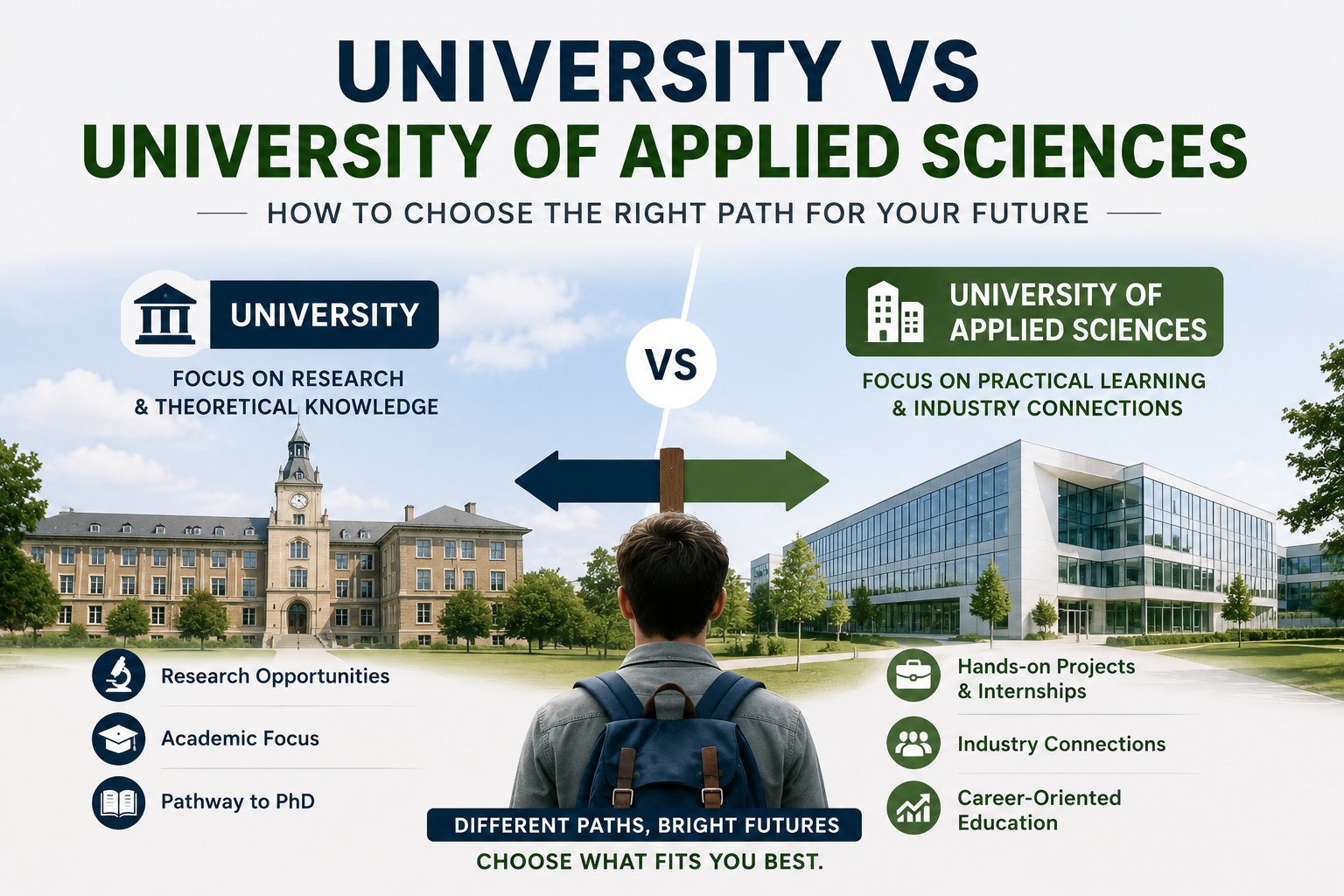
How to Choose Between a University and a University of Applied Sciences Abroad
When searching for universities abroad, students often come across different types of higher education institutions.
You may find traditional research universities alongside Universities of Applied Sciences, especially in countries such as Germany, Austria, the Netherlands, Finland, and other European destinations.
At first, the difference may not seem significant.
Both can offer bachelor's and master's degrees, and both can lead to successful careers.
However, their teaching approach, academic focus, research opportunities, and connection with industry can be quite different.
Understanding these differences can help you choose an institution that matches your academic background and career goals.
What Is a Traditional University?
A traditional university generally places a stronger emphasis on:
- Academic knowledge
- Research
- Theoretical foundations
- Scientific study
- Academic specialisation
Many traditional universities have extensive research facilities and doctoral programs.
They can be particularly suitable for students interested in:
- Research careers
- PhD studies
- Academic careers
- Scientific fields
- Research-intensive industries
However, the exact structure varies by university and program.
What Is a University of Applied Sciences?
A University of Applied Sciences focuses more strongly on practical and industry-oriented education.
Depending on the institution and program, students may have opportunities to work on:
- Practical projects
- Industry assignments
- Applied research
- Internships
- Real-world case studies
- Laboratory work
The goal is often to connect academic knowledge with practical applications.
These institutions can be attractive to students who want to develop skills that can be applied directly in professional environments.
University vs University of Applied Sciences
The biggest difference can be summarised as:
Traditional University → More research and theoretical focus
University of Applied Sciences → More practical and industry-oriented focus
However, this is a general comparison. Individual programs can differ significantly, so students should always examine the actual curriculum.
1. Teaching Style
Traditional universities may include a greater emphasis on:
- Lectures
- Academic theory
- Research methodology
- Independent study
- Scientific analysis
Universities of Applied Sciences may include more:
- Practical assignments
- Group projects
- Case studies
- Laboratory work
- Industry projects
If you prefer learning by applying concepts to real-world situations, an applied institution may be worth considering.
2. Research Opportunities
If research is your primary goal, a traditional university may offer a broader research environment.
You may find:
- Research laboratories
- Research centres
- Academic research groups
- Doctoral programs
- Research assistant opportunities
Universities of Applied Sciences can also conduct research, particularly applied research, but their research structure and doctoral opportunities may differ by country and institution.
3. Industry Exposure
Universities of Applied Sciences often place strong emphasis on industry collaboration.
Students may encounter:
- Company projects
- Industry partnerships
- Practical assignments
- Internships
- Guest lectures
- Industry-oriented research
This can be valuable for students who want to enter the workforce after completing their degree.
4. Internships
Internships can be an important part of career preparation.
Depending on the program, an applied institution may have a stronger practical component built into the curriculum.
However, internship opportunities are not exclusive to Universities of Applied Sciences.
Traditional universities can also offer internships, career fairs, company projects, and industry partnerships.
Always check the specific course structure.
5. Career-Oriented Education
If your goal is to build practical professional skills, an applied program may be particularly attractive.
For example, programs in:
- Engineering
- Information Technology
- Business
- Biotechnology
- Automotive Technology
- Renewable Energy
- Logistics
may include practical components designed around industry needs.
6. Academic and Career Goals Matter
There is no universally "better" option.
The right choice depends on what you want to do after graduation.
Choose a traditional university if you are primarily interested in:
- Research
- PhD studies
- Academic careers
- Scientific work
- Research-intensive industries
Consider a University of Applied Sciences if you prefer:
- Practical learning
- Industry projects
- Professional skills
- Internships
- Applied research
- Direct career preparation
7. Check the Degree Recognition
Before applying, check how the degree is recognised in your intended country and industry.
Look at:
- Degree level
- Accreditation
- Program recognition
- Professional recognition where relevant
- Further-study options
Don't assume that all institutions follow the same rules.
8. Can You Do a PhD After a University of Applied Sciences?
This depends heavily on the country, institution, degree, and doctoral regulations.
In some systems, graduates of Universities of Applied Sciences can progress toward doctoral studies, sometimes through cooperation with research universities.
In other cases, additional academic requirements may apply.
If a PhD is part of your long-term plan, check the specific progression route before choosing your master's program.
9. Compare the Course Curriculum
The institution type is important, but the individual course matters even more.
Before making a decision, compare:
- Core modules
- Electives
- Projects
- Thesis
- Laboratory work
- Internship requirements
- Specialisations
- Assessment methods
Two programs at different institution types may actually have very similar structures.
10. Consider Your Learning Style
Ask yourself how you learn best.
Do you prefer:
Theory → Research → Analysis → Academic study
or:
Theory → Practical application → Projects → Industry experience
Your answer can help you determine which environment may suit you better.
11. Compare Career Opportunities
Don't select an institution simply because it is called a "University."
Instead, investigate:
- Where graduates work
- Companies recruiting graduates
- Internship opportunities
- Career services
- Alumni network
- Industry partnerships
- Graduate outcomes where reliable data is available
This gives you a much clearer picture of the value of the program.
12. Location Can Also Matter
Two universities offering similar programs may be located in completely different environments.
Compare:
- Cost of living
- Student accommodation
- Transport
- Local industries
- Internship opportunities
- Part-time work opportunities
- Graduate employment environment
For industry-focused programs, being close to relevant companies can sometimes be advantageous.
13. Don't Choose Based on Name Alone
A common misconception is:
"Traditional university = better."
Another misconception is:
"Applied university = easier."
Neither assumption is necessarily correct.
The academic difficulty, quality, workload, and career value depend on the individual institution and program.
14. Compare Tuition and Living Costs
Your decision should also fit your financial plan.
Compare:
- Tuition fees
- Semester fees
- Accommodation
- Food
- Transportation
- Insurance
- Study materials
- Other student expenses
A lower tuition fee doesn't automatically mean lower total costs.
15. Think About Your Career Five Years From Now
Before choosing an institution, think beyond graduation.
Ask yourself:
Where do I want this degree to take me?
For example:
Goal: Research Scientist
A research-focused university may be worth prioritising.
Goal: Industry Engineer
A practical, industry-oriented program may be attractive.
Goal: PhD
Investigate research facilities and doctoral progression carefully.
Goal: Immediate Employment
Look closely at internships, practical projects, and employer connections.
Simple Comparison
Factor
Traditional University
University of Applied Sciences
Academic theory
Strong emphasis
Strong, with practical application
Research
Usually extensive
Often focused on applied research
Practical projects
Varies by program
Often prominent
Industry connection
Varies
Often strong
Internships
Program-dependent
Often integrated or encouraged
PhD pathway
Generally straightforward
Depends on country/institution
Career focus
Academic + professional
Strong professional orientation
Best suited for
Research and academic goals
Practical and industry-focused goals
Questions to Ask Before Choosing
Before applying, ask:
- Is the course research-focused or industry-focused?
- How much practical training is included?
- Is an internship part of the curriculum?
- What companies collaborate with the institution?
- What research opportunities are available?
- Can graduates progress to a PhD?
- Where do recent graduates work?
- Is the degree recognised for my intended career?
- What are the total study and living costs?
- Does the course match my long-term career plan?
Final Conclusion
Choosing between a traditional university and a University of Applied Sciences isn't about deciding which one is universally better.
It is about finding the right educational environment for your goals.
If you are passionate about research, scientific study, and potentially pursuing a PhD, a traditional university may be the better fit.
If you prefer practical learning, industry projects, internships, and career-oriented education, a University of Applied Sciences may be worth considering.
Most importantly, don't make the decision based only on the institution's name.
Compare the actual course, curriculum, career opportunities, research options, costs, and your long-term goals.
The best institution is the one that fits your profile and the career you want to build.
Verified by Edulx Germany Specialists
Have questions about your profile or APS verification? Book a free 1-on-1 session with our Pune counsellors.