How to Handle a Gap Year in Your Study Abroad Application
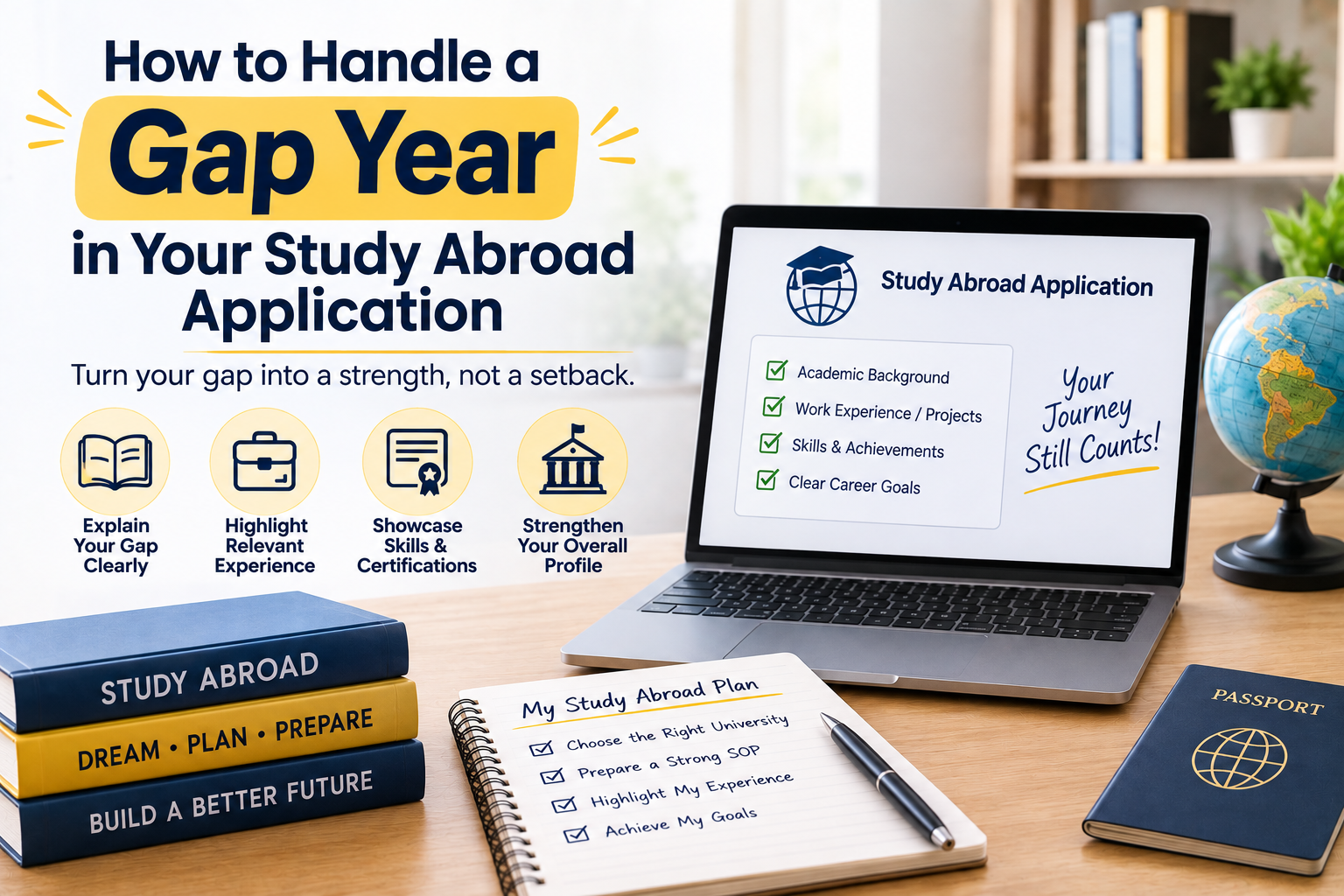
How to Handle a Gap Year in Your Study Abroad Application
Many students worry that a gap in their education could negatively affect their chances of studying abroad.
You may have taken time off after school, between your bachelor's and master's degree, or during your education because of work, exam preparation, personal circumstances, or other commitments.
The important thing to understand is that a study gap is not automatically a problem.
What matters is how you explain the gap, what you did during that period, and whether your overall academic and career plans make sense.
Universities generally assess applications holistically, and requirements can vary by country, university, and program.
What Is a Study Gap?
A study gap is a period during which you were not formally enrolled in an academic program.
For example:
- A gap after Class 12 before starting a bachelor's degree
- A gap between bachelor's and master's studies
- A break during your degree
- A period between graduation and employment
- A career break before applying for higher education
The length of the gap can vary from a few months to several years.
Does a Study Gap Affect Admission?
Not necessarily.
A gap itself does not determine whether you will receive admission.
Universities may consider factors such as:
- Academic performance
- Previous qualifications
- Course relevance
- Work experience
- Skills
- Statement of purpose
- English language proficiency
- Overall application profile
Some programs or institutions may have specific requirements regarding study gaps, so always check the individual university's admission rules.
Why Do Students Have Study Gaps?
There can be many legitimate reasons.
Common reasons include:
- Preparing for entrance examinations
- Searching for employment
- Working full-time
- Internships
- Professional training
- Learning a language
- Financial circumstances
- Family responsibilities
- Personal reasons
- Changing career direction
- Preparing for higher studies
The important thing is to explain the situation honestly.
How Should You Explain Your Study Gap?
The best approach is to be clear, honest, and concise.
Don't try to hide the gap.
Instead, explain:
What happened → What you did → What you learned → Why you are now ready to study
For example:
"After completing my bachelor's degree, I spent two years working in the IT sector. During this period, I gained practical experience in software development and developed a strong interest in data analytics. This experience motivated me to pursue a master's degree in Data Science."
This explanation connects the gap with your academic and career goals.
1. Mention the Gap in Your CV
Your CV should show your timeline clearly.
For example:
2022–2024
Software Developer – ABC Technologies
2024–2026
MSc Data Science
This makes the timeline easy for the university to understand.
Avoid leaving unexplained periods whenever possible.
2. Use Your Work Experience Positively
If you worked during your gap, highlight relevant experience.
Mention:
- Job title
- Company or organisation
- Employment period
- Responsibilities
- Technical skills
- Projects
- Achievements
Relevant work experience can strengthen your application when it connects with your intended course.
3. Include Certifications and Training
If you completed professional courses or certifications during your gap, mention them.
Examples could include:
- Programming certifications
- Data analytics courses
- Language courses
- Industry training
- Professional qualifications
- Technical workshops
Don't add certifications simply to fill the gap.
Focus on genuine learning that supports your profile.
4. Mention Internships and Projects
A gap period can also include practical learning.
You may have completed:
- Internships
- Freelance projects
- Research projects
- Personal projects
- Volunteering
- Business activities
These experiences can demonstrate that your time was productive.
5. Explain Exam Preparation Clearly
Some students take time to prepare for competitive or entrance examinations.
If this applies to you, explain it honestly.
You can mention:
- Examination preparation
- Number of attempts, if relevant
- Relevant subjects studied
- Skills developed
- What you decided afterward
Don't exaggerate your preparation or claim achievements you did not have.
6. Address the Gap in Your SOP When Necessary
If the gap is significant or requires explanation, your Statement of Purpose can provide additional context.
However, don't make the entire SOP about the gap.
Your SOP should primarily explain:
- Your academic background
- Your interests
- Relevant experience
- Why you selected the course
- Why you selected the university
- Your career goals
The gap should be addressed as part of your overall academic story.
7. Keep Your Explanation Consistent
Your information should match across:
- CV
- SOP
- Application form
- Employment documents
- Academic records
- Visa documentation
For example, if your CV says you worked from 2023 to 2025, your SOP and other documents should not give conflicting dates.
Consistency builds credibility.
8. Provide Supporting Documents
Depending on the reason for your gap, supporting documents may be useful.
These could include:
- Experience letters
- Employment certificates
- Internship certificates
- Course certificates
- Training records
- Project documentation
- Relevant official documents
Only provide documents that are genuine and relevant.
What If You Did Nothing During the Gap?
Don't invent experience.
This is extremely important.
If you spent time preparing for exams, dealing with personal circumstances, searching for opportunities, or deciding on your career direction, explain the situation honestly.
You don't need to create a fake internship or employment record just to make the gap look better.
A truthful explanation is better than fabricated documentation.
How to Explain a Gap Caused by Career Confusion
Some students take time to decide what they actually want to study.
This can be explained constructively.
For example:
"After completing my bachelor's degree, I spent time exploring different career paths and developing my understanding of the technology sector. Through independent learning and professional exposure, I became increasingly interested in artificial intelligence, which led me to pursue a master's degree in this field."
The key is to show clarity now, even if you didn't have complete clarity earlier.
What If Your Gap Was Due to Personal Reasons?
You don't necessarily need to disclose highly personal details.
You can provide a professional and concise explanation.
For example:
"Due to personal circumstances, I took a temporary break from my academic plans. Once the situation was resolved, I resumed my plans for higher education and began preparing for my intended master's program."
Only provide the level of detail that is necessary and appropriate.
How Work Experience Can Strengthen a Study Gap
For working professionals, a gap from formal education may actually represent valuable professional experience.
For example:
Bachelor's → 3 years of work → Master's
This isn't necessarily an unexplained study gap.
Your professional experience can demonstrate:
- Industry knowledge
- Practical skills
- Professional maturity
- Career progression
- Clearer academic goals
The important factor is how well your experience connects with the course you are applying for.
Avoid These Mistakes
Don't Hide the Gap
Universities can identify inconsistencies in your timeline.
Don't Create Fake Documents
Never fabricate employment, internship, or certification records.
Don't Give Different Explanations
Your CV, SOP, application, and other documents should tell the same story.
Don't Over-Explain
A simple and honest explanation is usually better than a long defensive paragraph.
Don't Apologise for the Gap
Focus on what you learned and how you are moving forward.
Sample Gap Explanation
Here is a simple example:
"After completing my Bachelor's degree in Mechanical Engineering in 2023, I spent approximately two years gaining professional experience in the manufacturing sector. During this period, I worked on production and process-related projects and developed a stronger interest in advanced manufacturing technologies. This experience helped me identify my long-term career interests and motivated me to pursue a master's degree in Industrial Engineering."
This works because it connects the experience with the student's future academic plans.
What Admissions Officers Want to Understand
When reviewing a student with a gap, an important question is often:
"Does this applicant have a clear and genuine reason for pursuing this course now?"
Your application should make that answer easy to understand.
Show:
Past experience → Current motivation → Future goal
For example:
Engineering degree → Relevant work experience → Master's in Renewable Energy → Career in clean energy
A logical progression can make your application easier to understand.
How to Make Your Application Stronger After a Gap
If you have a study gap, focus on strengthening the rest of your application.
You can work on:
- Relevant academic preparation
- English language proficiency
- Professional experience
- Relevant certifications
- Projects
- Strong SOP
- Strong recommendation letters
- Updated CV
- Clear career goals
The goal is to present your complete profile, not just the gap.
Final Conclusion
Having a study gap does not automatically end your chances of studying abroad.
What matters is how you explain the gap and how it fits into your overall academic and professional journey.
Be honest about what you did during the period, provide genuine supporting documents where relevant, and show how your experiences have helped you become more prepared for your chosen course.
Don't try to make your profile look perfect.
Instead, make it clear, consistent, genuine, and logically connected to your future goals.
A gap in your education is simply one part of your journey—it doesn't have to define your entire application.
Verified by Edulx Germany Specialists
Have questions about your profile or APS verification? Book a free 1-on-1 session with our Pune counsellors.