How to Prepare for a University Admission Interview Abroad: A Complete Guide for International Studen
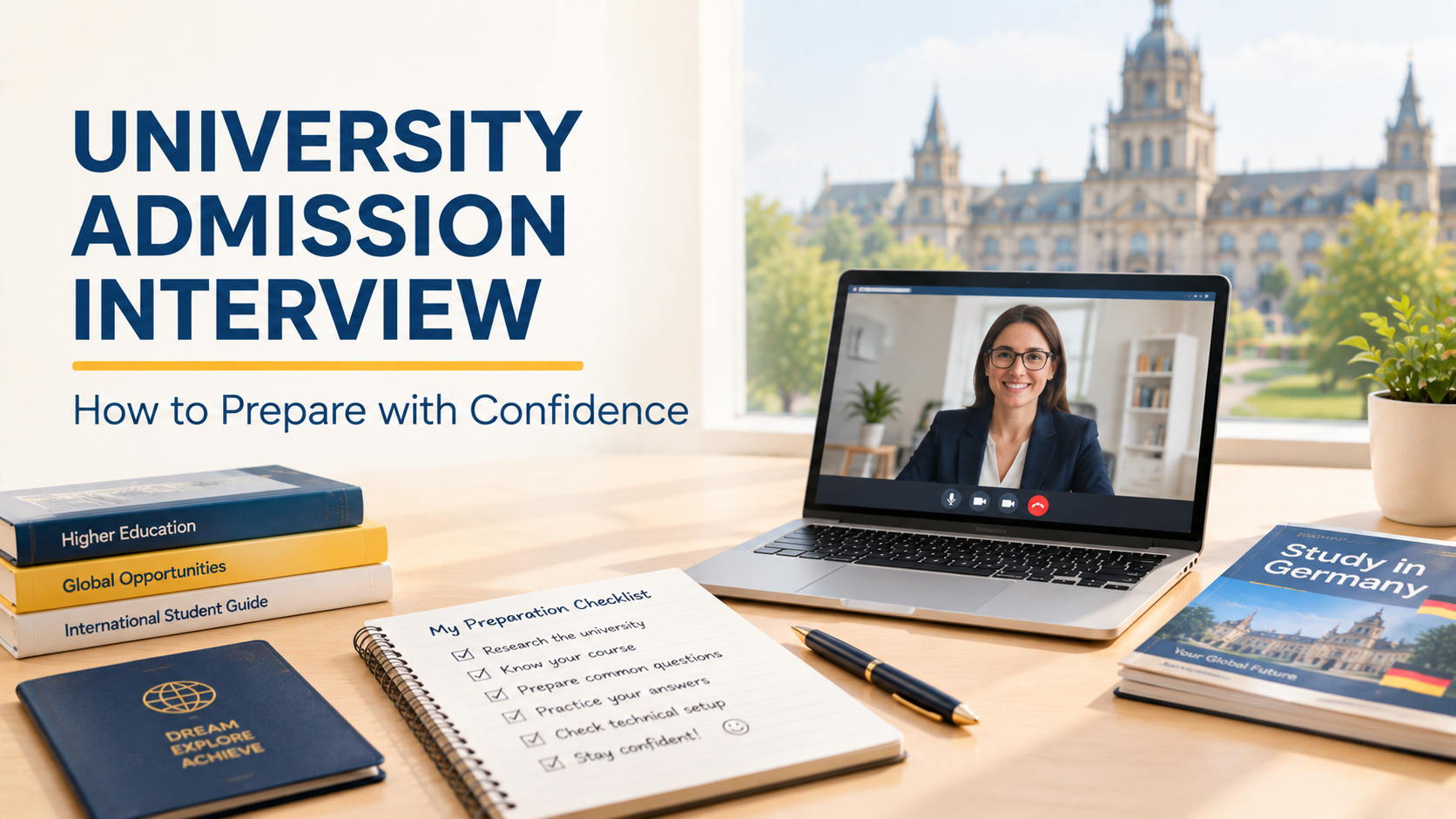
How to Prepare for a University Admission Interview Abroad: A Complete Guide for International Students
Receiving an invitation to a university admission interview is an important step in your study abroad journey. It means the university wants to learn more about you beyond the information in your application. For some programmes, an interview may be an important part of the selection process, while other programmes may assess students entirely through their submitted documents.
For students planning to study in the USA, UK, Germany, Canada, Australia, Japan, or another international destination, preparing for an interview can help make the process less stressful.
The key is not to memorise impressive answers. Instead, you should understand your chosen course, know why you selected the university, and be able to explain your academic background and future goals honestly.
In this guide, we explain how to prepare for a university admission interview, the questions you may encounter, common mistakes to avoid, and practical ways to build confidence before interview day.
1. Understand Why the University Has Invited You for an Interview
Universities may use interviews to understand an applicant's motivation, academic interests, communication skills, relevant experience, or suitability for a particular programme.
The purpose depends on the institution and course. An interview for a research-based master's programme may focus on your academic interests and previous projects, while a professional programme may explore your experience, problem-solving ability, or understanding of the field.
Before preparing your answers, check your interview invitation carefully. Find out whether the meeting is an academic interview, a general admissions discussion, a programme-specific assessment, or another type of interview.
Also check whether you need to prepare a presentation, portfolio, research proposal, or any supporting documents.
Important: Not every university or course requires an interview. Follow the instructions issued by the university you have applied to rather than assuming that every applicant will face the same process.
2. Research Your Chosen University and Course
One of the most important preparation steps is understanding why you selected that particular university and programme.
Simply saying that the university is highly ranked or located in a popular country may not fully explain your decision. Your answer should show that you have researched the course and understand how it connects with your interests.
Before the interview, review:
- Course curriculum: Identify subjects or modules that interest you and explain why.
- Teaching approach: Understand whether the programme emphasises research, practical learning, projects, placements, or other methods.
- University strengths: Research relevant facilities, laboratories, research groups, academic expertise, or industry connections where applicable.
- Career relevance: Consider how the programme supports your intended career direction.
- Study destination: Understand why the country and its education system suit your academic plans.
For example, a student applying for a master's in data science could explain how the programme's machine learning modules and applied research opportunities relate to previous projects and future goals.
The strongest answers connect specific course features with your own interests rather than repeating general statements about the university's reputation.
3. Prepare Answers to Common University Interview Questions
Although questions differ between universities, some themes appear frequently. Prepare key points for these questions, but avoid memorising complete answers word for word.
Why do you want to study this course?
Explain what interests you about the subject and how your previous education, projects, internships, or professional experience influenced your decision.
A convincing answer usually includes a specific academic interest and a clear reason for pursuing further study.
Why did you choose this university?
Mention relevant programme features that influenced your decision. These might include course modules, research opportunities, facilities, teaching methods, or practical learning opportunities.
Avoid relying entirely on general statements such as, "It is a famous university."
Why do you want to study abroad?
Discuss the academic or professional opportunities you are seeking. Explain how studying internationally fits into your educational plans and what you hope to learn from the experience.
Your answer should reflect your actual reasons for choosing an international education.
Tell us about your academic background.
Summarise your previous education, relevant subjects, projects, internships, or achievements. Focus on details connected to the programme you are applying for.
If your academic background differs from your intended course, be ready to explain how you developed the necessary interest and skills.
What are your strengths and weaknesses?
Choose genuine examples rather than simply listing positive qualities. If you mention problem-solving, teamwork, or time management, explain a situation in which you demonstrated that skill.
When discussing a weakness, describe what you are doing to improve it.
What are your future career goals?
Explain the skills or knowledge you want to develop and how the programme relates to your next career step. Your goals can evolve over time, but you should be able to describe a reasonable direction.
Tell us about a challenge you faced.
Choose a real academic, professional, or personal challenge that you are comfortable discussing. Explain the situation, the action you took, and what you learned from the experience.
The interviewer is often interested in your thinking and reflection, not just the final outcome.
4. Review Your SOP, CV, and Application Documents
Your interview preparation should begin with the documents you have already submitted.
Review your Statement of Purpose (SOP), résumé or CV, academic transcripts, project descriptions, work experience, and any research proposal or portfolio included in your application.
An interviewer may ask you to explain a project, discuss a claim in your SOP, or provide more detail about an internship or achievement.
For every important point in your application, ask yourself:
- Can I explain this experience clearly?
- What did I personally contribute?
- What skills or knowledge did I gain?
- How does it relate to my intended programme?
- Can I provide a specific example if asked?
Be especially careful with technical projects and research experience. You should understand the methods you used, the challenges you faced, and the results you achieved.
Your interview answers should be consistent with your submitted documents. If an application contains an error or an important change has occurred, seek the appropriate guidance rather than trying to conceal it.
5. Practise Speaking Naturally and Confidently
Understanding a question and communicating your answer clearly are two different skills. Practising aloud can help you organise your thoughts and become more comfortable speaking in an interview.
Ask a friend, teacher, mentor, or study abroad adviser to conduct a mock interview. They can ask common questions, introduce follow-up questions, and provide feedback on your clarity and confidence.
During practice:
- Keep your answers focused on the question.
- Support important claims with real examples.
- Explain technical concepts in language you can communicate clearly.
- Take a moment to think before answering.
- Practise explaining your motivation without reading from a script.
- Ask for clarification if a question is unclear.
You do not need to speak with a particular accent to perform well. Aim for clear communication, relevant answers, and a genuine understanding of your study plans.
6. Prepare for an Online University Interview
Many universities conduct interviews remotely, making it important to check both your preparation and your technology.
Before the interview:
- Test your internet connection, microphone, speakers, and camera.
- Check the meeting link and any required software.
- Choose a quiet, well-lit location.
- Keep your background simple and professional.
- Charge your laptop or arrange a reliable power source.
- Keep your interview invitation and permitted documents accessible.
- Confirm the interview time and time zone.
If you are attending an interview with a university in another country, pay particular attention to the time difference. A calendar entry showing the correct local time can help prevent confusion.
Log in a few minutes early, unless the university has given different instructions.
During the interview, look towards the camera when speaking naturally, listen carefully, and avoid reading prepared answers from another screen. Follow the institution's rules regarding notes, AI tools, recording, and other forms of assistance.
7. Prepare for Course-Specific Questions
Some interviews go beyond general questions and explore your knowledge of the subject.
For technical and research-based programmes, you may be asked about previous projects, relevant concepts, research interests, or problems related to your field. Professional courses may include scenarios, group activities, presentations, or practical assessments.
For example:
- Computer Science or Data Science: Be ready to explain a project, discuss your technical decisions, or describe a problem you solved.
- Business or Management: You may be asked about leadership, teamwork, business challenges, or your reasons for choosing the specialisation.
- Engineering: Review relevant fundamentals and be prepared to discuss practical applications of your previous learning.
- Research-based programmes: Understand your proposed research area, the questions you want to explore, and why the topic interests you.
- Creative programmes: Review your portfolio and be ready to explain your choices, influences, and creative process.
These are illustrative examples, not a guaranteed list of questions. Always prioritise the instructions and expectations provided by your specific university and department.
8. Prepare a Few Questions to Ask the Interviewer
An interview can also help you decide whether the programme is right for you.
If the interviewer invites questions, ask something relevant that you could not easily answer by reading the university website.
You could ask about:
- Opportunities to participate in research or practical projects.
- How students engage with faculty in your area of interest.
- Internship, placement, or industry collaboration opportunities, if applicable.
- Academic support available to students.
- How the programme helps students develop skills relevant to your field.
Choose questions that genuinely matter to your decision. Avoid asking for information that has already been clearly explained in the course materials.
9. Common Mistakes to Avoid During the Interview
Even well-qualified applicants can make avoidable mistakes when they are nervous or insufficiently prepared.
Memorising answers: Scripted responses can sound unnatural and make it difficult to respond to follow-up questions. Prepare key ideas instead.
Giving generic reasons: Statements such as "I want international exposure" are more useful when supported by a clear explanation of what you want to learn and why.
Exaggerating achievements: Discuss your real contributions and knowledge. You should be able to explain the experiences and skills you mention.
Not knowing your course: An inability to explain the programme you applied for may suggest that you have not researched your decision carefully.
Speaking for too long: Provide enough detail to answer the question, but avoid going off-topic. Let the interviewer guide the conversation.
Panicking over an unfamiliar question: It is acceptable to pause, ask for clarification, or explain how you would approach the problem. Do not pretend to know something you do not understand.
Ignoring interview instructions: Missing a required document, presentation, or deadline can create unnecessary difficulties. Read the invitation carefully and contact the university if something is unclear.
10. What Should You Do After the Interview?
Once the interview ends, thank the interviewer and follow any instructions provided about the next steps.
If you have another interview coming up, write down the topics discussed and identify areas you would like to improve. Do not share confidential interview material or violate any university rules.
Afterwards:
- Check your email and applicant portal for updates.
- Submit any additional documents requested by the university.
- Respond to admissions communications within the stated deadlines.
- Continue preparing for other applications or interviews if necessary.
- Wait for the official outcome rather than assuming that the interview alone determines the final decision.
Universities follow different review timelines, so there is no single waiting period that applies to every applicant.
University Admission Interview Preparation Checklist
Use this checklist before your interview:
Read the interview invitation and confirm the date, time, and format.
Research the university and your chosen programme.
Review your SOP, CV, projects, and application documents.
Prepare key points for common interview questions.
Practise answering questions aloud.
Review relevant academic or technical concepts.
Prepare any required portfolio, presentation, or supporting documents.
Test your camera, microphone, internet connection, and meeting link.
Prepare two or three thoughtful questions for the interviewer.
Get sufficient rest and join or arrive on time.
Frequently Asked Questions
1. Do all foreign universities conduct admission interviews?
No. Interview requirements vary by university, programme, degree level, and applicant category. Some courses require interviews, while others make decisions using application documents and other assessments. Check the official admissions instructions for your chosen programme.
2. How long does a university admission interview usually last?
There is no universal duration. Some interviews are brief conversations, while others involve longer academic discussions, multiple interviewers, presentations, or additional assessments. Check your invitation for details.
3. What should I wear for an online university interview?
Choose neat, comfortable, smart-casual clothing unless the university specifies a different dress code. Ensure your appearance and surroundings are appropriate for an academic meeting.
4. What if I do not know the answer to a question?
Stay calm and avoid guessing without explanation. You can ask the interviewer to clarify the question, take a moment to think, or explain the approach you would use to work through the problem.
5. Should I memorise my interview answers?
It is generally more helpful to prepare key points and practise explaining them naturally. Memorising entire answers can make it difficult to respond to unexpected follow-up questions.
6. Can a good interview guarantee admission?
No. An interview may form part of the university's selection process, but the final decision depends on the institution's admission criteria and the overall application. A strong interview does not guarantee an offer.
Final Thoughts
A university admission interview is an opportunity to explain your academic interests, demonstrate your motivation, and help the university understand the person behind your application.
The best preparation begins with knowing your own story: what you have studied, what you want to learn, why you selected the programme, and how it connects to your future plans.
Rather than trying to deliver perfect answers, focus on being informed, honest, and clear. With careful preparation and practice, you can approach your interview with greater confidence and make more informed decisions about your study abroad journey.
Planning to study abroad? EDULX Overseas supports students with profile evaluation, university and course shortlisting, SOP and LOR guidance, application assistance, visa guidance, scholarships, education loans, accommodation, and pre-departure and post-arrival support.
Visit edulx.in to explore how we can support your study abroad plans.
Verified by Edulx Germany Specialists
Have questions about your profile or APS verification? Book a free 1-on-1 session with our Pune counsellors.