How to Read a University Course Curriculum Before Applying
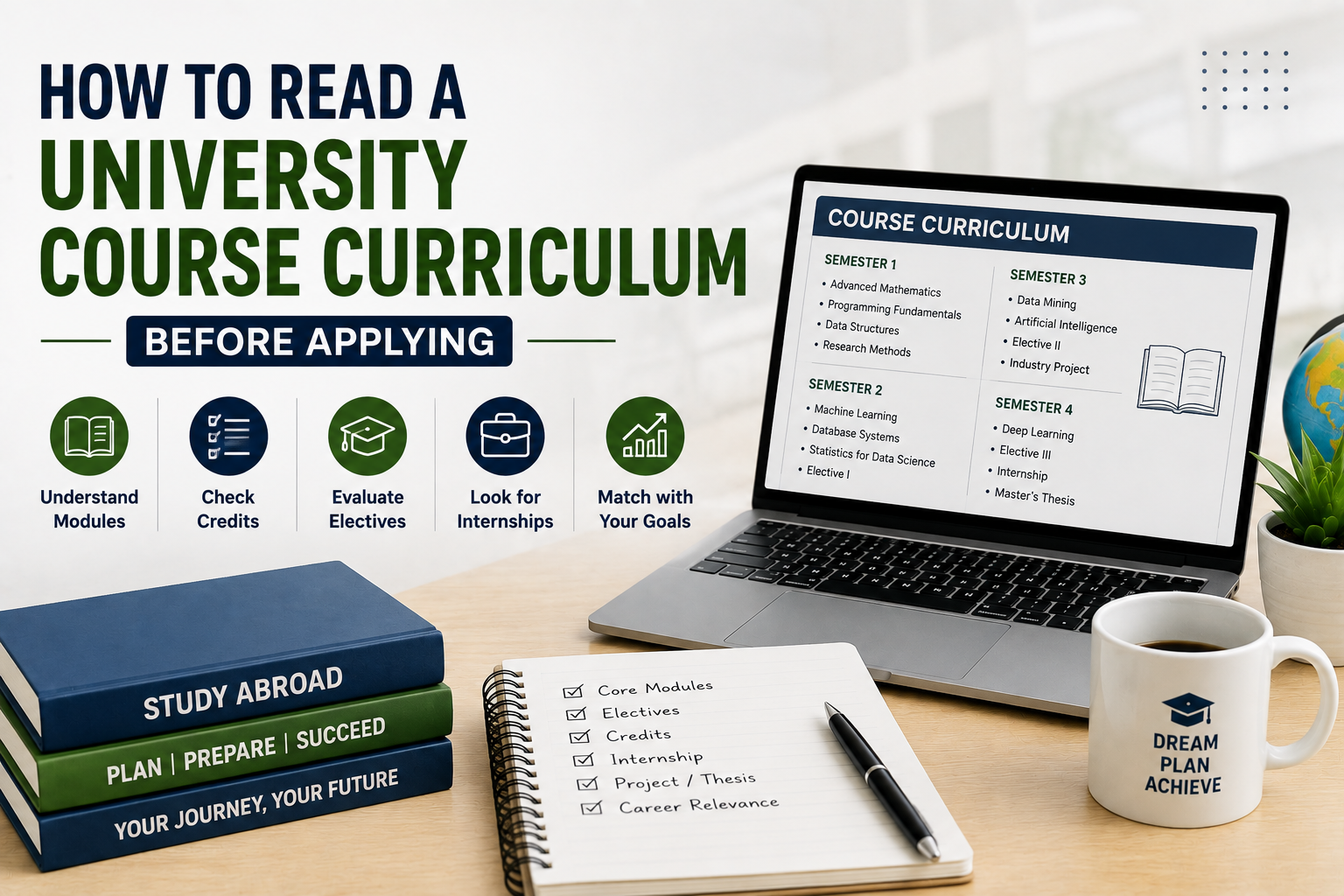
How to Read a University Course Curriculum Before Applying
When students search for universities abroad, they often focus on rankings, tuition fees, location, and admission requirements.
But there is another factor that deserves just as much attention:
The course curriculum.
Two universities can offer programs with almost identical names but completely different subjects, teaching methods, electives, projects, and career outcomes.
For example, an MSc Artificial Intelligence at one university may focus heavily on machine learning and deep learning, while another may include more robotics, computer vision, or data analytics.
Therefore, before applying, students should learn how to read a university's curriculum properly.
What Is a University Course Curriculum?
A course curriculum is the overall academic structure of a degree program.
It usually tells you:
- What subjects you will study
- How many credits each subject carries
- Which modules are compulsory
- Which modules are optional
- Whether internships are included
- Whether you need to complete a project or thesis
- How the degree is assessed
- How the program is structured across semesters
The curriculum gives you a much clearer idea of what you will actually study after joining the university.
Why Should You Check the Curriculum Before Applying?
A university may have an excellent reputation, but that doesn't automatically mean every program will be suitable for you.
Checking the curriculum can help you determine whether:
- The course matches your previous education
- The subjects match your interests
- You will learn relevant skills
- The program supports your career plans
- You meet the academic prerequisites
- The course contains practical training
- The specialization is suitable for your future goals
Your degree title is important, but the subjects inside the degree are equally important.
1. Start With the Core Modules
Core modules are usually the subjects that students are required to complete.
Look at the names of these modules carefully.
For example, a Data Science program might include:
- Statistics
- Machine Learning
- Data Mining
- Database Systems
- Data Visualisation
- Artificial Intelligence
Another program might have the same degree title but focus more on:
- Business Analytics
- Econometrics
- Management
- Business Intelligence
Both may be called "Data Science," but they can prepare students for very different career paths.
2. Understand Compulsory vs Optional Modules
Most programs have a combination of compulsory and elective subjects.
Compulsory Modules
These are subjects that every student must complete.
Elective Modules
These allow students to select subjects based on their interests.
For example, an AI program may allow you to choose between:
- Computer Vision
- Natural Language Processing
- Robotics
- Deep Learning
- Autonomous Systems
Electives can make a major difference to your learning experience.
3. Look at the Number of Credits
Universities use credits to measure the academic workload associated with a course or module.
Depending on the country and education system, credit systems can differ.
For example, European universities commonly use ECTS (European Credit Transfer and Accumulation System).
A typical European bachelor's degree may involve 180 ECTS, while a master's degree commonly involves 90 or 120 ECTS, although programs vary.
Don't compare credit numbers between countries without understanding the relevant credit system.
4. Check the Semester-Wise Structure
Don't just look at the list of subjects.
Check when you will study them.
For example:
Semester 1
- Advanced Mathematics
- Programming
- Data Structures
- Research Methods
Semester 2
- Machine Learning
- Data Mining
- Artificial Intelligence
- Elective
Semester 3
- Industry Project
- Advanced Electives
Semester 4
- Master's Thesis
This helps you understand how your knowledge will develop throughout the program.
5. Look for Practical Components
A course may be highly theoretical or strongly practical.
Check whether the curriculum includes:
- Laboratory sessions
- Practical assignments
- Projects
- Industry projects
- Workshops
- Fieldwork
- Internships
- Case studies
If your career goal is industry-focused, practical components can be particularly valuable.
6. Check for an Internship
An internship can provide valuable professional experience.
Look carefully at whether the internship is:
- Mandatory
- Optional
- Credit-bearing
- Part of the curriculum
- Available through university partnerships
Also check the duration.
An internship lasting several months can provide a very different experience from a short practical assignment.
7. Understand the Project or Thesis Requirement
Many master's programs include a dissertation or thesis.
Check:
- Whether a thesis is mandatory
- Number of credits
- Duration
- Research requirements
- Industry project options
- Available research areas
If you're planning to pursue a PhD, the research component may be particularly important.
8. Look at the Specialisations
Some universities allow students to specialise during the degree.
For example, a Computer Science program might offer specialisations such as:
- Artificial Intelligence
- Cybersecurity
- Data Science
- Software Engineering
- Computer Systems
A broad degree can become much more relevant to your career if you can choose a suitable specialization.
9. Identify Outdated Subjects
Technology and industry change quickly.
When comparing technical programs, check whether the curriculum contains current and relevant subjects.
For example, students interested in AI may want to look for subjects related to:
- Machine Learning
- Deep Learning
- Generative AI
- Computer Vision
- Natural Language Processing
- Data Engineering
However, don't reject a program simply because one trendy keyword is missing.
Look at the overall academic foundation and how the subjects connect.
10. Check the Prerequisites for Each Module
Some advanced subjects may require previous knowledge.
For example, a Machine Learning course might require:
- Programming
- Statistics
- Linear Algebra
- Calculus
This is important for international students because your bachelor's degree may not contain the same subjects as the university's expected background.
Before applying, compare the prerequisites with your academic transcript.
11. Compare Your Bachelor's Subjects With the Master's Curriculum
This is one of the most important steps.
Create two lists:
What You Have Studied
- Mathematics
- Programming
- Statistics
- Databases
- Algorithms
What the Master's Requires
- Mathematics
- Statistics
- Programming
- Algorithms
- Data Structures
Then identify where your background matches.
This can help you determine whether the program is academically suitable for your profile.
12. Don't Judge a Course by Its Title
Course titles can sometimes be misleading.
For example:
MSc Information Technology
could focus heavily on:
- Software development
while another program with the same title could focus on:
- Networks
- Cybersecurity
- Cloud computing
- Information systems
Similarly:
MSc Biotechnology
could have a strong focus on:
- Molecular biology
or:
- Bioprocess engineering
Always read the actual modules.
13. Check the Teaching and Assessment Methods
Look beyond subject names.
The curriculum or program handbook may explain whether students are assessed through:
- Written examinations
- Presentations
- Assignments
- Laboratory work
- Projects
- Group work
- Research papers
- Practical examinations
This can help you understand what studying the program will actually feel like.
14. Look for Industry-Relevant Skills
Ask:
What skills will I have after completing this program?
For example, an engineering program might help develop:
- CAD skills
- Simulation
- Manufacturing knowledge
- Automation
- Project management
A data-focused program might develop:
- Python
- SQL
- Statistics
- Machine Learning
- Data visualisation
A strong curriculum should provide knowledge and skills that are relevant to your intended career direction.
15. Check Whether the Curriculum Is Flexible
Some programs have very little flexibility.
Others allow students to choose several electives.
A flexible curriculum can be useful if your interests may evolve during your studies.
Check how many credits you can select yourself and whether electives come from your department or other faculties.
16. Check the Language of Each Module
Even if a degree is advertised as English-taught, check the program information carefully.
Look for:
- Program language
- Module language
- Examination language
- Thesis language
In some institutions, individual modules or university activities may have different language arrangements.
Always verify the details with the university if the information is unclear.
17. Look at the Academic Calendar
The curriculum should also be considered alongside the academic calendar.
Check:
- Semester dates
- Examination periods
- Internship periods
- Thesis period
- Program duration
This can help you plan your overall study abroad timeline.
18. Compare Multiple Universities
Don't evaluate one curriculum in isolation.
Take three universities offering similar programs and compare them.
For example:
Factor
University A
University B
University C
Core Subjects
Strong
Strong
Moderate
Electives
Many
Few
Many
Internship
Included
Optional
Included
Practical Projects
High
Moderate
High
Thesis
Required
Required
Optional
Specialisation
AI
Data Science
Robotics
This makes differences much easier to identify.
19. Match the Curriculum With Your Career Goal
Your career goal should influence your course selection.
If You Want a Research Career
Prioritise:
- Research methodology
- Advanced theory
- Research projects
- Thesis
- Research groups
If You Want an Industry Career
Look for:
- Practical projects
- Internships
- Industry collaboration
- Technical skills
- Applied coursework
If You Want to Become an Entrepreneur
Consider programs offering:
- Business modules
- Innovation
- Entrepreneurship
- Product development
- Industry projects
20. Read the Module Descriptions
Don't stop at module names.
If the university provides detailed module descriptions, read them.
For example:
Machine Learning
may sound impressive.
But the detailed description may tell you whether the module covers:
- Supervised learning
- Unsupervised learning
- Neural networks
- Model evaluation
- Feature engineering
- Real-world applications
The module description provides much more information than the title alone.
Questions to Ask Before Applying
Before choosing a course, ask yourself:
- What will I actually study?
- Which modules are compulsory?
- Which electives can I choose?
- Does the course match my previous degree?
- Are there prerequisite subjects?
- Does the program include practical training?
- Is an internship available?
- Is a thesis required?
- What skills will I gain?
- Does the curriculum support my career goal?
Common Mistakes Students Make
Choosing Based Only on University Ranking
A highly ranked university isn't automatically the best choice for your specific course.
Looking Only at the Degree Name
The actual modules matter more than the title alone.
Ignoring Prerequisites
A course may look attractive but require academic subjects you haven't studied.
Ignoring Electives
Electives can significantly influence your specialization.
Not Checking Practical Training
Students focused on employment should understand how much practical exposure the course provides.
Comparing Only Tuition Fees
A cheaper course isn't necessarily better value if it doesn't match your career goals.
A Simple Curriculum Evaluation Checklist
Before applying, save the official course page and check:
☐ Course duration
☐ Total credits
☐ Core modules
☐ Elective modules
☐ Specialisations
☐ Practical training
☐ Internship
☐ Project/thesis
☐ Entry requirements
☐ Module prerequisites
☐ Teaching language
☐ Assessment methods
☐ Career relevance
This simple checklist can help you make a more informed decision.
Final Conclusion
Choosing a university should never be based only on its ranking, location, or tuition fee.
The course curriculum tells you what you are actually going to learn.
Before applying, take time to examine the modules, credits, electives, practical training, internships, projects, thesis requirements, and prerequisites.
Then compare the curriculum with your previous education and future career plans.
A good university is valuable, but the right course at the right university can make an even bigger difference to your study abroad experience.
Don't just ask, "Which university should I choose?" Ask, "What exactly will I learn there, and will it help me reach my career goal?"
Verified by Edulx Germany Specialists
Have questions about your profile or APS verification? Book a free 1-on-1 session with our Pune counsellors.