How to Read a University Curriculum Before Applying (2027 Guide)
Introduction
Many students spend weeks comparing university rankings but only a few minutes looking at the actual curriculum.
This is one of the biggest mistakes you can make when applying to study abroad.
The curriculum tells you what you will actually study, the skills you will develop, and whether the course matches your career goals.
A university may have an excellent reputation, but if its curriculum doesn't align with your interests, you may not enjoy the program or achieve your career objectives.
This guide explains how to evaluate a university curriculum before submitting your application.
What Is a University Curriculum?
A curriculum is the complete academic structure of a degree program.
It usually includes:
- Core subjects
- Elective modules
- Credit requirements
- Practical sessions
- Laboratory work
- Internship opportunities
- Research projects
- Thesis requirements
Most universities publish the curriculum on their official program pages.
Step 1: Read the Course Overview
Start with the program description.
Ask yourself:
- What is the main focus of the course?
- Is it theoretical or practical?
- Does it match my career goals?
- What skills will I gain?
This section gives a quick overview of the program's purpose.
Step 2: Check Core Subjects
Core subjects are mandatory courses that every student must complete.
These subjects form the foundation of the degree.
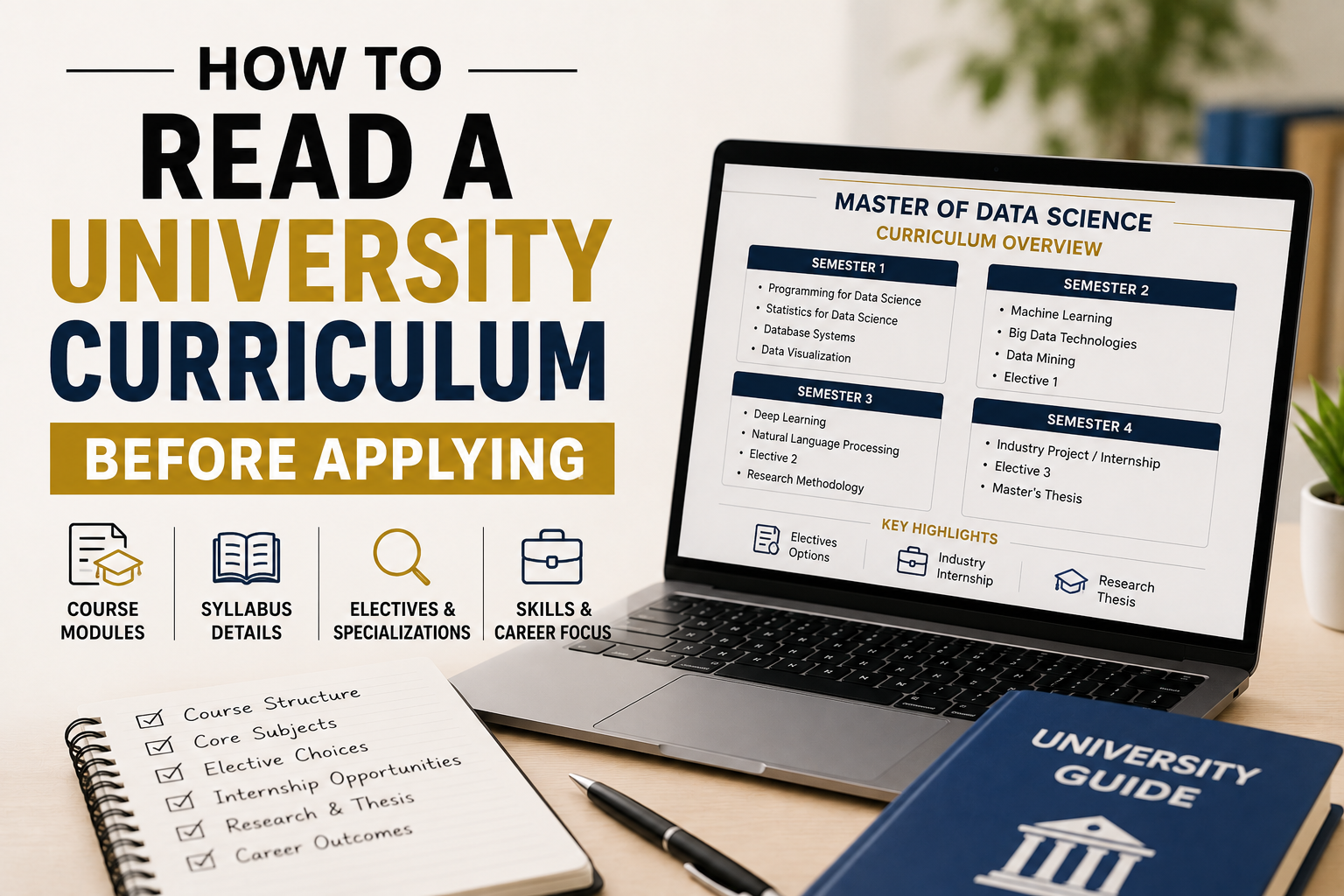
For example, a Data Science master's may include:
- Statistics
- Machine Learning
- Database Systems
- Programming
- Data Visualization
Review the topics carefully to ensure they match your interests.
Step 3: Look at Elective Modules
Electives allow you to specialize in areas that interest you.
Examples include:
- Artificial Intelligence
- Cybersecurity
- Bioinformatics
- Cloud Computing
- Robotics
- Business Analytics
A program with more elective options provides greater flexibility.
Step 4: Understand the Credit System
Most universities use an academic credit system to measure workload.
The curriculum usually shows:
- Total credits required
- Credits per semester
- Credits assigned to each subject
This helps you understand the program's intensity and academic structure.
Step 5: Check for Practical Learning
Practical experience is essential for many careers.
Look for opportunities such as:
- Laboratory sessions
- Industry projects
- Case studies
- Workshops
- Simulations
- Practical assignments
Programs with practical components can help you develop job-ready skills.
Step 6: Look for Internship Opportunities
Some universities include internships within the curriculum.
Ask:
- Is an internship mandatory?
- How long is it?
- Does the university assist students in finding placements?
- Are internships integrated into the academic schedule?
Industry experience can strengthen your resume before graduation.
Step 7: Research Project or Thesis
Many master's programs conclude with a research project or thesis.
Consider:
- Is a thesis compulsory?
- Can you choose your research topic?
- Are industry-sponsored projects available?
- Will you work with a faculty supervisor?
If you are interested in research or a future PhD, this section is especially important.
Step 8: Review Assessment Methods
Different universities evaluate students in different ways.
Assessments may include:
- Written exams
- Assignments
- Group projects
- Presentations
- Laboratory reports
- Research papers
- Final thesis
Choose a learning style that suits your strengths.
Step 9: Explore Specializations
Many universities allow students to specialize during the program.
Examples include:
- Artificial Intelligence
- Renewable Energy
- Finance
- Marketing
- Biotechnology
- Human Resource Management
Specializations can make your profile more attractive to employers in a particular field.
Step 10: Compare Multiple Universities
Never evaluate only one curriculum.
Create a comparison table using factors such as:
- Core subjects
- Elective choices
- Internship opportunities
- Research facilities
- Teaching style
- Industry collaborations
- Thesis requirements
- Total credits
Comparing multiple universities helps you make a more informed decision.
Questions You Should Ask Before Applying
Before finalizing your application, ask yourself:
- Does this curriculum match my career goals?
- Will I learn the skills employers expect?
- Does the course include practical experience?
- Are internships available?
- Can I choose electives that interest me?
- Does the university have strong industry connections?
If the answer is "yes" to most of these questions, the program is likely a good fit.
Common Mistakes Students Make
Choosing Based Only on Rankings
A higher-ranked university may not offer the best curriculum for your career interests.
Ignoring Elective Options
Electives can shape your specialization and future job opportunities.
Not Checking Internship Availability
Practical experience is often just as valuable as classroom learning.
Overlooking Research Opportunities
Students planning for research careers should carefully review thesis and laboratory options.
Copying Others' Choices
The best curriculum depends on your own career goals, not someone else's.
The Real Truth
A university's curriculum is one of the most important factors in your study abroad journey.
It determines what you will learn, the skills you will develop, and how well prepared you will be for your future career.
Instead of choosing a university based only on rankings or popularity, invest time in understanding the curriculum.
A course that aligns with your interests, offers practical learning, and supports your career goals will provide far greater long-term value than a famous university with an unsuitable syllabus.
Frequently Asked Questions (FAQs)
1. What is a university curriculum?
A university curriculum is the complete academic structure of a program, including subjects, electives, credits, internships, and thesis requirements.
2. Why is reading the curriculum important?
It helps you understand what you will study and whether the course matches your career goals.
3. Should I focus more on rankings or curriculum?
Both are important, but the curriculum often has a greater impact on your learning experience and future career.
4. What are elective modules?
Electives are optional subjects that allow you to specialize in areas of personal or professional interest.
5. How do internships help?
Internships provide practical experience, improve employability, and help students build industry connections.
6. Where can I find a university curriculum?
Most universities publish detailed curricula, module handbooks, or program structures on their official course webpages.
Verified by Edulx Germany Specialists
Have questions about your profile or APS verification? Book a free 1-on-1 session with our Pune counsellors.