How to Read University Admission Requirements Before Applying Abroad
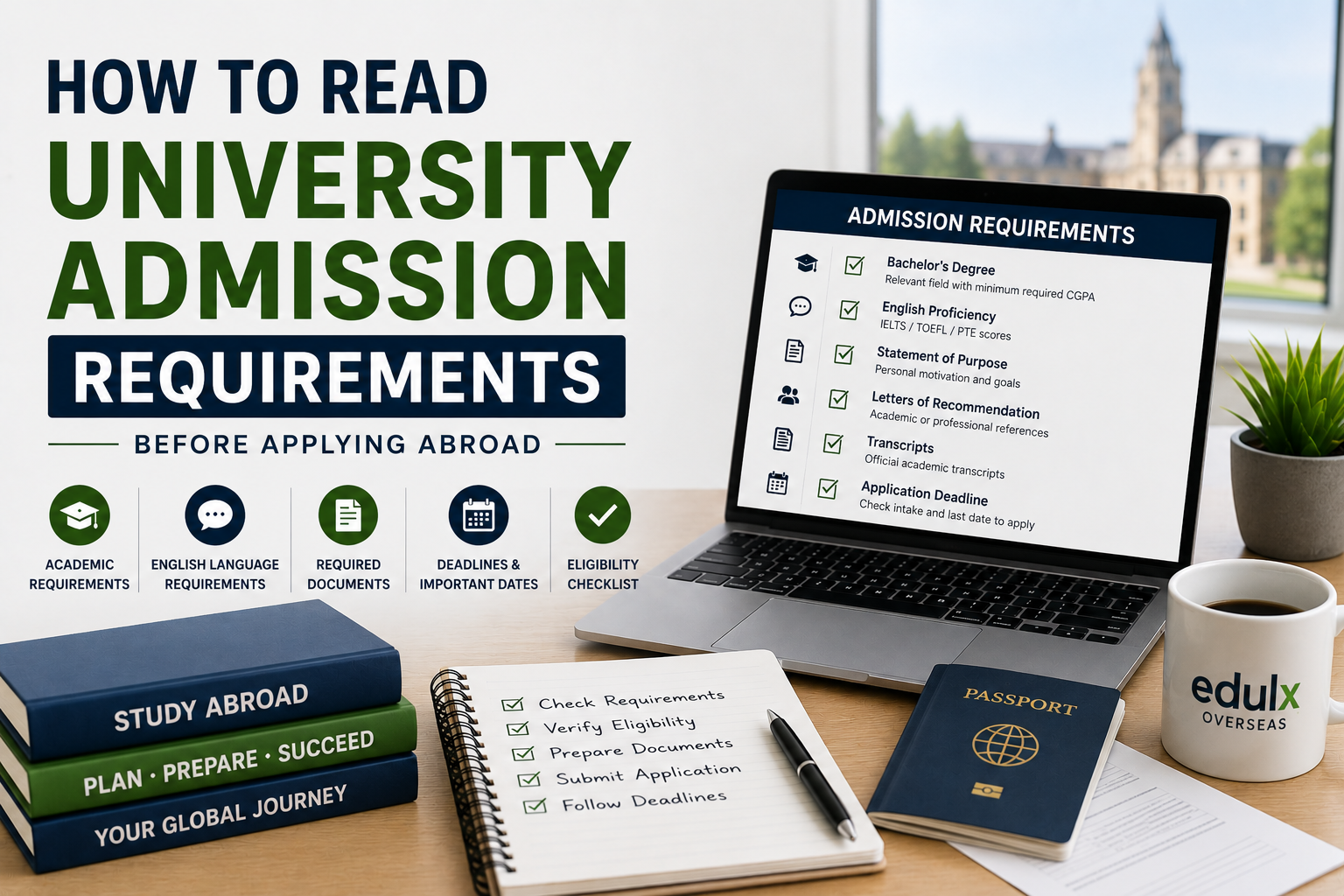
How to Read University Admission Requirements Before Applying Abroad
Applying to a university abroad can feel complicated, especially when every university appears to have different admission requirements.
One university may ask for a specific bachelor's degree. Another may require particular subjects or credits. Some universities may ask for English language test scores, while others may accept alternative forms of proof.
Students often make the mistake of looking only at the minimum CGPA or IELTS score.
However, university eligibility is usually more detailed than a single number.
Before applying, you need to understand exactly what the university means by:
- Academic requirements
- Subject prerequisites
- English language requirements
- Work experience
- Required documents
- Application deadlines
- Country-specific qualifications
- Program-specific conditions
This guide explains how students can read and understand university admission requirements before applying abroad.
Why Understanding Admission Requirements Matters
Submitting an application does not automatically mean that you are eligible for a course.
A university may evaluate several aspects of your profile, including:
- Previous qualification
- Academic performance
- Relevant subjects
- Credits or coursework
- English proficiency
- Professional experience
- Entrance tests
- Supporting documents
- Application timing
If you misunderstand even one important requirement, you could apply for a course that does not actually match your academic background.
Understanding requirements before applying can save time, application fees, and unnecessary effort.
What Are University Admission Requirements?
University admission requirements are the conditions that applicants must meet to be considered for a particular academic program.
These requirements can be divided into different categories.
Academic requirements
Your previous qualification and academic performance.
Subject requirements
Specific subjects, modules, credits, or academic background required for the course.
Language requirements
English or another language proficiency requirement.
Additional requirements
These may include:
- Work experience
- Entrance examinations
- Interviews
- Portfolios
- GMAT/GRE
- Professional registration
- Specific certifications
Documentation requirements
Documents you must submit to prove that you meet the requirements.
The exact requirements depend on the university, course, degree level, and country.
Step 1: Check the Required Previous Qualification
Start by checking what qualification the university expects.
For a Master's program, the requirement might refer to:
- Bachelor's degree
- Relevant undergraduate degree
- Equivalent qualification
- Specific field of study
- Minimum number of credits
For a Bachelor's program, the university may require:
- Higher secondary qualification
- Specific school subjects
- Foundation qualification
- Diploma
- International equivalent qualification
Do not assume that having a degree automatically makes you eligible.
The field and level of your previous qualification can matter just as much as the qualification itself.
Step 2: Check Whether Your Degree Must Be Relevant
This is one of the most important requirements for Master's applicants.
Suppose you have a:
Bachelor's in Computer Engineering
and want to apply for:
Master's in Data Science
The university may accept applicants from several related backgrounds.
But another university may require a degree specifically in:
- Computer Science
- Data Science
- Mathematics
- Statistics
- Information Technology
Therefore, always look for phrases such as:
"Relevant bachelor's degree"
or
"Degree in a related field."
Then find out what the university considers "relevant."
Step 3: Look for Specific Subject or Credit Requirements
Some programs have requirements beyond your degree title.
For example, a university might require previous coursework in:
- Mathematics
- Statistics
- Programming
- Physics
- Chemistry
- Biology
- Economics
The requirement may also be expressed in terms of ECTS credits, modules, or equivalent coursework, depending on the education system.
This means two students with the same degree title may not necessarily have identical eligibility.
Example
Student A:
Bachelor's in Computer Science
Strong mathematics and programming coursework
Student B:
Bachelor's in Computer Science
Very limited mathematics coursework
A program with strict mathematics prerequisites may evaluate these profiles differently.
Therefore, read the prerequisite subjects carefully.
Step 4: Understand the Minimum CGPA Requirement
Many universities specify a minimum academic requirement.
This could appear as:
- Minimum GPA
- Minimum CGPA
- Minimum percentage
- Grade classification
- Equivalent qualification requirement
For Indian students, the university may use its own method for assessing academic qualifications.
Do not automatically convert your CGPA into another grading system unless the university specifically asks you to do so.
Also remember:
Meeting the minimum academic requirement does not always guarantee admission.
Some programs are competitive and may consider applicants comparatively.
Step 5: Check English Language Requirements
International students may need to demonstrate English language proficiency.
Commonly accepted tests can include:
- IELTS
- TOEFL
- PTE
- Cambridge English qualifications
- Other university-approved tests
The university may specify:
- Overall score
- Minimum score in each section
- Validity period
- Accepted test types
- Exemption conditions
For example, a university might require an overall score while also specifying minimum scores for reading, writing, listening, and speaking.
So don't look only at the overall score.
Always check:
Overall requirement + individual section requirements
Step 6: Check Whether You Qualify for an English Test Exemption
Some universities may provide exemptions under specific circumstances.
For example, they may consider:
- Previous education taught in English
- Certain countries of prior education
- Specific qualifications
- Approved alternative evidence
However, exemption rules differ significantly between universities.
Never assume that studying in English automatically means you are exempt.
Check the university's official language requirements carefully.
Step 7: Check Work Experience Requirements
Not every Master's degree requires professional experience.
Some programs may specifically state:
"Work experience required."
Others may say:
"Work experience preferred."
These two statements have different meanings.
Required
You generally need to meet the stated experience requirement.
Preferred
Experience may strengthen your application but may not be mandatory.
This distinction is important for working professionals and fresh graduates.
Step 8: Look for Entrance Tests and Interviews
Some courses may have additional selection stages.
Depending on the university and program, these can include:
- Entrance examinations
- Aptitude tests
- Subject-specific tests
- Interviews
- Portfolio reviews
- Auditions
- Written assessments
This is more common in certain specialised or competitive programs.
If an entrance test is required, check:
- Test format
- Registration process
- Test date
- Passing requirement
- Whether the test is conducted online or in person
Step 9: Check the Required Documents
Eligibility and documentation are closely connected.
A university may require documents such as:
- Academic transcripts
- Degree certificate
- Passport
- English language test result
- CV/resume
- Motivation letter or SOP
- Letters of recommendation
- Portfolio
- Work experience documents
- Academic grading information
Some documents may need:
- Certified copies
- Official translations
- Legalisation
- Specific formats
- Verification
Read the document requirements carefully before submitting your application.
Step 10: Understand "Required" vs "Recommended"
University websites often use different words for documents and qualifications.
Pay attention to terms such as:
Required
You must submit or meet it.
Mandatory
It is compulsory.
Recommended
It is advisable but may not always be compulsory.
Preferred
It may strengthen your profile.
Where applicable
It applies only to certain applicants.
Understanding these words can help you avoid unnecessary confusion.
Step 11: Check Country-Specific Requirements
International universities may have different requirements depending on where your previous education was completed.
For Indian students, a university may provide separate information about:
- Indian bachelor's degrees
- Indian school qualifications
- Grading systems
- English proficiency
- Required documents
- Qualification equivalency
Always look for a country-specific admissions section if the university provides one.
Step 12: Check Application Deadlines Separately
Admission requirements and application deadlines are two different things.
A student may meet every eligibility condition but still miss the application deadline.
Check:
- Application opening date
- Priority deadline
- Final deadline
- Scholarship deadline
- Document submission deadline
- Deposit deadline
Also check whether the deadline is:
For all international students
or
For applicants from a specific country/category.
Step 13: Check Intake-Specific Requirements
Some universities offer multiple intakes.
For example:
- September/Autumn intake
- January/Winter intake
- Spring intake
- Other program-specific intakes
The requirements or deadlines can sometimes differ by intake.
Never assume that information listed for one intake automatically applies to another.
Step 14: Check if Admission Is Competitive
There is an important difference between:
"You are eligible to apply."
and
"You are likely to be admitted."
A university may publish minimum eligibility criteria, but admission can still depend on:
- Number of applicants
- Academic profile
- Relevant coursework
- Available seats
- Program competitiveness
- Selection criteria
Therefore, meeting the minimum requirements should be viewed as the starting point, not a guarantee of admission.
Minimum Requirements vs Competitive Profile
This is one of the most useful concepts for students to understand.
Minimum requirement
The basic condition you must meet to be considered.
Competitive profile
The overall profile that makes you a stronger candidate compared with other applicants.
For example:
Minimum: Bachelor's degree + required English score
Competitive: Strong academic record + relevant coursework + projects + internships + research + strong application documents
Not every university uses a formal "competitive score," but understanding this difference helps students set realistic expectations.
A Simple Example of Reading Requirements
Imagine a university lists the following:
Academic: Bachelor's degree in Computer Science or related field
Grade: Minimum equivalent of 2.5 GPA
English: IELTS 6.5
Mathematics: Previous coursework required
Documents: Transcript, degree certificate, CV and motivation letter
A student should interpret this as:
Academic
Your bachelor's degree must be in an accepted field.
Grade
Your academic performance must meet the stated minimum equivalency.
English
You need to meet the university's accepted English requirement.
Mathematics
Your previous transcript should demonstrate the required mathematics coursework.
Documents
You must provide the listed supporting documents.
This is much more useful than simply asking:
"What CGPA is required?"
Common Mistakes Students Make
Mistake 1: Looking Only at CGPA
A good CGPA does not automatically satisfy subject prerequisites.
Mistake 2: Ignoring Individual English Section Scores
An overall IELTS score may not be enough if the university specifies minimum section scores.
Mistake 3: Assuming Any Bachelor's Degree Is Accepted
Some Master's programs require a relevant academic background.
Mistake 4: Ignoring Credit Requirements
Specific coursework may be mandatory.
Mistake 5: Confusing Preferred With Mandatory
"Preferred" does not necessarily mean "required."
Mistake 6: Checking Old Information
Admission requirements can change between academic years.
Always check the current official program page.
Mistake 7: Applying Without Checking the Deadline
Meeting eligibility requirements does not help if the application period has already closed.
How Indian Students Can Evaluate Their Eligibility
Before applying, create a simple comparison between your profile and the university's requirements.
Your Profile
- Bachelor's degree
- University
- CGPA/percentage
- Relevant subjects
- Credits
- English test
- Work experience
- Internships/projects
- Required documents
University Requirements
- Required degree
- Minimum grade
- Required subjects
- Credit requirements
- English score
- Work experience
- Additional tests
- Documents
- Deadline
Then identify:
✔ Meets requirement
⚠ Needs clarification
✘ Does not meet requirement
This gives you a much clearer picture of your eligibility.
What to Do If a Requirement Is Unclear
University websites can sometimes use technical academic terminology.
If you don't understand a requirement, don't guess.
You can:
- Read the official admission regulations.
- Check the university's FAQ section.
- Contact the admissions office.
- Ask whether your qualification is considered equivalent.
- Provide your transcript if they need to assess specific coursework.
When contacting the university, mention:
- Your previous qualification
- Institution
- Graduation year
- Relevant subjects
- Your intended program
- The specific requirement you are unsure about
A clear question is more likely to receive a useful answer.
Should You Apply If You Meet Only the Minimum Requirements?
You can consider applying if you meet the stated eligibility requirements, but admission is not guaranteed.
Before applying, assess:
- Program competitiveness
- Your academic background
- Relevant coursework
- Overall profile
- Available seats
- Additional selection criteria
For competitive programs, it is sensible to maintain a balanced university shortlist rather than applying only to highly selective institutions.
Admission Requirements Checklist
Before submitting your application, check:
Academic
Correct previous qualification
Relevant academic background
Minimum grade/CGPA met
Required subjects completed
Required credits completed
Language
Accepted English test confirmed
Overall score requirement checked
Section-wise minimums checked
Exemption rules checked if applicable
Documents
Transcript
Degree certificate
Passport
CV/resume
SOP/motivation letter
Recommendation letters
Portfolio or additional documents if required
Application
Intake confirmed
Deadline checked
Application procedure understood
Application fee checked
Additional tests/interviews checked
Current-year requirements verified
Why Students Should Always Check the Official University Website
Education portals and third-party websites can be useful for discovering programs, but admission requirements should ultimately be verified through the official university source.
University websites provide the most relevant information about:
- Current admission criteria
- Program structure
- Required documents
- Language requirements
- Deadlines
- Application procedures
Requirements can change, so students should avoid relying on old screenshots, social media posts, or outdated articles when making an application decision.
How Edulx Can Help With University Eligibility
Understanding admission requirements is an important part of choosing the right university.
Edulx can help students evaluate factors such as:
- Academic profile
- Course eligibility
- University requirements
- Program fit
- Application documentation
- Intake and deadlines
- Overall application strategy
Students should still verify final requirements directly with the university because admission rules can change between intakes and academic years.
Frequently Asked Questions
What are university admission requirements?
University admission requirements are the academic, language, documentation, and other conditions applicants must meet to be considered for a specific program.
Is the minimum CGPA enough for admission?
Not necessarily. Meeting the minimum academic requirement may make you eligible to apply, but admission can depend on the competitiveness of the program and the overall applicant profile.
Do all universities require IELTS?
No. English language requirements vary by university, program, and applicant circumstances. Some universities accept alternative tests or exemptions under specific conditions.
Does my bachelor's degree have to match my Master's course?
Not always, but many programs require a relevant or related academic background. Some courses also require specific subjects or credits.
What does "relevant degree" mean?
It generally means your previous qualification should be academically related to the program you are applying for. The exact interpretation depends on the university and course.
What is the difference between required and preferred?
"Required" generally means compulsory, while "preferred" usually indicates something that can strengthen your application but may not be mandatory.
Can admission requirements change?
Yes. Universities can update academic, language, document, and deadline requirements. Always check the current official program page before applying.
What should I do if I don't understand an admission requirement?
Contact the university's admissions office with details of your previous qualification and ask a specific question about the requirement.
Should I apply if I meet only the minimum requirements?
You can consider applying if you meet the published eligibility conditions, but minimum eligibility does not guarantee admission. Your overall profile and program competitiveness also matter.
Final Takeaway
University admission requirements are more than just a minimum CGPA or IELTS score.
Before applying, carefully check:
Your previous qualification
Relevant subjects and credits
Academic performance
English language requirements
Work experience, if applicable
Required documents
Additional tests or interviews
Application deadlines
Intake-specific conditions
Most importantly, distinguish between minimum eligibility and actual admission competitiveness.
Before submitting your application, compare your profile against every requirement and verify the latest information through the university's official website.
A well-informed eligibility check can help you avoid unsuitable applications and focus your time and money on universities where your academic profile genuinely fits.
Verified by Edulx Germany Specialists
Have questions about your profile or APS verification? Book a free 1-on-1 session with our Pune counsellors.