How to Write a Strong University Email to Admissions Offices
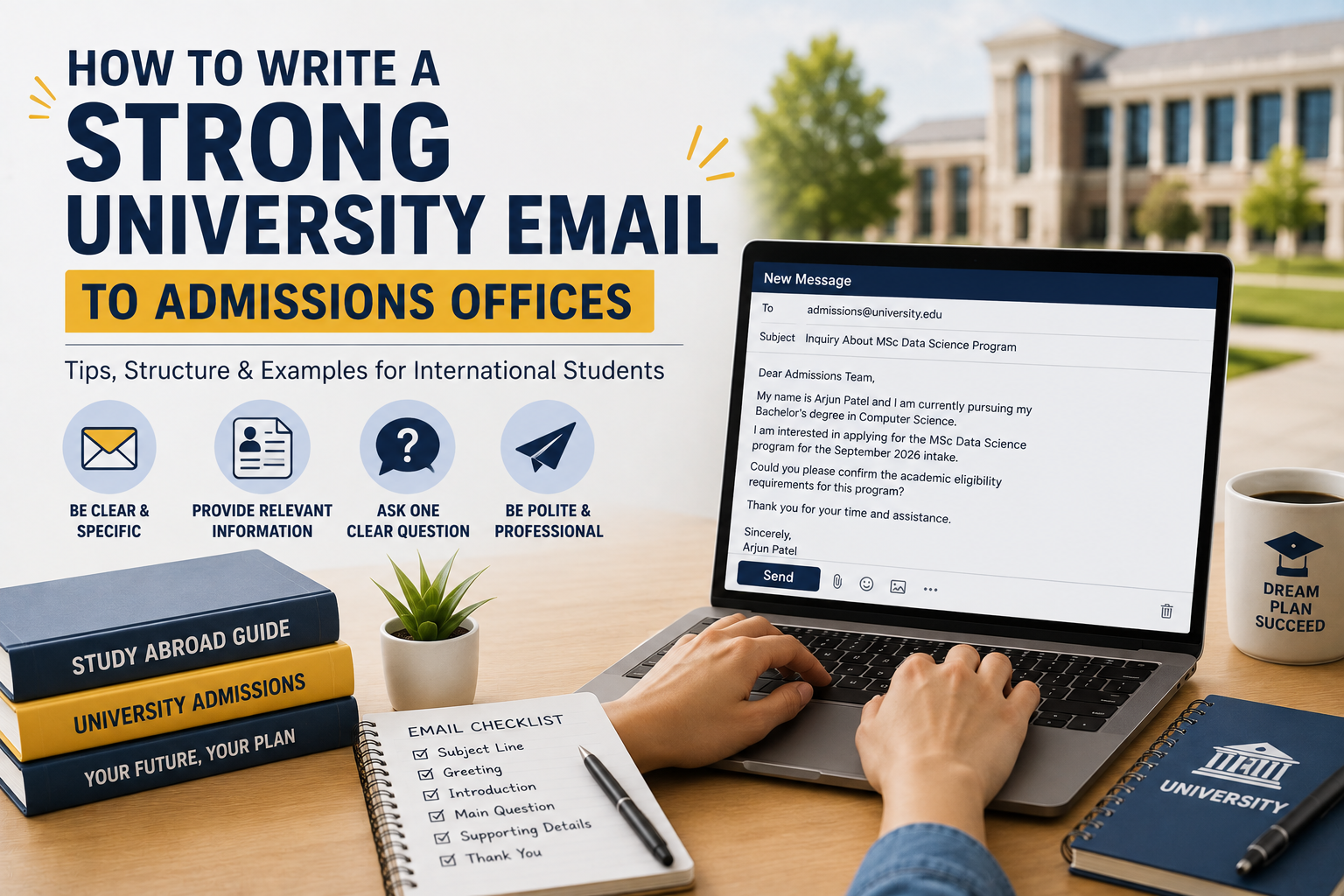
How to Write a Strong University Email to Admissions Offices
During the study abroad application process, students often have questions that cannot always be answered through a university website.
You may want to ask about:
- Course eligibility
- Application deadlines
- Required documents
- English language requirements
- Application status
- Scholarships
- Course availability
- Credit requirements
- Deferral options
In such situations, contacting the university's admissions office directly is often the best approach.
However, sending a simple message like "Can I apply for this course?" may not get you the most useful response.
A clear, professional, and well-structured email makes it easier for the admissions team to understand your situation and provide an accurate answer.
Why Is a University Email Important?
Email communication with a university can help you clarify important information before submitting an application.
A professional email can:
- Get answers to specific questions
- Clarify eligibility requirements
- Confirm document requirements
- Understand application procedures
- Resolve issues with an existing application
- Demonstrate professional communication
It can also prevent you from making an application mistake based on incomplete or misunderstood information.
Before Writing the Email, Do Your Research
Before contacting the admissions office, check the university's:
- Official website
- Course page
- Admission requirements
- FAQ section
- Application portal
- Deadline information
Universities receive a large number of enquiries, and asking something that is already clearly mentioned on the website may result in a brief response.
Research first, then ask a specific question.
Use a Clear Subject Line
The subject line should immediately tell the admissions team what your email is about.
Good Examples
- Inquiry About MSc Computer Science Eligibility
- Question Regarding Application Deadline – MSc Data Science
- Request for Clarification on Required Documents
- Inquiry About January 2027 Intake
- Application Status Inquiry – Applicant ID 12345
Avoid vague subjects such as:
- Important
- Help
- Admission
- Please reply
- Urgent question
A specific subject makes your email easier to identify and process.
Start With a Professional Greeting
Use a professional greeting such as:
Dear Admissions Team,
or
Dear Admissions Officer,
If you know the specific person's name, you can address them directly.
Avoid overly casual openings such as:
Hi bro,
Hello Sir/Madam,
or
Hey,
Professional communication creates a better first impression.
Introduce Yourself Briefly
You don't need to write your entire academic history.
Include only the information relevant to your question.
For example:
- Your name
- Current degree or qualification
- University
- Graduation year
- Intended course
- Intended intake
- Applicant ID, if applicable
Example
"My name is [Name], and I am currently completing my Bachelor's degree in Mechanical Engineering. I am interested in applying for the MSc Renewable Energy Engineering program for the September 2027 intake."
This gives the admissions team enough context to understand your situation.
Ask One Clear Question
One of the biggest mistakes students make is sending extremely long emails containing multiple unrelated questions.
Instead, make your main question clear.
For example:
"Could you please confirm whether a Bachelor's degree in Mechanical Engineering meets the academic eligibility requirements for this program?"
This is much easier to answer than:
"I want to know everything about admission, fees, documents, eligibility, visa, accommodation and jobs."
Include Relevant Details
The more specific your question is, the more useful the response is likely to be.
For example, instead of:
"Am I eligible?"
write:
"I have completed a Bachelor's degree in Computer Engineering with 8.2/10 CGPA and have studied mathematics, programming, and database systems. Could you please confirm whether my academic background meets the entry requirements for the MSc Data Science program?"
The admissions team can evaluate your situation more effectively.
Keep the Email Short
Admissions offices receive many emails every day.
Try to keep your message:
- Clear
- Concise
- Relevant
- Professional
You don't need to explain your entire life story.
A good university enquiry can often be completed in 150–250 words.
Mention the Exact Course and Intake
Universities may offer several programs with similar names.
Always mention:
Course name + intake
For example:
"MSc Artificial Intelligence – September 2027 Intake"
This reduces confusion and helps the admissions team respond accurately.
Ask About Eligibility Before Applying
If you're unsure whether your academic background qualifies, contacting the university can be useful.
You can mention:
- Degree
- Major
- Subjects studied
- Graduation status
- Relevant work experience
Then ask whether your profile meets the program's requirements.
However, remember that an informal email response may not always constitute a formal admission decision.
Asking About Missing Documents
If you're unsure about a document, don't guess.
For example:
"I noticed that the application portal requests a degree certificate. As I am currently in my final semester and will receive my degree certificate after graduation, could you please confirm whether I can submit my provisional certificate or current academic transcript at this stage?"
This provides useful context and asks for a specific solution.
Asking About Application Status
If you've already applied, include your:
- Full name
- Application number
- Program
- Intake
Then ask politely for an update.
Avoid sending repeated emails every few days unless the university has specifically requested additional information.
How to Follow Up
If you haven't received a response, you can send a polite follow-up after a reasonable period.
Your follow-up should be short.
For example:
"I am writing to kindly follow up on my previous email regarding the eligibility requirements for the MSc program. I would appreciate any clarification you can provide."
Avoid writing:
"Why haven't you replied yet?"
or
"Please reply immediately."
Common Mistakes to Avoid
1. Using Informal Language
Avoid texting-style language such as:
- Plz
- U
- ASAP
- Wanna
- Kindly do the needful
Use complete and professional sentences.
2. Sending a Generic Email
Don't send the exact same email to every university.
Mention the specific university and program.
3. Asking Questions Already Answered on the Website
Always check the official course page first.
4. Writing Extremely Long Emails
Keep your message focused.
5. Sending Multiple Emails for the Same Question
Repeated messages can make communication confusing.
6. Forgetting Attachments
If you mention an attachment, make sure you actually attach it.
7. Using an Unprofessional Email Address
Use a simple email address based on your name whenever possible.
Example Situations Where You Can Email Admissions
You may contact admissions about:
Eligibility
"Does my Bachelor's degree meet the academic requirements?"
Documents
"Can I submit my provisional degree certificate?"
Deadlines
"Is the application deadline extended for international applicants?"
English Language Requirements
"Does the university accept my English proficiency test?"
Course Availability
"Is this program available for the January intake?"
Application Status
"Could you please provide an update on my application?"
Deferral
"Is it possible to defer my admission to the next intake?"
A Simple Structure to Follow
A professional university email can follow this structure:
Subject → Greeting → Introduction → Relevant Background → Specific Question → Supporting Information → Thank You → Signature
This structure keeps your communication organised and easy to understand.
Tips for Getting Better Responses
Be Specific
Ask exactly what you want to know.
Provide Context
Give enough information for the admissions team to understand your situation.
Be Polite
Professional communication matters.
Use the Correct Department
Some questions are handled by different teams, such as:
- Admissions
- International Office
- Finance
- Accommodation
- Scholarships
Sending your enquiry to the appropriate department can save time.
Proofread Before Sending
Check:
- Spelling
- Grammar
- Course name
- University name
- Intake
- Attachments
A quick review can prevent embarrassing mistakes.
Final Conclusion
Writing to a university admissions office doesn't need to be complicated.
The most effective emails are short, specific, professional, and supported by the right information.
Before sending your enquiry, research the university, identify your exact question, provide relevant academic details, and clearly explain what you need from the admissions team.
Remember:
A good university email doesn't try to say everything. It makes one important question easy to understand and easy to answer.
When you communicate professionally from the beginning, you can avoid confusion, get more accurate information, and make better decisions throughout your study abroad application journey.
Verified by Edulx Germany Specialists
Have questions about your profile or APS verification? Book a free 1-on-1 session with our Pune counsellors.