Minimum CGPA Required to Study Abroad
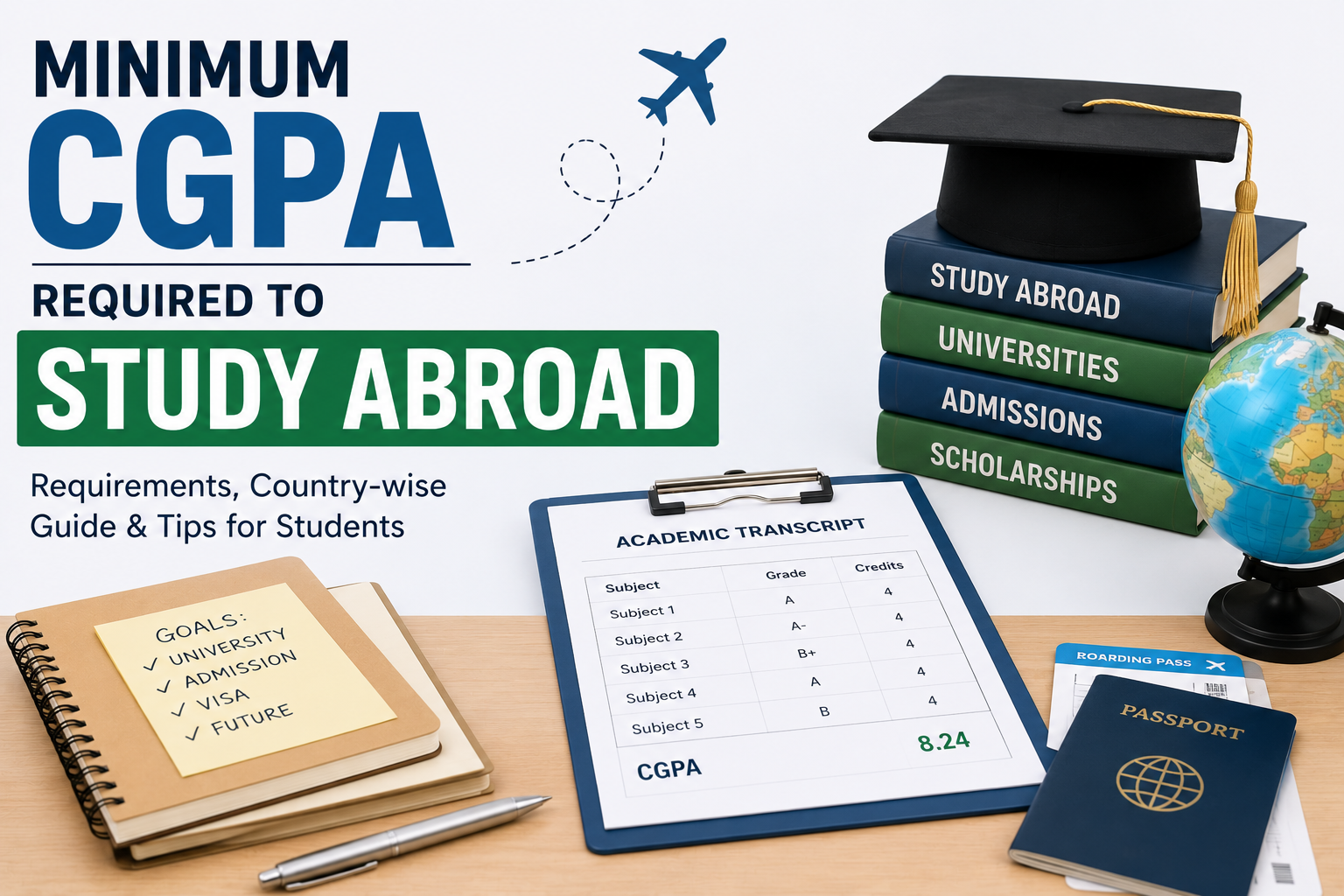
Minimum CGPA Required to Study Abroad – Everything You Need to Know
One of the most common questions students ask when planning to study abroad is:
"What is the minimum CGPA required to get admission to a foreign university?"
The simple answer is:
There is no universal minimum CGPA.
Every university and every course has its own admission criteria. Some highly competitive programs expect an excellent academic record, while many others accept students with average grades if they have a strong overall profile.
If your CGPA isn't as high as you hoped, don't assume your study abroad dream is over. Understanding how universities evaluate applications can help you make smarter choices.
What Is CGPA?
CGPA (Cumulative Grade Point Average) is a measure of your overall academic performance throughout your degree.
Universities use CGPA to understand your academic consistency and readiness for higher education.
However, it is only one part of your application.
Admissions committees usually consider several factors together.
Is There a Standard Minimum CGPA?
No.
Universities set their own academic requirements based on:
- The course
- The level of competition
- The country
- The institution's admission policy
For this reason, two universities offering the same program may have completely different admission expectations.
Always check the official admission requirements of the universities you plan to apply to.
Typical CGPA Expectations
Although there is no universal rule, many universities generally fall into these broad categories:
Excellent Academic Profile
Students with a CGPA equivalent to approximately 8.5/10 or above often qualify for a wide range of competitive universities, provided they meet other admission requirements.
Strong Academic Profile
A CGPA around 7.5–8.5/10 is considered competitive for many master's programs worldwide.
Average Academic Profile
Students with a CGPA between 6.5–7.5/10 can still receive admissions at many universities, especially when supported by internships, projects, certifications, or relevant work experience.
Lower Academic Profile
Even students below 6.5/10 may find opportunities at certain universities, particularly where admissions are based on a holistic review or where pathway options are available.
Important: These are general observations, not official admission cut-offs. Actual requirements vary by university and program.
Does Every Country Have the Same CGPA Requirement?
No.
Different countries evaluate applicants differently.
Germany
Many universities focus on:
- Academic performance
- Subject compatibility
- Bachelor's curriculum
- Entrance requirements (where applicable)
Some programs are highly competitive, while others evaluate applications more holistically.
United Kingdom
Many UK universities consider:
- Degree classification or equivalent
- Relevant academic background
- SOP
- English language proficiency
Some universities also assess professional experience.
Canada
Canadian universities often place significant emphasis on academic performance but may also value research, projects, and work experience depending on the program.
Australia
Australian universities usually evaluate:
- Previous academic qualifications
- English proficiency
- Program-specific requirements
Some institutions also offer pathway options for eligible students.
Ireland
Irish universities commonly consider:
- Academic background
- Relevant coursework
- SOP
- English language scores
United States
Universities in the USA often follow a holistic admissions process.
Along with CGPA, they may evaluate:
- SOP
- LORs
- Research
- Projects
- Internships
- Standardized tests (if required by the program)
Can You Study Abroad with a Low CGPA?
Yes.
A lower CGPA does not automatically prevent admission.
Many universities evaluate the complete application.
You can strengthen your profile through:
- Relevant internships
- Industry projects
- Research experience
- Professional certifications
- Strong SOP
- Good recommendation letters
- Relevant work experience
These elements help demonstrate your potential beyond academic scores.
How Can You Improve Your Chances?
Write a Strong Statement of Purpose
Explain:
- Your academic journey
- Career goals
- Why you chose the course
- How you are prepared for graduate study
A thoughtful SOP can help admissions officers understand your motivation and growth.
Gain Practical Experience
Hands-on experience through internships or projects shows that you can apply your knowledge in real-world settings.
Earn Relevant Certifications
Certifications in your field demonstrate continuous learning and initiative.
Choose certifications that align with your intended program.
Apply Strategically
Rather than applying only to highly competitive universities, create a balanced list that includes:
- Dream universities
- Target universities
- Safe universities
This improves your chances of receiving multiple admission offers.
Does a High CGPA Guarantee Admission?
No.
Even students with excellent grades can be rejected if other parts of their application are weak.
Universities also assess:
- SOP quality
- LORs
- English language proficiency
- Research or project experience
- Program fit
Admissions decisions are based on the overall profile.
Common Mistakes Students Make
Focusing Only on CGPA
Grades are important, but they are only one part of the application.
Comparing Themselves to Other Students
Every university and every applicant is different.
Focus on building the strongest version of your own profile.
Ignoring Course Requirements
Some programs require prerequisite subjects, portfolios, or work experience in addition to academic performance.
Always review the official eligibility criteria.
Applying Without Research
Admission requirements vary between universities and may change over time.
Verify information directly from official university websites before applying.
Tips for Students with an Average CGPA
If your CGPA is lower than expected:
✔ Build a strong portfolio of projects.
✔ Complete relevant internships.
✔ Gain industry certifications.
✔ Write a compelling SOP.
✔ Obtain strong recommendation letters.
✔ Choose universities that match your academic profile.
A well-planned application strategy can significantly improve your chances.
Final Conclusion
There is no single minimum CGPA required to study abroad.
Admission depends on the university, the course, and the strength of your overall application.
While good academic performance is valuable, universities also consider your practical experience, motivation, skills, and future potential.
If your CGPA isn't perfect, don't lose confidence. By strengthening other parts of your profile and applying strategically, you can still find excellent opportunities to study abroad.
Remember:
Your CGPA may open the door, but your complete profile often determines whether you walk through it.
Verified by Edulx Germany Specialists
Have questions about your profile or APS verification? Book a free 1-on-1 session with our Pune counsellors.