Public Transport in Germany for International Students: A Complete Guide for 2027
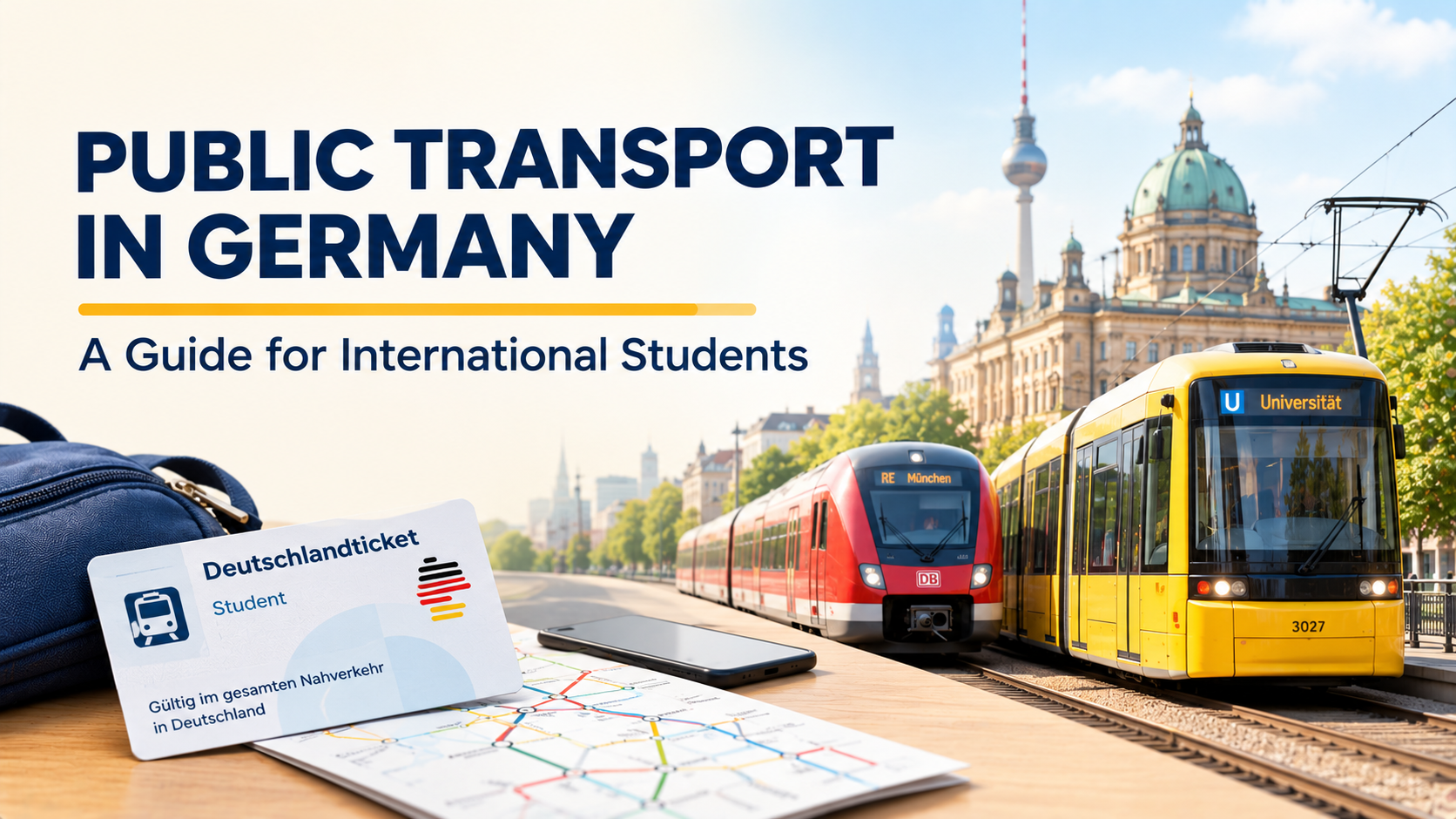
Public Transport in Germany for International Students: A Complete Guide for 2027
Moving to Germany for higher education comes with many new experiences. From attending university lectures to visiting supermarkets, exploring nearby cities and travelling during semester breaks, getting around efficiently is an important part of student life.
Fortunately, Germany has an extensive public transport network connecting cities, university campuses, residential areas and regional destinations. International students can use buses, trams, underground trains, suburban trains and regional trains to travel without owning a car.
However, understanding which ticket to buy can be confusing at first. A semester ticket, a Deutschlandticket and a single-journey ticket serve different purposes, and the best option depends on your university, location and travel habits.
In this guide, EDULX Overseas explains how public transport works in Germany and what students planning to arrive in 2027 should know.
1. How Does Public Transport Work in Germany?
Germany's public transport system includes several types of services. The names may look unfamiliar when you first arrive, but each serves a different purpose.
- Bus: Connects residential neighbourhoods, campuses, railway stations and smaller towns.
- Tram or Straßenbahn: Runs on tracks, often along city streets, and is common in many German cities.
- U-Bahn: An underground or urban rapid-transit railway serving parts of larger cities.
- S-Bahn: A suburban railway connecting city centres with surrounding districts and nearby towns.
- Regionalbahn (RB): A regional train that stops at many stations.
- Regional-Express (RE): A regional train that usually makes fewer stops than an RB service.
Most cities and regions have transport associations called Verkehrsverbünde. These organisations coordinate fares, routes and tickets across participating transport providers.
This means you can often use one local ticket across several types of transport within the relevant fare zone. Always check the ticket's validity before boarding.
For longer journeys between major cities, you may also encounter ICE, IC and EC trains. These are long-distance services and generally require a separate ticket if you are travelling with a Deutschlandticket.
Official reference: Deutsche Bahn – Deutschlandticket and Transport Validity
2. What Is a Semester Ticket in Germany?
A Semesterticket is a public transport ticket offered to students through participating universities or student organisations.
Depending on the university and its transport agreement, the ticket may cover local transport in a city, a wider regional network or eligible nationwide local and regional transport.
Some universities include the cost in the semester contribution, while others provide different arrangements. Do not assume that every German university offers the same ticket.
Before enrolling, check:
- Whether your university offers a semester ticket.
- Which transport services and geographical areas it covers.
- Whether it is included in your semester contribution.
- When the ticket becomes valid.
- Whether it is available digitally, as a chip card or in another format.
- Whether there are restrictions on guest students, exchange students or students on leave.
For example, some universities participate in the nationwide Deutschlandsemesterticket arrangement, while other institutions have different regional arrangements.
Important: Paying your semester contribution does not necessarily mean you can immediately board any train in Germany. First, confirm that your ticket has been issued, activated and is valid for your journey.
3. What Is the Deutschlandticket?
The Deutschlandticket is a personal subscription ticket that allows unlimited travel on participating local and regional public transport services throughout Germany.
It is useful for students who travel regularly between their accommodation, university, shopping areas and nearby cities.
The ticket generally covers:
- Local buses.
- Trams.
- U-Bahn services.
- S-Bahn services.
- Regional trains, including RB and RE services, in second class.
It generally does not cover long-distance ICE, IC or EC trains, or private long-distance services such as FlixTrain. Some routes have special exceptions, so check your journey before travelling.
How much does the Deutschlandticket cost in 2027?
According to Deutsche Bahn's published information as of October 2026, the regular Deutschlandticket costs €63 per month through 31 December 2026. The announced price from 1 January 2027 is €66.80 per month. https://www.bahn.de/angebot/regio/deutschland-ticket
The regular ticket is issued as a subscription and is personal, meaning you cannot simply lend it to a friend. Cancellation deadlines and the precise terms depend on the issuing provider; Deutsche Bahn states that cancellation by the 10th of the month generally ends the subscription at the end of that month.
Before purchasing, confirm the current price, cancellation deadline and ticket validity with the provider.
Official reference: Deutsche Bahn – Deutschlandticket
4. Is the Deutschlandticket the Same as the Deutschlandsemesterticket?
No. These tickets are related, but they are not identical.
The regular Deutschlandticket is purchased individually as a subscription. The Deutschlandsemesterticket is a student arrangement available through participating universities and student organisations.
Where offered, the student version provides nationwide access to eligible local and regional public transport. Its cost, issue process and period of validity are linked to the relevant student arrangement.
For example, the Hamburg transport association HVV lists a Deutschlandsemesterticket price of €226.80 for the winter semester 2026/27, equivalent to €37.80 per month. This reflects the student arrangement for participating institutions and should not be assumed to apply to every university in Germany.
Official reference: HVV – Tickets for Students
Before buying a regular Deutschlandticket, check whether your university already provides a semester ticket. You may otherwise pay for a ticket you do not need.
5. Which Ticket Should You Choose as a Student?
The right ticket depends on how often you travel and what your university provides.
Choose a semester ticket if:
- Your university offers one that suits your travel needs.
- The cost is included in your semester contribution or is otherwise affordable.
- Its validity covers your campus, accommodation and usual destinations.
Consider the Deutschlandticket if:
- You frequently travel beyond your university's local area.
- Your university ticket does not cover the routes you need.
- You want flexibility to use eligible local and regional transport across Germany.
Consider single or day tickets if:
- You travel only occasionally.
- You need transport for a short visit.
- Buying a monthly subscription would cost more than your planned journeys.
Always compare the ticket's total cost, validity period and cancellation rules before deciding. A nationwide ticket is not automatically the cheapest choice for every student.
6. How Can You Buy a Public Transport Ticket?
The purchasing process depends on the ticket type and the transport provider.
For a semester ticket: Follow the instructions issued by your university, student services office or student organisation. You may need to activate a digital ticket or use a university-provided app or chip card.
For a Deutschlandticket: Purchase it through an authorised transport provider or transport association. It is commonly available as a digital ticket, with other formats depending on the provider.
For local tickets: Check the transport operator's app, ticket machine, customer service centre or official website.
Before completing a purchase, check the following details:
- Ticket start date and end date.
- Whether it is valid for the journey you plan to take.
- Whether it is a subscription.
- The cancellation deadline.
- Whether you need a separate ticket for a bicycle or another additional service.
Keep your ticket accessible during travel. If it is digital, make sure you can display it when requested.
7. How Do You Plan a Journey in Germany?
You do not need to memorise every route to use public transport. Journey-planning apps and official transport websites make it easier to find connections.
A useful starting point is Deutsche Bahn's journey planner. Local transport operators also provide apps and route information for their cities.
To plan a journey:
- Enter your starting point and destination.
- Select your preferred departure or arrival time.
- Review the suggested routes and transfer points.
- Check whether the journey uses local, regional or long-distance services.
- Confirm that your ticket covers the entire journey.
- Check for platform changes, delays and service disruptions before leaving.
For example, a route between your accommodation and university may involve a bus followed by an S-Bahn. If both services fall within your ticket's validity, you may not need to buy separate tickets.
For journeys involving an ICE or another long-distance train, verify whether you need an additional ticket.
8. Do You Need to Validate Your Ticket Before Boarding?
Ticket validation rules depend on the ticket type and local transport system.
Some paper tickets need to be stamped or validated before travel. Other tickets are issued for a specific date or time, while digital tickets may be valid according to the details shown in the app.
Do not assume that every ticket works the same way.
Before your first journey, check:
- Whether a paper ticket must be validated.
- Whether the ticket is valid immediately after purchase.
- Whether it has a specific start time.
- Whether it must be shown with identification.
- Whether it is restricted to a named passenger.
The Deutschlandticket is personal, and passengers may be asked to prove their identity during a ticket inspection. If you have a student ticket, follow the identification requirements provided by your university or transport operator.
9. What Happens If You Travel Without a Valid Ticket?
Travelling without a valid ticket can result in an additional fare or penalty under the applicable transport conditions.
Common mistakes include boarding before validating a ticket when validation is required, using a ticket outside its permitted zone, travelling on an ICE with a Deutschlandticket alone, or assuming that a student ID automatically grants free travel.
To avoid problems:
- Confirm the ticket's validity before boarding.
- Check whether the service is regional or long-distance.
- Keep your ticket available for inspection.
- Carry any identification required by the ticket conditions.
- Do not use another person's personal ticket.
- Follow the instructions of the relevant transport operator.
If you are unsure whether your ticket covers a particular route, ask the transport provider before starting the journey.
10. Practical Tips for International Students
Getting used to a new transport system takes time. These simple habits can make everyday travel easier.
Save your regular routes: Keep the routes between your accommodation, university, supermarket and railway station easy to access.
Allow extra time: During your first few weeks, leave early enough to handle unfamiliar stations and transfers.
Check the platform: Railway platforms can change. Check the departure boards and journey-planning app before boarding.
Learn the last departure time: If you are returning late, check the final available connection and any night services.
Keep your ticket accessible: Make sure your phone has enough battery if you rely on a digital ticket.
Understand local ticket zones: Some local tickets cover only specific zones, so a journey outside the zone may require an additional ticket.
Check student benefits: Your university or local transport association may offer student-specific arrangements.
Plan airport transfers separately: Do not assume that your semester ticket or local ticket covers every airport route. Check the route and ticket conditions in advance.
11. Common Public Transport Mistakes to Avoid
International students can avoid unnecessary expenses by checking a few important details before travelling.
- Buying a Deutschlandticket without checking whether a semester ticket is already available.
- Assuming the Deutschlandticket covers ICE, IC or EC trains.
- Forgetting that the regular Deutschlandticket is a subscription.
- Missing the cancellation deadline.
- Travelling with an expired or not-yet-valid ticket.
- Assuming the same ticket rules apply in every city.
- Lending a personal ticket to someone else.
- Ignoring service disruptions or platform changes.
- Assuming a student ID alone is a travel ticket.
A little preparation can make your daily commute more predictable and help you manage your student budget.
12. Public Transport Checklist for Students Arriving in Germany in 2027
Use this checklist before you begin travelling regularly:
Check whether your university offers a semester ticket.
Confirm the ticket's geographical coverage and validity dates.
Compare the semester ticket with the regular Deutschlandticket.
Check the announced ticket price for your travel period.
Understand subscription and cancellation conditions.
Download a suitable journey-planning app.
Learn the route between your accommodation and university.
Check whether your ticket needs validation.
Understand which trains are excluded from your ticket.
Save emergency route information and alternative connections.
Final Thoughts
Germany's public transport system can make student life more convenient, whether you are travelling to lectures, running errands or exploring another city during the weekend.
The most important step is choosing the right ticket for your university and travel habits. Check your semester ticket first, understand the difference between regional and long-distance trains, and verify the latest ticket prices and conditions before purchasing.
For students planning to move to Germany in 2027, preparing these details before arrival can make the transition smoother and help prevent avoidable travel costs.
Planning to study in Germany? EDULX Overseas can help you understand your study-abroad journey, from university applications and visa guidance to practical preparation before departure.
Visit edulx.in to explore our services.
Verified by Edulx Germany Specialists
Have questions about your profile or APS verification? Book a free 1-on-1 session with our Pune counsellors.