Public University vs University of Applied Sciences: Which Should You Choose? (2027 Guide)
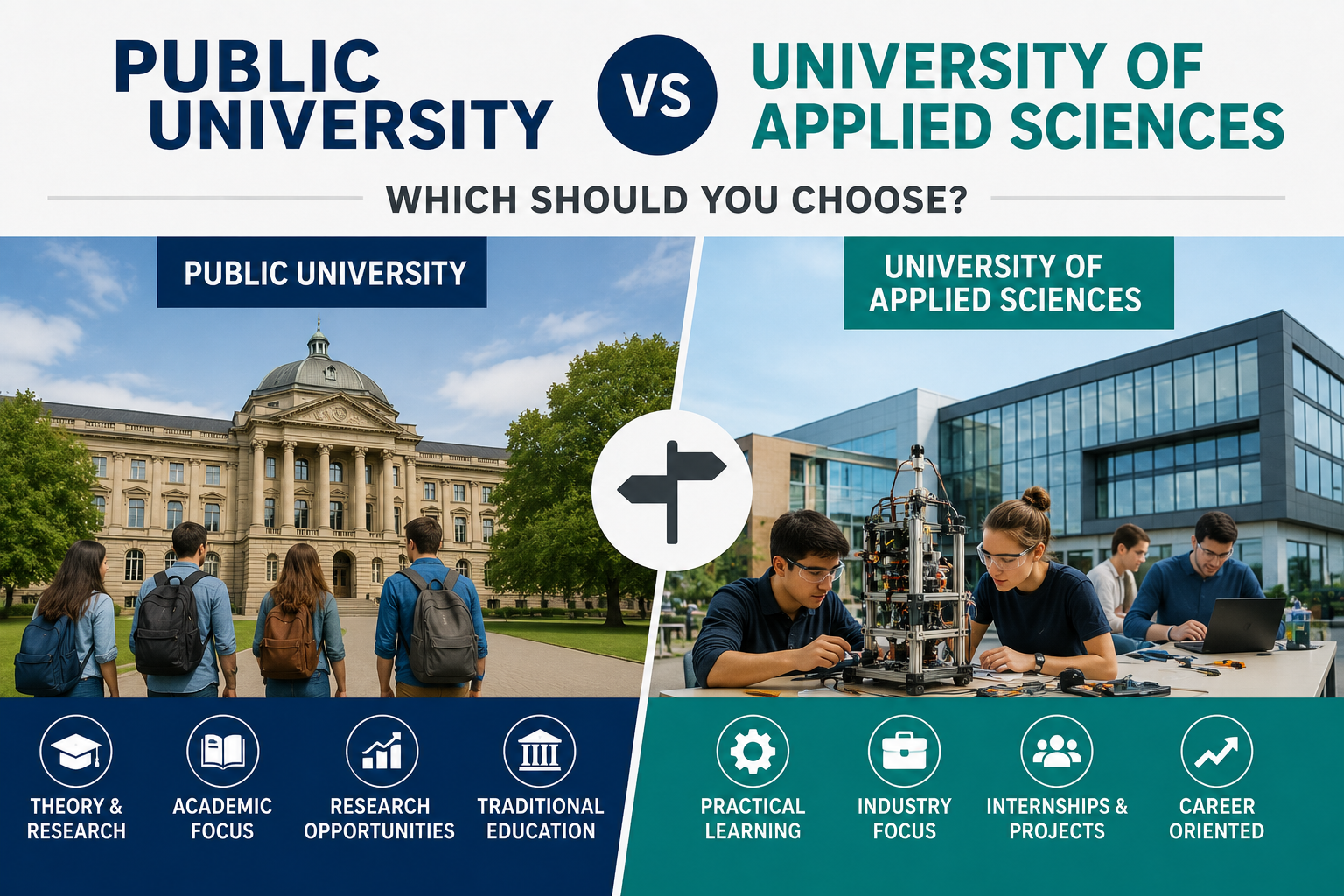
Introduction
Germany offers two major types of higher education institutions for international students:
- Public Universities (Universität)
- Universities of Applied Sciences (Hochschule/Fachhochschule)
Both provide internationally recognized degrees, but they differ in their teaching approach, research opportunities, industry exposure, and career focus.
Choosing the right type of institution depends on your career goals, preferred learning style, and future plans.
This guide explains the key differences to help you make an informed decision.
What Is a Public University?
Public universities are government-funded institutions that focus on:
- Academic excellence
- Scientific research
- Theoretical knowledge
- Innovation
They offer bachelor's, master's, and doctoral (PhD) programs across a wide range of disciplines.
Many of Germany's globally ranked universities belong to this category.
What Is a University of Applied Sciences?
Universities of Applied Sciences focus on practical education and industry-oriented learning.
Their programs emphasize:
- Hands-on training
- Practical projects
- Industry collaboration
- Real-world problem solving
Many courses include mandatory internships or project-based learning with companies.
Teaching Style
Public University
Learning is generally more theoretical and research-oriented.
Students are expected to:
- Study independently
- Conduct academic research
- Attend lectures and seminars
- Develop analytical skills
This environment is ideal for students interested in research or academia.
University of Applied Sciences
Teaching is practical and application-based.
Students participate in:
- Laboratory work
- Industry projects
- Case studies
- Practical assignments
- Company collaborations
Classes are often smaller, allowing more interaction with professors.
Research Opportunities
Public University
Public universities are known for:
- Advanced research facilities
- Research grants
- International collaborations
- PhD opportunities
Students interested in pursuing doctoral studies often choose public universities.
University of Applied Sciences
Research exists but is usually applied rather than theoretical.
Projects are often carried out in collaboration with industries to solve real-world challenges.
Internship Opportunities
Public University
Internships may be optional or depend on the course.
Students often need to arrange internships independently.
University of Applied Sciences
Internships are frequently integrated into the curriculum.
Many universities maintain strong partnerships with companies, making it easier for students to gain industry experience.
Class Size
Public University
Lecture halls may have hundreds of students, especially during the first semesters.
Independent learning plays a significant role.
University of Applied Sciences
Classes are generally smaller.
Students receive more interaction with professors and personalized academic support.
Industry Connections
Public University
Industry collaboration depends on the department and research projects.
Research partnerships are common in engineering and science fields.
University of Applied Sciences
Strong industry partnerships are one of their biggest advantages.
Students often work on real projects with companies before graduation.
Career Opportunities
Graduates from both institution types can build successful careers.
Public University
Well suited for careers in:
- Research
- Academia
- R&D
- Government organizations
- Large multinational companies
University of Applied Sciences
Ideal for careers in:
- Engineering
- Information Technology
- Business
- Manufacturing
- Consulting
- Product Development
Employers often value the practical experience gained during these programs.
Can You Pursue a PhD?
Public University
Yes.
Public universities are the traditional route for students planning to pursue doctoral studies.
University of Applied Sciences
Graduates can pursue a PhD, but the process may differ depending on the university and country.
Some students continue their doctoral studies through collaborations with public universities.
Tuition Fees
Most public universities in Germany charge little or no tuition fees for many programs, although students are usually required to pay a semester contribution.
Universities of Applied Sciences may also be publicly funded with similar fee structures, while private institutions generally charge tuition fees.
Always check the fee structure of your chosen university.
Which One Is Better?
Choose a Public University if you:
- Enjoy academic research
- Plan to pursue a PhD
- Prefer theoretical learning
- Want a research-oriented career
Choose a University of Applied Sciences if you:
- Prefer practical learning
- Want industry exposure
- Like project-based education
- Aim to enter the job market quickly
Neither option is universally better—the right choice depends on your goals.
Common Misconceptions
"Public Universities Are Better"
Both institution types are respected and recognized.
The best choice depends on your career objectives.
"Universities of Applied Sciences Offer Lower-Quality Degrees"
This is incorrect.
Degrees from accredited Universities of Applied Sciences are internationally recognized and valued by employers.
"Only Public University Graduates Get Good Jobs"
Employers generally value practical skills, internships, and experience in addition to academic qualifications.
Many graduates from Universities of Applied Sciences secure excellent positions in industry.
The Real Truth
Public Universities and Universities of Applied Sciences serve different purposes.
Public Universities are ideal for students interested in research, theoretical knowledge, and higher academic studies.
Universities of Applied Sciences are designed for students who prefer practical learning, industry projects, and career-focused education.
Before applying, think about your long-term goals rather than choosing an institution based solely on its name.
The best university is the one that supports your future career path.
Frequently Asked Questions (FAQs)
1. What is the difference between a Public University and a University of Applied Sciences?
Public Universities focus more on research and theory, while Universities of Applied Sciences emphasize practical learning and industry experience.
2. Which is better for international students?
Both are excellent options. The right choice depends on your career goals and preferred learning style.
3. Can I get a job after graduating from a University of Applied Sciences?
Yes. Graduates are highly employable due to their practical training and industry exposure.
4. Can I pursue a PhD after studying at a University of Applied Sciences?
Yes, although the pathway may vary depending on the university and program.
5. Are degrees from Universities of Applied Sciences recognized internationally?
Yes. Degrees from accredited institutions are internationally recognized.
6. Which is better for engineering and IT?
Both offer strong programs. Public Universities emphasize research, while Universities of Applied Sciences focus more on practical and industry-oriented education.
Verified by Edulx Germany Specialists
Have questions about your profile or APS verification? Book a free 1-on-1 session with our Pune counsellors.