Should You Choose a Research-Based or Course-Based Master's? (2027 Guide)
Introduction
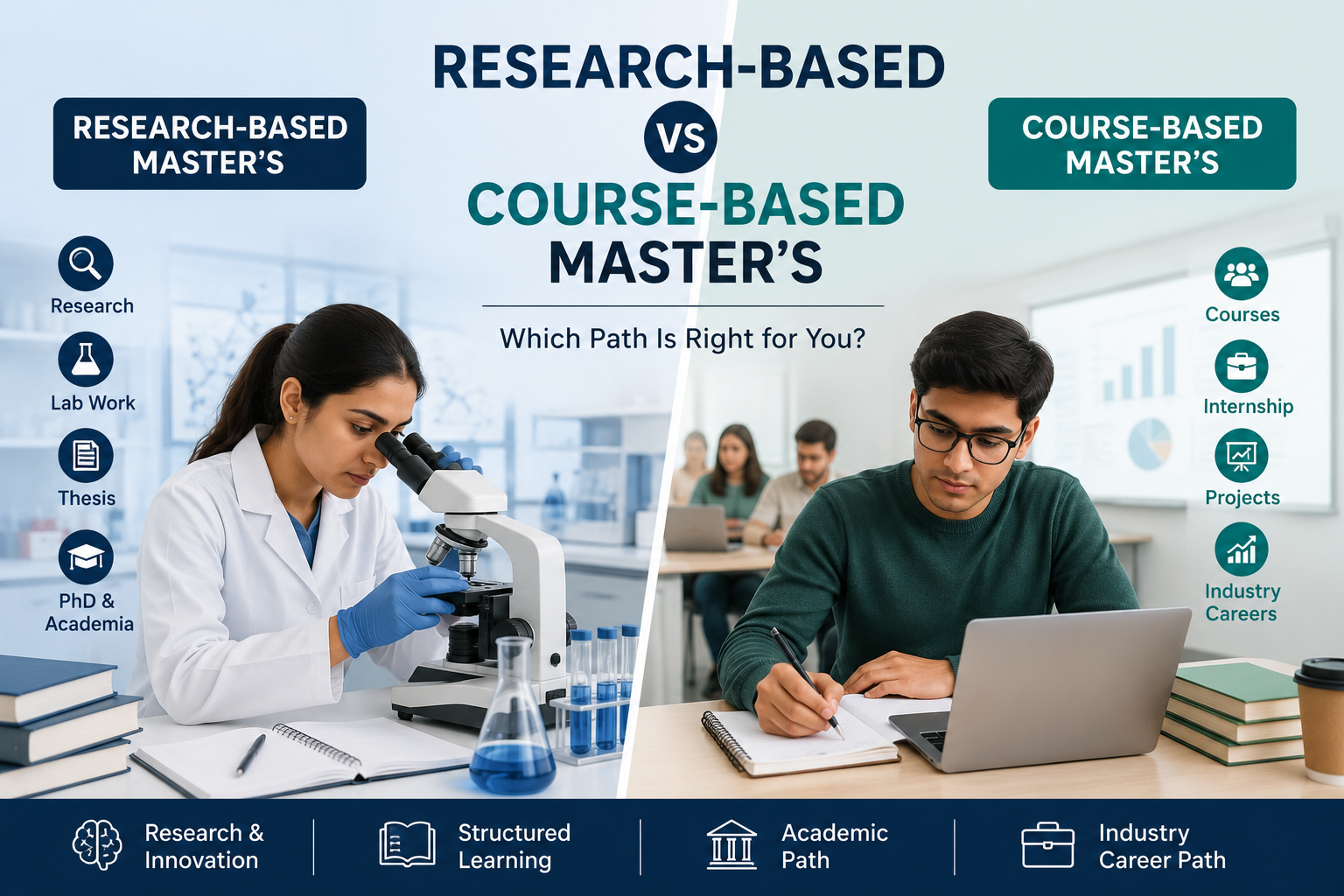
Choosing the right master's program is about more than selecting a university or country. One of the most important decisions you'll make is whether to pursue a Research-Based Master's or a Course-Based Master's.
Although both degrees lead to a master's qualification, they are designed for different career paths, learning styles, and future goals.
A research-based program emphasizes independent research and academic discovery, while a course-based program focuses on structured learning and practical industry skills.
Understanding these differences will help you choose a program that supports your long-term career aspirations.
What Is a Research-Based Master's?
A research-based master's is designed for students who enjoy investigating complex problems and creating new knowledge.
Instead of spending most of the program in traditional classrooms, students work closely with faculty supervisors on research projects.
The program usually includes:
- Literature reviews
- Research methodology
- Laboratory work
- Data collection
- Data analysis
- Scientific writing
- Master's thesis or dissertation
Research forms the largest part of the degree.
What Is a Course-Based Master's?
A course-based master's focuses primarily on classroom learning and professional skill development.
Students complete a structured curriculum consisting of:
- Lectures
- Tutorials
- Practical assignments
- Group projects
- Case studies
- Presentations
- Examinations
Some programs also include a capstone project or a small research project, but coursework remains the primary focus.
Key Differences at a Glance
Feature
Research-Based Master's
Course-Based Master's
Main Focus
Independent research
Classroom learning
Thesis
Major research thesis
Optional or smaller project
Learning Style
Self-directed
Structured
Research
Extensive
Limited
Practical Projects
Moderate
High
Internship Opportunities
Varies
Common in many programs
Best For
PhD & research careers
Industry & professional careers
Curriculum Comparison
Research-Based Master's
The curriculum usually contains fewer taught subjects and greater emphasis on independent research.
Students spend most of their time:
- Reviewing academic papers
- Conducting experiments
- Working in laboratories
- Meeting research supervisors
- Writing their thesis
The workload requires strong analytical and problem-solving skills.
Course-Based Master's
Course-based programs follow a semester-wise structure.
Students study multiple subjects and gain practical knowledge through:
- Assignments
- Presentations
- Industry projects
- Workshops
- Group discussions
- Practical exercises
Many universities also allow students to choose electives based on their interests.
Research Opportunities
If your goal is to contribute to scientific discoveries or continue into doctoral studies, research opportunities are essential.
Research-based master's programs often provide:
- Access to advanced laboratories
- Research grants
- Faculty mentoring
- Publications
- Conference participation
These experiences strengthen applications for PhD programs.
Internship Opportunities
Internships are generally more common in course-based master's programs.
Students may benefit from:
- Industry internships
- Company-sponsored projects
- Co-op opportunities
- Live business case studies
- Practical training
These experiences improve employability after graduation.
Assessment Methods
Research-Based Master's
Students are typically assessed through:
- Research progress
- Thesis quality
- Dissertation defense
- Academic presentations
- Published papers (where applicable)
Course-Based Master's
Assessment usually includes:
- Exams
- Assignments
- Group projects
- Practical work
- Presentations
- Capstone projects
Students receive continuous evaluation throughout the program.
Career Opportunities
Research-Based Master's
Graduates commonly work in:
- Universities
- Research institutes
- Government laboratories
- Research & Development (R&D)
- Biotechnology companies
- Pharmaceutical companies
- Scientific organizations
This path is ideal for students planning to pursue a PhD.
Course-Based Master's
Graduates often work in:
- Technology companies
- Engineering firms
- Business organizations
- Consulting companies
- Healthcare
- Finance
- Marketing
- Manufacturing
The focus is on preparing students for industry roles immediately after graduation.
Which Master's Is Better for International Students?
Neither option is universally better.
The right choice depends on your goals.
Choose a Research-Based Master's if you:
- Enjoy research
- Like solving complex problems
- Want to publish research papers
- Plan to pursue a PhD
- Prefer independent learning
Choose a Course-Based Master's if you:
- Want practical industry skills
- Prefer classroom learning
- Plan to work immediately after graduation
- Enjoy teamwork and projects
- Want internship opportunities
Advantages of a Research-Based Master's
- Strong preparation for PhD programs
- Advanced research experience
- Opportunity to publish research
- Close interaction with professors
- Excellent analytical skill development
Advantages of a Course-Based Master's
- Practical learning
- Industry-oriented curriculum
- Internship opportunities
- Broader subject coverage
- Faster transition into employment
Common Myths
"Research-Based Master's Is Better"
Not necessarily.
It depends entirely on your career goals.
"Course-Based Master's Is Easier"
Not always.
Course-based programs often include continuous assessments, projects, and exams throughout the year.
"Only Research Students Get Good Jobs"
Both program types can lead to excellent careers.
Employers value practical skills, problem-solving ability, communication, and experience.
How to Choose the Right Program
Before applying, ask yourself:
- Do I enjoy research?
- Do I want to pursue a PhD?
- Do I prefer practical learning?
- Am I interested in internships?
- What type of career do I want after graduation?
- Which curriculum aligns with my goals?
Your answers will help determine the best option.
The Real Truth
A master's degree is an investment in your future, and choosing the right type of program is just as important as choosing the right university.
A research-based master's is ideal for students interested in innovation, scientific research, and academia.
A course-based master's is better suited for students who want practical knowledge, industry exposure, and quicker entry into the workforce.
Neither path is superior—the best choice is the one that aligns with your ambitions, interests, and career plans.
Frequently Asked Questions (FAQs)
1. What is the difference between a research-based and a course-based master's?
A research-based master's focuses on independent research and a thesis, while a course-based master's emphasizes classroom learning, assignments, and practical projects.
2. Which master's is better for getting a job?
Course-based master's programs are generally more industry-oriented, while research-based master's programs are ideal for research careers.
3. Can I pursue a PhD after a course-based master's?
Yes. Many universities allow PhD admission after a course-based master's, provided you meet their research requirements.
4. Which master's is better for international students?
Both are excellent choices. The best option depends on your career goals and learning preferences.
5. Do research-based master's programs always require a thesis?
Yes. A substantial research thesis or dissertation is usually a core requirement.
6. How do I choose between the two?
Consider your interest in research, preferred learning style, internship opportunities, and long-term career goals before making a decision.
Verified by Edulx Germany Specialists
Have questions about your profile or APS verification? Book a free 1-on-1 session with our Pune counsellors.