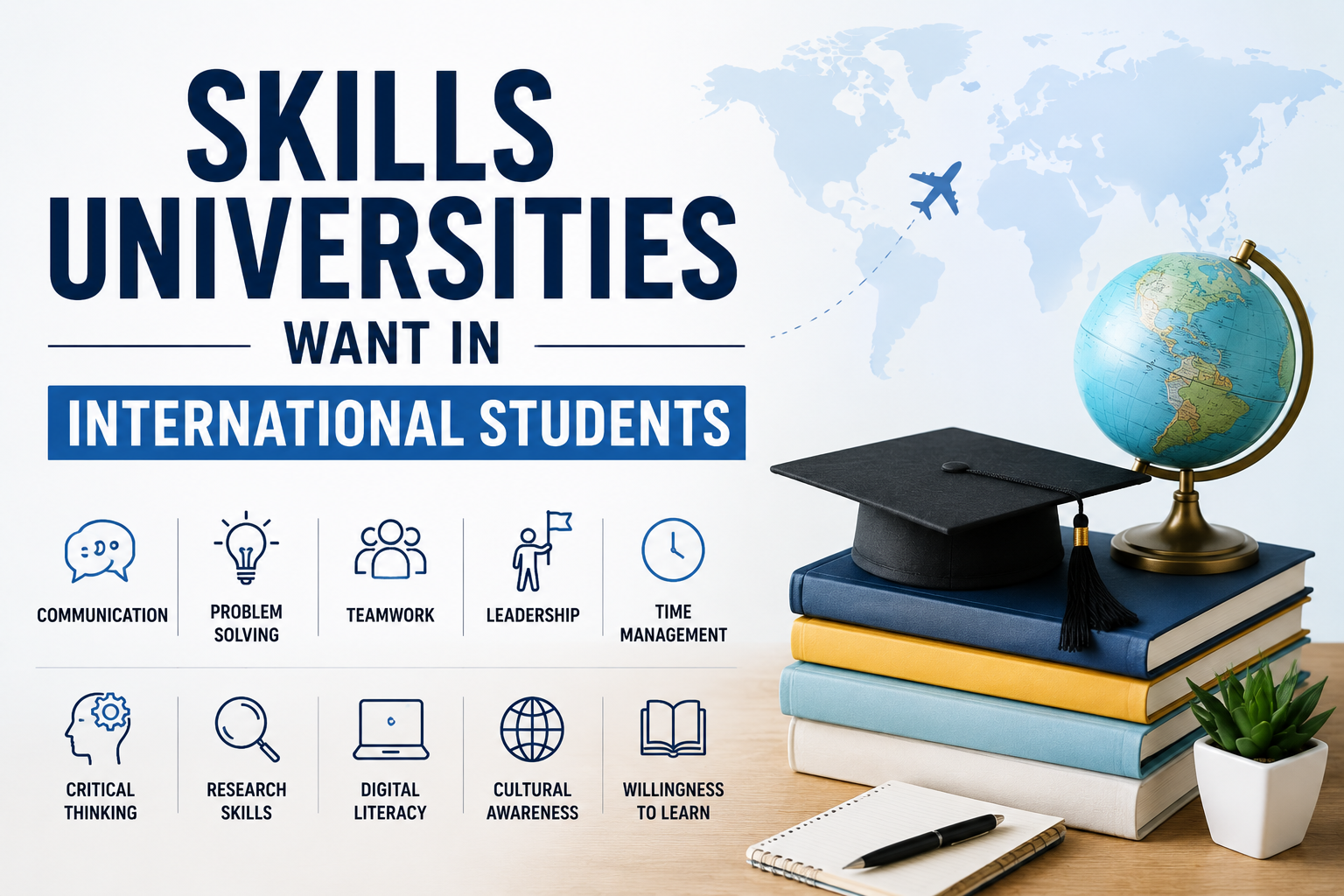
Skills Universities Want in International Students (2026 Guide)
Introduction
Many students believe that admission to an international university depends only on grades.
While strong academics are important, universities today evaluate applicants more holistically.
Admission committees look for students who can contribute to campus life, adapt to new environments, and succeed academically and professionally.
If you're planning to study abroad, developing the right skills can significantly strengthen your application.
Strong Communication Skills
Universities value students who can express their ideas clearly.
Communication skills include:
- Writing effectively
- Speaking confidently
- Active listening
- Presenting ideas clearly
Good communication helps students perform well in classrooms, group projects, and research activities.
Problem-Solving Ability
Higher education focuses on finding solutions rather than memorizing information.
Universities appreciate applicants who can:
- Analyze situations
- Think critically
- Make informed decisions
- Solve real-world problems
These skills are especially valuable in STEM, Business, and Research programs.
Leadership Skills
Leadership does not always mean being a class president.
Universities also value students who:
- Take initiative
- Organize activities
- Support team members
- Handle responsibilities
Leadership experience can come from school projects, clubs, volunteering, or internships.
Teamwork and Collaboration
International universities encourage collaborative learning.
Students should demonstrate the ability to:
- Work in teams
- Respect different opinions
- Share responsibilities
- Achieve common goals
Group assignments are common in many study programs.
Adaptability
Studying abroad involves adjusting to:
- A new country
- Different teaching methods
- Cultural diversity
- Independent living
Universities prefer students who are flexible and open to learning from new experiences.
Time Management
Managing multiple responsibilities is an essential student skill.
Successful students know how to balance:
- Classes
- Assignments
- Part-time work
- Personal commitments
Good time management often leads to better academic performance.
Critical Thinking
Universities encourage students to question, evaluate, and analyze information.
Critical thinking helps students:
- Conduct research
- Solve complex problems
- Develop logical arguments
- Make evidence-based decisions
It is an important skill across all academic disciplines.
Research Skills
Many degree programs involve research projects.
Students who have experience with:
- Research assignments
- Data collection
- Academic writing
- Literature reviews
often adapt more easily to university-level studies.
Digital Skills
Technology plays an important role in modern education.
Useful digital skills include:
- Microsoft Office
- Google Workspace
- Online collaboration tools
- Data analysis software
- Basic programming (where applicable)
Digital literacy has become an important advantage for students.
Cultural Awareness
International universities welcome students from diverse backgrounds.
Applicants who demonstrate:
- Respect for different cultures
- Open-mindedness
- Global perspective
- Inclusiveness
often fit well into multicultural learning environments.
Extracurricular Involvement
Universities appreciate students who participate beyond academics.
Examples include:
- Sports
- Student clubs
- Volunteering
- Competitions
- Community service
These activities demonstrate initiative, leadership, and personal development.
Willingness to Learn
One of the most valuable qualities universities seek is curiosity.
Students who show a genuine interest in learning, improving, and exploring new ideas often stand out during the admission process.
How Can You Develop These Skills?
You don't need extraordinary achievements.
You can strengthen your profile by:
- Joining student clubs
- Participating in competitions
- Volunteering
- Completing internships
- Taking online certification courses
- Working on personal projects
- Improving communication skills
Small, consistent efforts make a significant difference over time.
Common Mistakes Students Make
Focusing Only on Grades
Excellent academic performance is important, but universities also value well-rounded applicants.
Ignoring Extracurricular Activities
Activities outside the classroom can strengthen your application.
Copying Generic SOPs
Universities appreciate authentic stories and genuine experiences.
Not Developing Soft Skills
Communication, teamwork, and leadership are just as valuable as technical knowledge.
The Real Truth
International universities are not simply looking for students with high marks.
They want applicants who are:
- Curious learners
- Responsible individuals
- Effective communicators
- Collaborative team members
- Future leaders
Building these skills before applying can improve not only your admission chances but also your success during university and throughout your career.
Frequently Asked Questions (FAQs)
1. Do universities only consider academic scores?
No. Most universities also evaluate skills, extracurricular activities, personal statements, and overall profile.
2. Which skill is most important for international students?
Communication, adaptability, and problem-solving are among the most valued skills.
3. Are extracurricular activities important?
Yes. They demonstrate leadership, teamwork, and personal growth.
4. Can internships improve my application?
Yes. Practical experience shows initiative and real-world learning.
5. How can I improve my university profile?
Focus on academics, skill development, volunteering, certifications, internships, and extracurricular involvement.
6. Do universities value soft skills?
Yes. Soft skills are increasingly important in both admissions and future career success.Introduction
Many students believe that admission to an international university depends only on grades.
While strong academics are important, universities today evaluate applicants more holistically.
Admission committees look for students who can contribute to campus life, adapt to new environments, and succeed academically and professionally.
If you're planning to study abroad, developing the right skills can significantly strengthen your application.
Strong Communication Skills
Universities value students who can express their ideas clearly.
Communication skills include:
- Writing effectively
- Speaking confidently
- Active listening
- Presenting ideas clearly
Good communication helps students perform well in classrooms, group projects, and research activities.
Problem-Solving Ability
Higher education focuses on finding solutions rather than memorizing information.
Universities appreciate applicants who can:
- Analyze situations
- Think critically
- Make informed decisions
- Solve real-world problems
These skills are especially valuable in STEM, Business, and Research programs.
Leadership Skills
Leadership does not always mean being a class president.
Universities also value students who:
- Take initiative
- Organize activities
- Support team members
- Handle responsibilities
Leadership experience can come from school projects, clubs, volunteering, or internships.
Teamwork and Collaboration
International universities encourage collaborative learning.
Students should demonstrate the ability to:
- Work in teams
- Respect different opinions
- Share responsibilities
- Achieve common goals
Group assignments are common in many study programs.
Adaptability
Studying abroad involves adjusting to:
- A new country
- Different teaching methods
- Cultural diversity
- Independent living
Universities prefer students who are flexible and open to learning from new experiences.
Time Management
Managing multiple responsibilities is an essential student skill.
Successful students know how to balance:
- Classes
- Assignments
- Part-time work
- Personal commitments
Good time management often leads to better academic performance.
Critical Thinking
Universities encourage students to question, evaluate, and analyze information.
Critical thinking helps students:
- Conduct research
- Solve complex problems
- Develop logical arguments
- Make evidence-based decisions
It is an important skill across all academic disciplines.
Research Skills
Many degree programs involve research projects.
Students who have experience with:
- Research assignments
- Data collection
- Academic writing
- Literature reviews
often adapt more easily to university-level studies.
Digital Skills
Technology plays an important role in modern education.
Useful digital skills include:
- Microsoft Office
- Google Workspace
- Online collaboration tools
- Data analysis software
- Basic programming (where applicable)
Digital literacy has become an important advantage for students.
Cultural Awareness
International universities welcome students from diverse backgrounds.
Applicants who demonstrate:
- Respect for different cultures
- Open-mindedness
- Global perspective
- Inclusiveness
often fit well into multicultural learning environments.
Extracurricular Involvement
Universities appreciate students who participate beyond academics.
Examples include:
- Sports
- Student clubs
- Volunteering
- Competitions
- Community service
These activities demonstrate initiative, leadership, and personal development.
Willingness to Learn
One of the most valuable qualities universities seek is curiosity.
Students who show a genuine interest in learning, improving, and exploring new ideas often stand out during the admission process.
How Can You Develop These Skills?
You don't need extraordinary achievements.
You can strengthen your profile by:
- Joining student clubs
- Participating in competitions
- Volunteering
- Completing internships
- Taking online certification courses
- Working on personal projects
- Improving communication skills
Small, consistent efforts make a significant difference over time.
Common Mistakes Students Make
Focusing Only on Grades
Excellent academic performance is important, but universities also value well-rounded applicants.
Ignoring Extracurricular Activities
Activities outside the classroom can strengthen your application.
Copying Generic SOPs
Universities appreciate authentic stories and genuine experiences.
Not Developing Soft Skills
Communication, teamwork, and leadership are just as valuable as technical knowledge.
The Real Truth
International universities are not simply looking for students with high marks.
They want applicants who are:
- Curious learners
- Responsible individuals
- Effective communicators
- Collaborative team members
- Future leaders
Building these skills before applying can improve not only your admission chances but also your success during university and throughout your career.
Frequently Asked Questions (FAQs)
1. Do universities only consider academic scores?
No. Most universities also evaluate skills, extracurricular activities, personal statements, and overall profile.
2. Which skill is most important for international students?
Communication, adaptability, and problem-solving are among the most valued skills.
3. Are extracurricular activities important?
Yes. They demonstrate leadership, teamwork, and personal growth.
4. Can internships improve my application?
Yes. Practical experience shows initiative and real-world learning.
5. How can I improve my university profile?
Focus on academics, skill development, volunteering, certifications, internships, and extracurricular involvement.
6. Do universities value soft skills?
Yes. Soft skills are increasingly important in both admissions and future career success.
Verified by Edulx Germany Specialists
Have questions about your profile or APS verification? Book a free 1-on-1 session with our Pune counsellors.