SOP, LOR & Documents: Complete Checklist for Study Abroad Applications
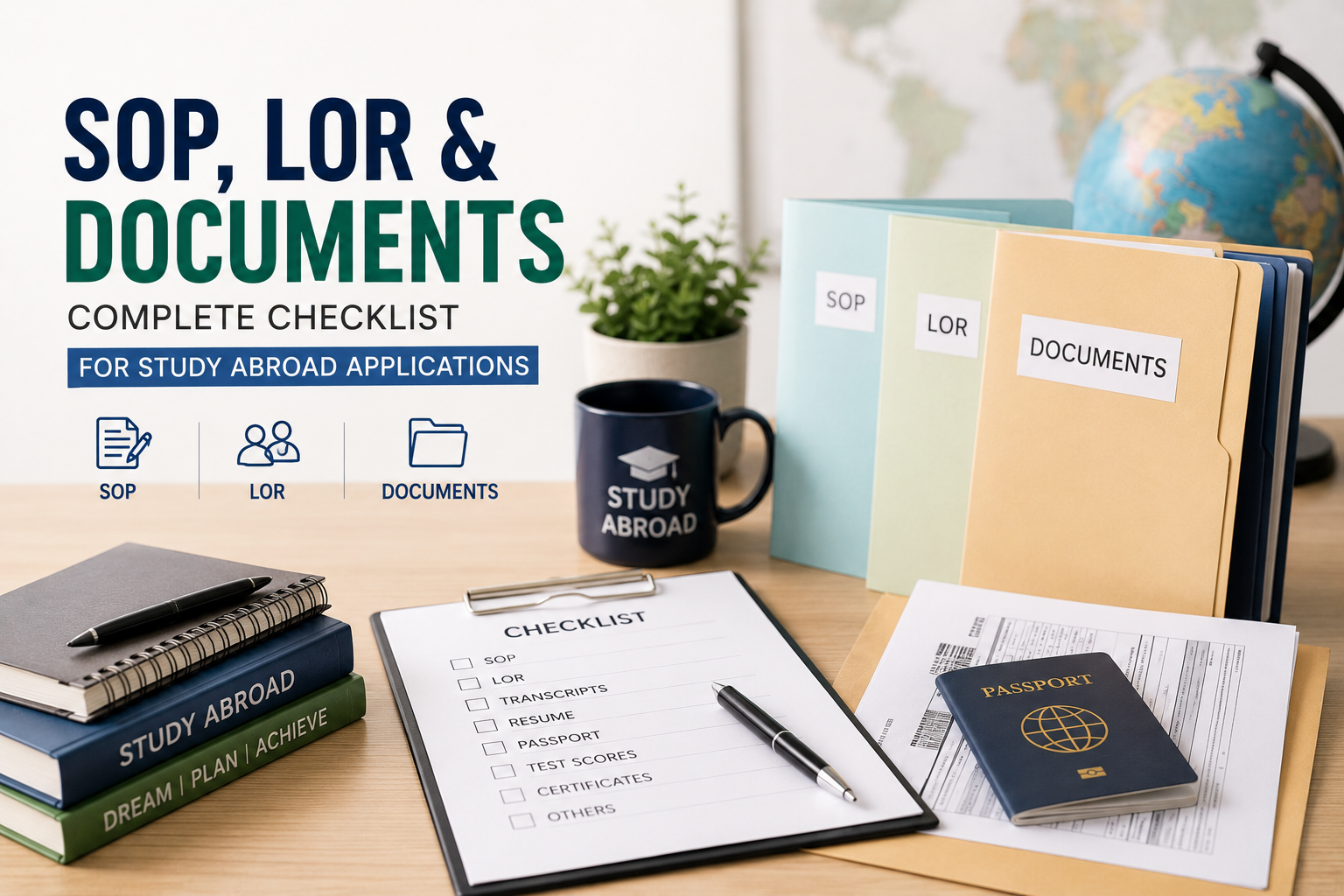
Introduction
One of the most common reasons students face delays in university applications is incomplete documentation.
Many students focus only on university selection and language tests but forget that admission applications require several important documents.
Having all documents ready in advance makes the application process smoother and less stressful.
This guide explains the most important documents every study abroad applicant should know about.
Why Documents Matter
Universities use application documents to evaluate:
- Academic performance
- Professional experience
- Communication skills
- Career goals
- Eligibility for admission
Incomplete or incorrect documentation can lead to delays or rejection.
Statement of Purpose (SOP)
The Statement of Purpose is one of the most important documents in any application.
An SOP explains:
- Academic background
- Career goals
- Reason for choosing the course
- Reason for choosing the university
- Future plans
A strong SOP should be clear, personalized, and focused on your academic journey.
Avoid copying SOPs from the internet.
Universities prefer authentic and genuine content.
Letter of Recommendation (LOR)
A Letter of Recommendation provides an external evaluation of your abilities.
Universities use LORs to understand:
- Academic strengths
- Professional skills
- Leadership qualities
- Work ethic
LORs are usually written by:
- Professors
- Project guides
- Employers
- Reporting managers
The best recommender is someone who knows your work well and can provide specific examples.
Academic Transcripts
Academic transcripts are official records of your education.
They usually include:
- Subjects studied
- Grades obtained
- Credit information
- Academic performance history
Universities use transcripts to assess your eligibility for the chosen program.
Students should ensure transcripts are clear, complete, and officially issued.
Degree Certificate
A degree certificate confirms completion of your academic program.
Some students applying during their final semester may submit provisional certificates or expected completion documents if permitted by the university.
Always check university-specific requirements.
Resume or CV
A professional resume helps admission officers understand your profile quickly.
A study abroad resume typically includes:
- Academic qualifications
- Projects
- Internships
- Work experience
- Technical skills
- Certifications
- Achievements
The resume should be concise and professionally formatted.
English Language Test Scores
Many universities require proof of English proficiency.
Commonly accepted tests include:
- IELTS
- TOEFL
- PTE
- Duolingo English Test (where accepted)
Score requirements vary depending on the university and course.
Passport
A valid passport is essential for:
- University applications
- Visa applications
- Travel arrangements
Students should check passport validity well in advance.
Work Experience Documents
For professional programs, universities may request:
- Experience letters
- Appointment letters
- Salary slips
- Employer certificates
These documents help verify professional experience.
Additional Supporting Documents
Depending on the course and university, additional documents may include:
- Portfolio
- Research proposal
- Motivation letter
- Certificates
- Publications
- Internship completion certificates
Requirements differ by program.
Common Mistakes Students Make
Missing Deadlines
Preparing documents at the last minute often causes delays.
Submitting Incorrect Files
Always verify document names, formats, and uploads before submission.
Using Generic SOPs
Universities can easily identify copied content.
Choosing Weak Recommenders
LOR quality matters more than designation.
Ignoring University Requirements
Each university may have different document requirements.
Always review official guidelines carefully.
Recommended Document Preparation Timeline
12 Months Before Intake
- Research universities
- Check document requirements
10 Months Before Intake
- Prepare for language tests
- Update resume
8 Months Before Intake
- Draft SOP
- Request LORs
6 Months Before Intake
- Collect transcripts
- Organize academic documents
4 Months Before Intake
- Submit applications
2 Months Before Intake
- Prepare visa documents
Early preparation reduces stress and improves application quality.
The Real Truth
Strong applications are not built in one week.
Students who prepare their SOP, LORs, transcripts, and supporting documents early often have a smoother admission journey.
A well-organized document checklist can save time, prevent mistakes, and improve overall application quality.
Frequently Asked Questions (FAQs)
1. What are the most important study abroad documents?
SOP, LOR, transcripts, passport, resume, and language test scores.
2. Is SOP mandatory for all universities?
Most universities require an SOP, but requirements may vary.
3. How many LORs are usually needed?
Most universities ask for two or three LORs.
4. Can I apply without a passport?
Some universities may allow applications, but a passport is required later for visa and travel processes.
5. When should I request LORs?
Ideally several months before application deadlines.
6. What is the most common application mistake?
Submitting incomplete or poorly prepared documents.
Verified by Edulx Germany Specialists
Have questions about your profile or APS verification? Book a free 1-on-1 session with our Pune counsellors.