Understanding ECTS Credits for International Students (2027 Guide)
Introduction
If you're planning to study in Germany, France, Italy, the Netherlands, Sweden, Finland, or other European countries, you've probably come across the term ECTS Credits.
Many international students ignore this term while applying, but understanding ECTS is extremely important. It affects admissions, eligibility, graduation requirements, credit transfers, and even your course selection.
This guide explains ECTS credits in simple language and why they matter for every student planning to study in Europe.
What Is ECTS?
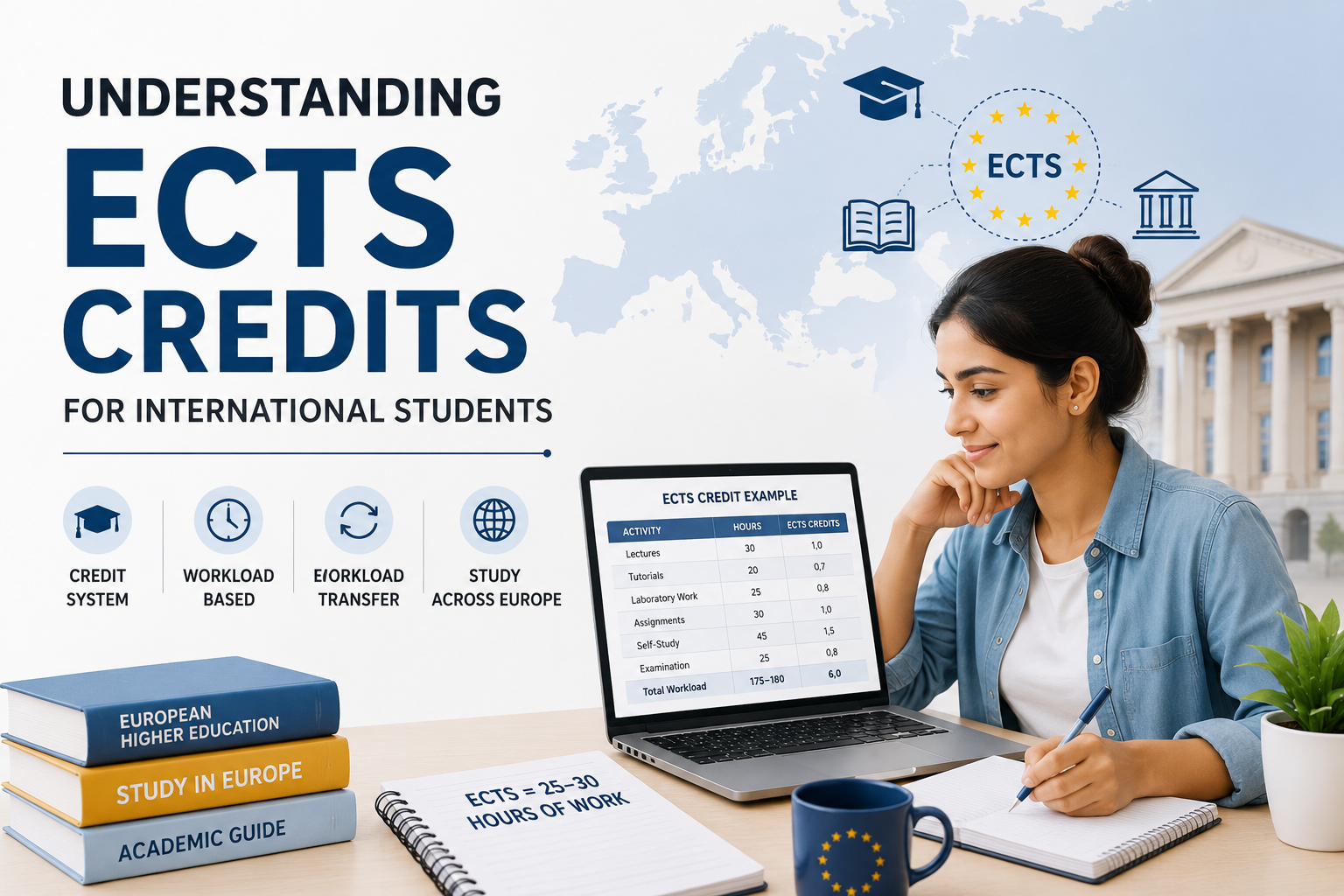
ECTS stands for European Credit Transfer and Accumulation System.
It is a standardized credit system used by most European universities to measure a student's academic workload.
Instead of only counting classroom hours, ECTS considers the total amount of work required to complete a course, including:
- Lectures
- Tutorials
- Laboratory work
- Assignments
- Self-study
- Projects
- Examinations
This system makes it easier for universities across Europe to recognize each other's courses.
Why Was ECTS Introduced?
Before ECTS, universities across Europe used different grading and credit systems.
This made student mobility and credit recognition difficult.
ECTS was introduced to:
- Standardize academic credits
- Simplify student exchange programs
- Improve recognition of qualifications
- Make degree comparisons easier across Europe
Today, it is widely used in countries participating in the European Higher Education Area (EHEA).
How Do ECTS Credits Work?
Each subject or module is assigned a specific number of credits based on the expected workload.
Generally:
- 60 ECTS = One full academic year
- 30 ECTS = One semester
- 20 ECTS = One trimester (where applicable)
The number of credits reflects the effort needed to successfully complete the course.
How Many Hours Does One ECTS Credit Represent?
Although it varies slightly by country, 1 ECTS credit usually represents approximately 25–30 hours of total student workload.
This includes:
- Classroom learning
- Practical sessions
- Independent study
- Assignments
- Exam preparation
It does not refer only to lecture hours.
Why Are ECTS Credits Important?
ECTS credits are important because they help universities determine:
- Whether you meet admission requirements
- If your previous education is equivalent
- Whether credits from another university can be transferred
- Your graduation eligibility
Many master's programs specify a minimum number of ECTS credits in certain subjects.
ECTS and Master's Admissions
Many European universities require applicants to have completed a certain number of credits in relevant subjects.
For example, a Data Science master's may require credits in:
- Mathematics
- Programming
- Statistics
- Computer Science
Similarly, a Biotechnology program may expect credits in:
- Biology
- Chemistry
- Genetics
- Biochemistry
If your bachelor's degree lacks the required credits, you may not meet the eligibility criteria.
Can Indian Students Apply Without ECTS?
Yes.
Indian universities usually do not use the ECTS system.
When you apply, the admissions committee evaluates your:
- Academic transcripts
- Course syllabus
- Subjects studied
- Credit structure
The university may internally compare your academic background with ECTS requirements.
You do not need to convert your credits yourself unless the university specifically requests it.
ECTS and Student Exchange Programs
ECTS makes international student exchanges much easier.
If you complete a semester abroad, your home university can often recognize those credits because they follow the same standardized system.
This is one of the reasons why exchange programs within Europe are so popular.
ECTS and Graduation Requirements
Every European degree has a minimum number of credits required for graduation.
For example:
Bachelor's Degree
Usually 180–240 ECTS
Master's Degree
Usually 60–120 ECTS
Doctoral Programs
PhD programs generally focus on research rather than a fixed ECTS requirement, although some coursework may still carry credits.
Common Misconceptions About ECTS
"ECTS Is the Same as Marks"
Incorrect.
ECTS measures academic workload, not grades.
"International Students Must Convert Their Credits"
Not usually.
Universities generally evaluate transcripts themselves unless they request a specific conversion.
"More Credits Mean Better Grades"
No.
Credits indicate workload, while grades measure academic performance.
"ECTS Is Used Only in Germany"
No.
ECTS is widely used across most European countries participating in the Bologna Process.
Tips for International Students
Before applying:
- Read the admission requirements carefully.
- Check whether subject-specific credits are required.
- Download the curriculum or module handbook.
- Keep your transcripts and course syllabus ready.
- Contact the admissions office if you are unsure about eligibility.
Understanding ECTS requirements early can save time and prevent application rejections.
The Real Truth
ECTS credits are not something to fear.
They are simply a standardized way for European universities to measure academic workload and compare qualifications from different countries.
For international students, understanding ECTS helps you:
- Choose suitable universities
- Check eligibility requirements
- Understand degree structures
- Plan your academic journey more effectively
Rather than ignoring ECTS, use it as a tool to make better study abroad decisions.
Frequently Asked Questions (FAQs)
1. What does ECTS stand for?
ECTS stands for the European Credit Transfer and Accumulation System.
2. How many ECTS credits are required for a bachelor's degree?
Most bachelor's degrees in Europe require 180–240 ECTS credits.
3. How many ECTS credits are needed for a master's degree?
Most master's programs require 60–120 ECTS credits, depending on the country and university.
4. Do Indian students need to convert their credits into ECTS?
Usually no. Universities evaluate Indian transcripts and compare them with their own ECTS requirements.
5. Does one ECTS credit equal one classroom hour?
No. One ECTS credit generally represents 25–30 hours of total student workload, including lectures, assignments, self-study, and exams.
6. Why are ECTS credits important?
They help universities evaluate eligibility, recognize previous education, transfer credits, and determine graduation requirements.
Verified by Edulx Germany Specialists
Have questions about your profile or APS verification? Book a free 1-on-1 session with our Pune counsellors.