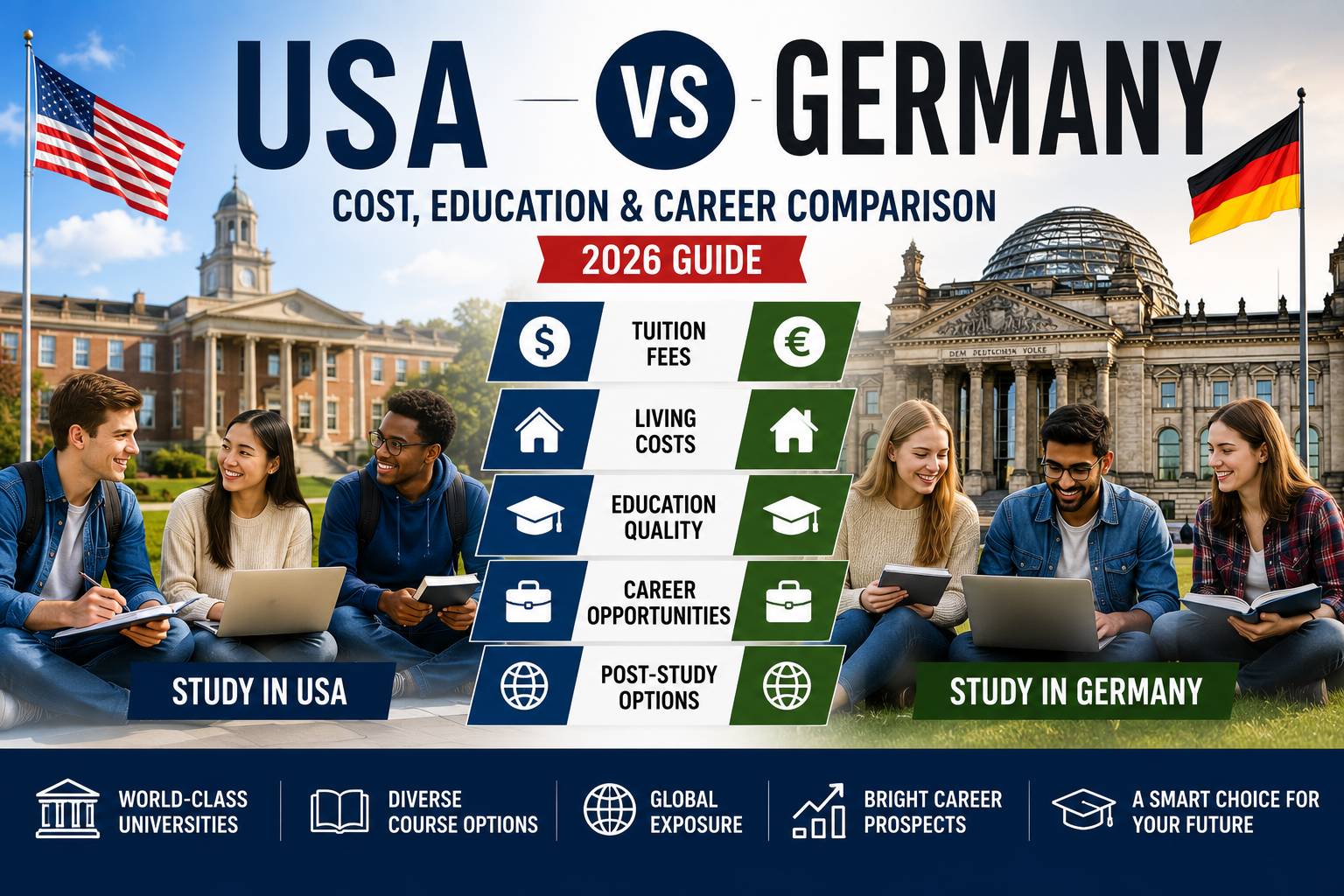
USA vs Germany: Cost, Education & Career Comparison (2026 Guide)
Introduction
The USA and Germany are two of the most popular study-abroad destinations for international students.
Both countries offer world-class universities, excellent career opportunities, and globally recognized degrees.
However, they differ significantly in terms of education costs, admission requirements, work opportunities, and lifestyle.
If you're unsure which country is the better fit for your goals, this guide compares the USA and Germany across the factors that matter most.
Education System
United States
The USA offers a flexible education system where students can often choose electives and customize their academic path.
Universities emphasize:
- Research
- Innovation
- Practical learning
- Industry collaboration
Students have access to a wide variety of programs and specializations.
Germany
Germany is known for its structured and research-oriented education system.
Many public universities offer high-quality education with a strong focus on technical knowledge and practical skills.
Engineering, science, and technology programs are particularly well regarded.
Tuition Fees
USA
Tuition fees vary widely depending on the university and program.
Private universities generally charge higher tuition than public institutions.
Students should carefully evaluate the total cost before applying.
Germany
Most public universities charge little to no tuition fees for many degree programs.
Students usually pay a semester contribution that covers administrative services and other student benefits.
Private universities charge tuition fees that vary by institution.
Living Costs
Living expenses depend on the city and lifestyle.
USA
Students should budget for:
- Accommodation
- Food
- Transportation
- Health insurance
- Personal expenses
Major cities generally have higher living costs.
Germany
Students also need to budget for:
- Rent
- Health insurance
- Food
- Transportation
- Utilities
Smaller cities are often more affordable than large metropolitan areas.
Quality of Education
Both countries provide excellent education.
USA
Strengths include:
- Global university rankings
- Research opportunities
- Innovation
- Diverse course options
Germany
Strengths include:
- Engineering excellence
- Strong public universities
- Research-based education
- Affordable access to quality education
The right choice depends on your academic interests.
Popular Courses
USA
Popular programs include:
- Computer Science
- Business Administration
- Artificial Intelligence
- Finance
- Data Science
- Medicine
Germany
Popular programs include:
- Mechanical Engineering
- Automotive Engineering
- Biotechnology
- Computer Science
- Renewable Energy
- Data Science
Internship Opportunities
Both countries encourage students to gain practical experience during their studies.
Internships help students:
- Build professional networks
- Develop practical skills
- Improve employability
Many universities have partnerships with industry.
Career Opportunities
USA
The USA has one of the world's largest job markets.
Career opportunities are available across sectors such as:
- Technology
- Finance
- Healthcare
- Research
- Business
Germany
Germany has strong demand for skilled professionals in:
- Engineering
- Manufacturing
- IT
- Automotive
- Healthcare
- Renewable Energy
Graduates often find opportunities in internationally recognized companies.
Post-Study Opportunities
Both countries offer pathways that allow eligible graduates to gain work experience after completing their studies.
The available options depend on immigration regulations and individual circumstances.
Students should always review the latest government policies before planning their careers.
Which Country Is Better for Different Students?
Choose the USA if you:
- Prefer flexible academic programs
- Want access to a wide variety of universities
- Are interested in entrepreneurship
- Plan to study business, technology, or research-intensive subjects
Choose Germany if you:
- Want affordable education
- Are interested in engineering or STEM fields
- Prefer research-focused learning
- Want to reduce tuition costs
USA vs Germany at a Glance
Feature
USA
Germany
Tuition Fees
Generally higher
Public universities are often tuition-free or low-cost
Education Style
Flexible
Structured
Research
Excellent
Excellent
Engineering
Strong
Outstanding
Business Studies
Excellent
Strong
Living Costs
Moderate to high
Moderate
English-Taught Programs
Widely available
Increasingly available
Global Recognition
Excellent
Excellent
Common Mistakes Students Make
Choosing Based Only on Cost
Affordability is important, but career goals should also influence your decision.
Ignoring Course Strengths
Some countries are particularly strong in specific academic fields.
Not Researching Visa Policies
Students should understand visa requirements before applying.
Following Friends Instead of Personal Goals
Your destination should match your own academic and career plans.
The Real Truth
There is no universal winner between the USA and Germany.
The better destination depends on your priorities.
If you value flexibility, extensive course options, and a broad range of industries, the USA may be the right choice.
If your priorities are affordable education, research excellence, and strong engineering programs, Germany is an excellent option.
Carefully compare costs, universities, career opportunities, and long-term goals before making your decision.
Frequently Asked Questions (FAQs)
1. Which country is cheaper for international students, the USA or Germany?
Germany is generally more affordable because many public universities charge little to no tuition fees.
2. Which country is better for engineering?
Germany is internationally recognized for its engineering education and strong industrial base.
3. Is the USA better for business studies?
The USA offers many globally respected business schools and a wide range of business specializations.
4. Can I study in Germany without knowing German?
Yes. Many master's programs are taught entirely in English.
5. Which country offers better job opportunities after graduation?
Both countries provide strong career opportunities, depending on your field of study and qualifications.
6. Which country should I choose?
Choose the destination that best aligns with your budget, preferred course, career goals, and long-term plans.
Verified by Edulx Germany Specialists
Have questions about your profile or APS verification? Book a free 1-on-1 session with our Pune counsellors.