What Is a Bridge Course and Who Needs It?
What Is a Bridge Course and Who Needs It? – Complete Guide
While researching universities abroad, many students come across the term "Bridge Course" or "Bridging Program."
This often raises questions such as:
- What exactly is a bridge course?
- Is it compulsory?
- Will I need one?
- Does it increase my chances of admission?
The good news is that bridge courses are not required for every student. They are designed for specific situations where an applicant needs additional academic preparation before beginning a degree program.
Let's understand what bridge courses are and who can benefit from them.
What Is a Bridge Course?
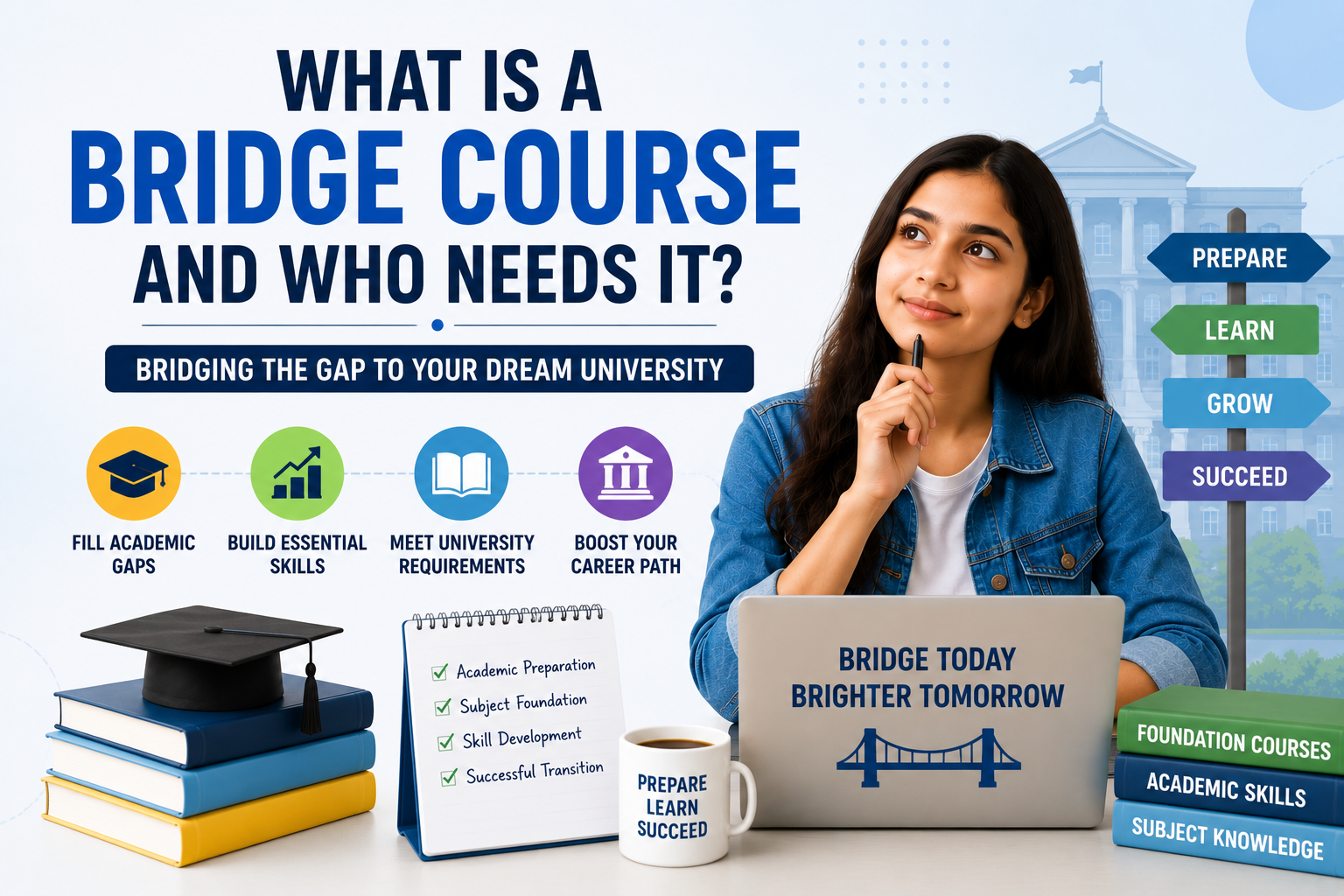
A bridge course is a short academic program that helps students gain the knowledge or skills required for a university degree.
Its purpose is to bridge the gap between your previous education and the requirements of your chosen program.
Bridge courses usually focus on:
- Academic subjects
- Technical skills
- Language preparation
- Study skills
- Foundation knowledge
They are commonly offered before students begin their main degree.
Why Do Universities Offer Bridge Courses?
Universities want students to be prepared for the academic demands of their programs.
Sometimes an applicant is highly motivated but may be missing:
- Certain prerequisite subjects
- Required academic credits
- Technical knowledge
- Language proficiency
- Local education equivalency
Instead of rejecting the application immediately, some universities offer a bridge course to help the student become eligible.
Who Needs a Bridge Course?
Not every international student requires a bridge course.
However, it may be recommended in the following situations.
1. Students Missing Required Subjects
Some master's programs require specific undergraduate coursework.
For example:
A Data Science program may require:
- Programming
- Mathematics
- Statistics
If your bachelor's degree did not include enough of these subjects, a bridge course may help you meet the requirement.
2. Students Changing Their Academic Field
Many students wish to change careers.
Examples include:
- Mechanical Engineering to Data Science
- Civil Engineering to Project Management
- Commerce to Business Analytics
- Biology to Bioinformatics
If your previous education differs significantly from your chosen field, a bridge course can provide the necessary foundation.
3. Students With Academic Gaps
Some applicants may have been away from formal education for several years.
A bridge course helps refresh important concepts before starting advanced studies.
This is especially useful for working professionals returning to higher education.
4. Students Needing Language Preparation
Some universities offer bridge programs focused on:
- Academic English
- Writing skills
- Research communication
These courses help students succeed in English-medium classrooms.
5. Students From Different Education Systems
Education systems vary from country to country.
Sometimes universities require additional preparation to ensure students meet local academic standards.
Bridge courses can help students transition smoothly into a new educational environment.
What Subjects Are Taught in a Bridge Course?
The curriculum depends on the degree and university.
Common subjects include:
Technology Programs
- Programming Fundamentals
- Mathematics
- Databases
- Statistics
Engineering Programs
- Engineering Mathematics
- Physics
- Mechanics
- Technical Computing
Business Programs
- Economics
- Accounting
- Business Statistics
- Management Principles
Healthcare Programs
- Human Biology
- Medical Terminology
- Basic Health Sciences
The content is designed to prepare students for the main degree program.
How Long Does a Bridge Course Last?
Bridge courses are generally shorter than regular degree programs.
They may last:
- A few weeks
- Two to three months
- One semester
- Up to one academic year
The duration depends on the university and the level of preparation required.
Are Bridge Courses Mandatory?
Not always.
Some universities make bridge courses:
Mandatory
Students must successfully complete the course before starting the degree.
Recommended
Students can choose whether to take the course based on their academic background.
Always read the admission offer carefully to understand the university's requirements.
Benefits of a Bridge Course
A bridge course offers several advantages.
Better Academic Preparation
Students begin their degree with stronger foundational knowledge.
Increased Confidence
Understanding key concepts before classes start can reduce academic stress.
Improved Admission Opportunities
Bridge programs may allow students to qualify for courses they would otherwise be ineligible for.
Easier Transition
Students become familiar with:
- University teaching methods
- Academic expectations
- Assessment styles
before beginning the main program.
Does Completing a Bridge Course Guarantee Admission?
Not necessarily.
Admission policies vary.
Some universities offer:
- Conditional admission followed by a bridge course.
Others require students to:
- Successfully complete the bridge program before full admission.
Always check the university's official admission conditions.
Common Misconceptions
"Bridge Courses Are Only for Weak Students."
False.
Many capable students take bridge courses simply because they are changing fields or coming from different education systems.
"Bridge Courses Delay Graduation."
Sometimes they extend the study period slightly, but they can also improve academic success and reduce the risk of struggling later.
"Every International Student Needs One."
Most students do not require a bridge course.
Only applicants with specific academic gaps or eligibility issues are usually asked to complete one.
How Do You Know If You Need One?
You may need a bridge course if:
- Your degree does not fully match the program requirements.
- Required subjects are missing.
- The university specifically mentions a bridging program in the admission offer.
- Your education system differs significantly from the university's expectations.
If you're unsure, contact the admissions office for clarification.
Tips Before Applying
Before submitting your application:
✅ Read the admission requirements carefully.
✅ Compare your coursework with the required subjects.
✅ Check whether prerequisite credits are needed.
✅ Review the curriculum of your chosen program.
✅ Ask the university if you are unsure about your eligibility.
Being proactive can help you avoid surprises later.
Final Conclusion
A bridge course is designed to help students build the academic foundation needed for success in a university program.
It is not a sign of weakness or failure. Instead, it is an opportunity to strengthen your knowledge, meet admission requirements, and prepare for advanced study.
If a university recommends a bridge course, view it as a stepping stone rather than an obstacle.
With the right preparation, a bridge course can open the door to degree programs that may otherwise seem out of reach.
Verified by Edulx Germany Specialists
Have questions about your profile or APS verification? Book a free 1-on-1 session with our Pune counsellors.