What Is a Modulhandbuch in Germany? How to Read It Before Applying
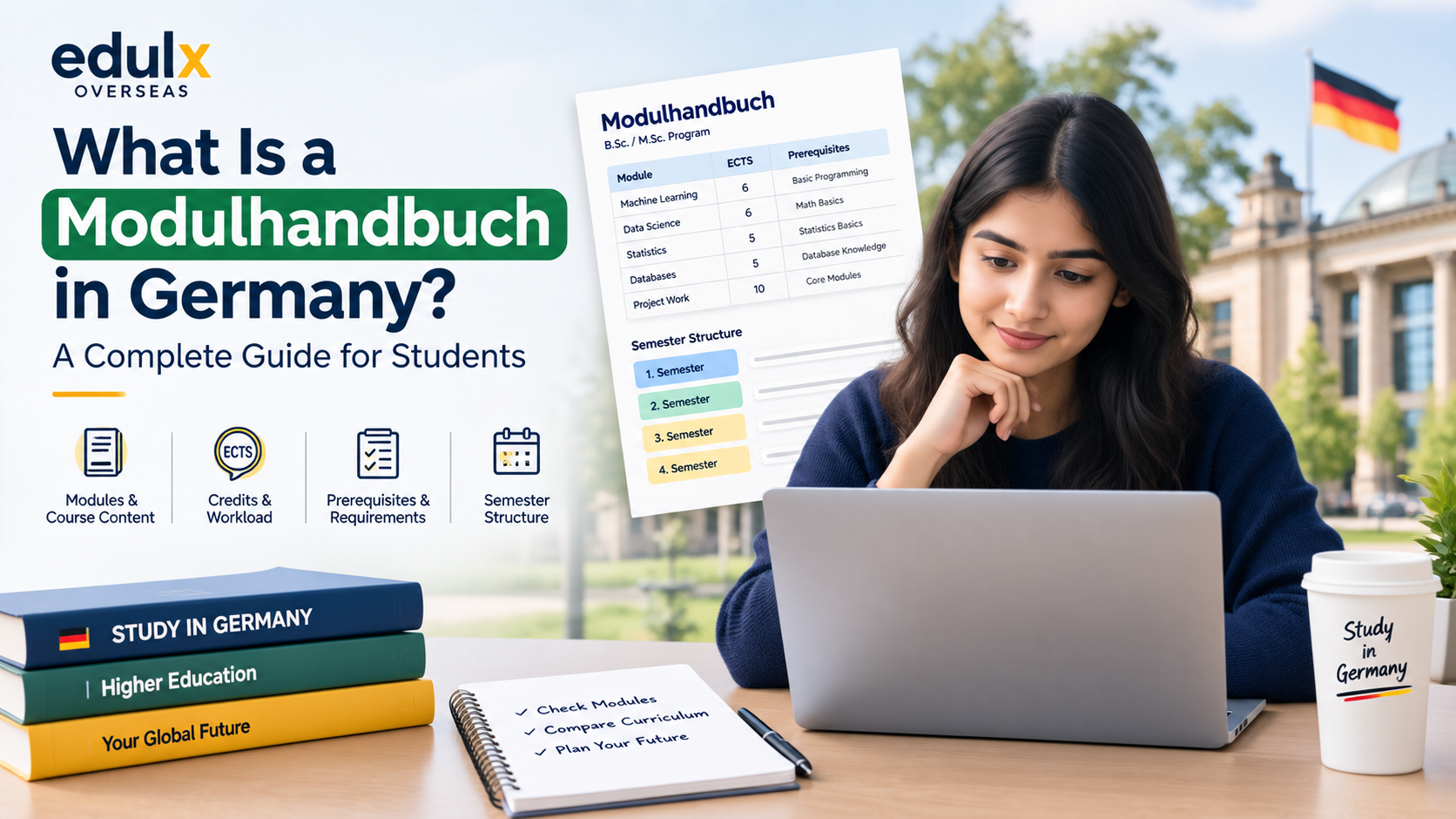
What Is a Modulhandbuch in Germany?
When students search for Master's programmes in Germany, they often look at the university name, ranking, tuition fees, admission requirements and career opportunities.
But there is another document that deserves just as much attention:
The Modulhandbuch.
A Modulhandbuch, or module handbook, is a university document that provides detailed information about the modules or courses included in a study programme.
According to uni-assist, a module handbook generally contains information about course content, learning objectives, workload and course requirements.
In simple words:
"The programme page tells you what degree you are applying for. The Modulhandbuch helps you understand what you will actually study."
For students applying to German universities, this can be extremely useful when comparing similar programmes.
Why Should Students Read the Modulhandbuch?
Two Master's programmes can have almost identical names but completely different academic content.
For example, consider these hypothetical programmes:
MSc Data Science
Programme A may focus heavily on:
- Machine Learning
- Artificial Intelligence
- Statistics
- Deep Learning
- Data Mining
Programme B may focus more on:
- Business Analytics
- Data Visualisation
- Business Intelligence
- Management
- Digital Transformation
Both may be called Data Science, but they can lead to very different academic experiences.
The Modulhandbuch allows you to look beyond the programme title.
This is particularly important when you are trying to determine:
- Whether the course matches your Bachelor's background
- Whether the subjects match your career goals
- Whether you meet prerequisite requirements
- Whether the programme is technical or management-oriented
- How many credits are assigned to different modules
- Whether electives are available
- What you will study semester by semester
What Information Does a Modulhandbuch Usually Contain?
The exact format varies by university, but a Modulhandbuch can contain detailed information about individual modules.
Common information includes:
1. Module Name
This is the title of the subject or module.
Examples might include:
- Machine Learning
- Financial Management
- Advanced Programming
- Molecular Biology
- Digital Marketing
- Computer Vision
2. Module Description
This section explains what the module covers.
It can help you understand whether a subject is introductory, intermediate or advanced.
For example, a module called Advanced Machine Learning may cover topics such as model optimisation, neural networks or advanced statistical methods.
The title alone may not tell you enough.
The description provides more context.
3. Learning Objectives
Learning objectives explain what students are expected to know or be able to do after completing the module.
This is particularly useful when comparing courses.
For example, a module may aim to help students:
- Develop machine-learning models
- Analyse datasets
- Understand statistical methods
- Design experiments
- Apply theoretical concepts to real-world problems
This gives you a better idea of the academic depth of the programme.
4. ECTS Credits
Many German and European university programmes use ECTS credits to represent the workload associated with study modules.
A Modulhandbuch usually indicates how many credits each module carries.
For example:
Machine Learning — 6 ECTS
Statistics — 5 ECTS
Data Mining — 6 ECTS
Master's Thesis — 30 ECTS
This can help you understand how the overall programme is structured.
It also becomes useful when comparing your academic background with programme-specific requirements.
5. Workload
A module handbook may also specify the expected workload for a module.
This can include:
- Contact hours
- Self-study
- Preparation
- Assignments
- Examination preparation
For example, a module may have a workload of several hundred hours while awarding a certain number of ECTS credits.
This helps students understand that university workload is not limited to classroom hours.
6. Teaching and Learning Methods
The Modulhandbuch may explain how a particular module is taught.
Depending on the programme, this can include:
- Lectures
- Seminars
- Tutorials
- Laboratory sessions
- Projects
- Practical exercises
- Group work
This can give you an idea of whether a programme is primarily theoretical, practical or project-oriented.
7. Examination or Assessment Method
A module may be assessed through different methods.
For example:
- Written examination
- Oral examination
- Project
- Presentation
- Seminar paper
- Practical assessment
- Portfolio
This can help students understand how they will actually be evaluated.
A programme with many project-based modules can feel very different from one that relies heavily on written examinations.
8. Prerequisites
Some modules may specify prerequisites or recommended prior knowledge.
This is particularly important for Master's applicants.
For example, an advanced programming module may expect students to already understand:
- Programming fundamentals
- Algorithms
- Data structures
- Object-oriented programming
Similarly, an advanced statistics module may expect prior knowledge of:
- Probability
- Statistics
- Linear algebra
- Calculus
These details can help you identify whether the programme is realistically suited to your academic background.
How Is a Modulhandbuch Different From a Course Page?
This is one of the most important distinctions.
University Course Page
Usually provides:
- Programme name
- Degree awarded
- Duration
- Admission requirements
- Language
- Application information
- Career information
- General programme overview
Modulhandbuch
Usually provides much more detailed academic information about individual modules.
It may tell you:
- What subjects you will study
- What each module covers
- Learning objectives
- Workload
- ECTS
- Assessment method
- Prerequisites
- Teaching format
So students should ideally use both.
Do not replace the official programme page with the Modulhandbuch.
Use them together.
How to Find the Modulhandbuch
The document may be available under different names depending on the university.
Search the university website for terms such as:
- Modulhandbuch
- Module Handbook
- Module Manual
- Module Catalogue
- Course Catalogue
- Studiengang
- Module description
Some universities provide the Modulhandbuch directly on the programme page.
Others may place it under:
Study Programme → Documents → Downloads
or
Faculty → Degree Programme → Examination Regulations / Documents
The exact structure differs from university to university.
Modulhandbuch vs Study Plan
Students may also encounter another document called a:
Studienverlaufsplan
or study plan.
The two documents can be related but are not necessarily identical.
A study plan generally helps you understand when modules are expected to be taken.
For example:
Semester 1
- Statistics
- Programming
- Data Management
Semester 2
- Machine Learning
- Data Mining
- Elective
Semester 3
- Advanced Analytics
- Elective
- Project
Semester 4
- Master's Thesis
The Modulhandbuch can then provide detailed information about each of those modules.
So think of it this way:
Study plan = When you study it
Modulhandbuch = What the module contains
How to Read a Modulhandbuch Before Applying
You do not need to read every page randomly.
Use a structured approach.
Step 1: Start With the Programme Name
Confirm:
- Exact degree title
- Degree level
- Subject area
- Duration
- Language of instruction
Make sure you are looking at the correct programme and not an older document.
Step 2: Look at the Core Modules
Identify the compulsory modules.
These tell you what the university considers essential to the programme.
For example, if you are applying for an MSc in Artificial Intelligence, check whether the core curriculum actually contains subjects such as:
- Machine Learning
- Artificial Intelligence
- Algorithms
- Deep Learning
- Data Mining
Do not assume these subjects are included just because the programme has "AI" in its title.
Step 3: Check the Electives
Electives can significantly affect your study experience.
Look for:
- Number of elective credits
- Available elective modules
- Specialisation options
- Whether electives are restricted to certain areas
A programme with a large elective component may allow you to customise your Master's degree around your career goals.
Step 4: Check Prerequisites
This is especially important for international students.
Look for terms such as:
- Prerequisite
- Recommended prior knowledge
- Required knowledge
- Entry requirements
- Previous knowledge
Then compare them with your Bachelor's curriculum.
For example, if a Master's programme contains advanced control systems and expects previous coursework in control engineering, a Mechanical Engineering student should check their own Bachelor's transcript carefully.
Step 5: Compare the Modules With Your Bachelor's
This is one of the most useful ways to use a Modulhandbuch.
Suppose you completed a Bachelor's degree in Computer Engineering.
Your transcript may include:
- Programming
- Data Structures
- Algorithms
- Database Systems
- Computer Networks
- Operating Systems
Now compare these subjects with the Master's programme requirements.
You can identify:
Strong match
Your previous studies directly cover the expected background.
Partial match
You have related subjects but may be missing some specific areas.
Weak match
The Master's programme expects substantial prior coursework that is not present in your Bachelor's degree.
This comparison can help you avoid applying blindly.
Step 6: Look at the ECTS Distribution
Do not only count the total ECTS of the programme.
Look at where those ECTS are allocated.
For example:
Computer Science Master's
- Core Computer Science — 30 ECTS
- AI — 20 ECTS
- Mathematics — 10 ECTS
- Electives — 20 ECTS
- Project — 10 ECTS
- Thesis — 30 ECTS
This tells you much more about the academic focus than the programme title.
Step 7: Check the Master's Thesis
The thesis can represent a significant portion of the programme.
Check:
- Number of ECTS
- When students begin the thesis
- Whether a research project is required
- Whether industry projects are possible
- Whether a specific module is required before starting
For students interested in research or PhD studies, this can be particularly important.
Step 8: Look for Practical Components
Students who want industry-oriented programmes should look for:
- Projects
- Labs
- Internships
- Industry projects
- Practical seminars
- Capstone projects
A programme can be technically strong but still be highly theoretical.
The Modulhandbuch can help you identify the balance.
How Indian Students Can Use a Modulhandbuch
For Indian applicants, the Modulhandbuch can be particularly useful when assessing academic compatibility.
Consider a student with a Bachelor's degree in:
Mechanical Engineering
who wants to apply for:
MSc Automotive Engineering
The student should compare:
Bachelor's Background
- Thermodynamics
- Fluid Mechanics
- Manufacturing
- Vehicle Engineering
- Mechanics
- Control Systems
Master's Programme
- Vehicle Dynamics
- Automotive Control
- Advanced Manufacturing
- Simulation
- Mechatronics
This comparison provides a much stronger understanding of academic fit than simply checking whether both programme names contain the word "Automotive."
Can the Modulhandbuch Help With Admission Eligibility?
Yes, but with an important limitation.
The Modulhandbuch can help you understand and assess academic fit, but it does not replace the university's official admission requirements.
A university may separately specify:
- Required Bachelor's degree
- Minimum credits in a particular subject
- Mathematics credits
- Programming credits
- Engineering credits
- Specific academic background
- Minimum grade
- Language requirements
- Other admission criteria
Therefore:
Admission requirements + transcript + Modulhandbuch
should be considered together.
Do not use the Modulhandbuch alone to conclude that you are eligible.
Why Module Titles Can Be Misleading
A common mistake is to compare subjects only by their names.
For example:
Statistics
in one university may focus on:
- Probability
- Statistical inference
- Regression
while another module with the same name may focus more on:
- Business statistics
- Data interpretation
- Applied analytics
Similarly:
Artificial Intelligence
could mean different things across programmes.
Always read the actual module description and learning objectives.
What If the Modulhandbuch Is in German?
Do not automatically reject a programme because the Modulhandbuch is written in German.
German universities may provide programme documents in German even when the degree itself is taught in English.
If you cannot understand the document completely, focus first on:
- Module names
- ECTS
- Prerequisites
- Workload
- Examination format
- Learning objectives
For important admission decisions, students should verify the interpretation with the university rather than relying entirely on machine translation.
Common Mistakes Students Make
1. Looking Only at University Rankings
A highly ranked university does not automatically mean the specific programme is right for your academic background.
2. Applying Based Only on the Course Name
"Data Science", "AI", "Business Analytics" and "Computer Science" can have very different curricula.
3. Ignoring Prerequisites
A programme may expect previous coursework that your Bachelor's degree does not contain.
4. Looking Only at Total ECTS
The distribution of ECTS across subjects can matter much more than the total.
5. Ignoring Electives
Electives can determine whether you can specialise in your preferred area.
6. Not Checking the Latest Version
Universities can update programme structures and module descriptions.
Always verify that you are reading the current official document.
7. Treating the Modulhandbuch as the Admission Letter
A module handbook describes the academic programme. It does not guarantee admission.
A Simple Modulhandbuch Evaluation Checklist
Before applying to a German Master's programme, check:
Exact programme name
Degree awarded
Language of instruction
Core modules
Elective modules
ECTS per module
Total programme ECTS
Prerequisites
Recommended previous knowledge
Learning objectives
Examination methods
Workload
Practical/project components
Internship requirements
Master's thesis requirements
Semester-wise structure
Match with your Bachelor's transcript
Current version/date of the document
Modulhandbuch Example
Imagine you are considering an MSc in Data Science.
The programme title looks perfect.
But after checking the Modulhandbuch, you discover:
Core modules:
- Advanced Statistics — 10 ECTS
- Machine Learning — 10 ECTS
- Mathematical Foundations — 10 ECTS
Electives:
- Deep Learning — 5 ECTS
- Computer Vision — 5 ECTS
- Business Analytics — 5 ECTS
Your Bachelor's degree contains:
- Programming — 6 ECTS
- Database Systems — 6 ECTS
- Statistics — 3 ECTS
- Mathematics — 4 ECTS
Now you can see that the programme may require a much stronger mathematics and statistics background than you initially expected.
This does not automatically mean you are ineligible.
But it tells you that you need to carefully check the official admission requirements before applying.
Modulhandbuch vs Admission Requirements vs Transcript
These three documents answer different questions.
Admission Requirements
"What does the university require from applicants?"
Transcript
"What have I already studied?"
Modulhandbuch
"What will I study in this programme?"
Together, they provide a much clearer picture.
For a serious university shortlist, students should ideally compare all three.
Should You Read the Modulhandbuch for Every University?
If you are seriously considering applying, yes—at least for your final shortlist.
You do not necessarily need to read a 100-page document word-for-word.
Instead, focus on:
- Core modules
- Prerequisites
- ECTS distribution
- Electives
- Practical components
- Thesis
- Semester structure
This can save you from applying to programmes that look suitable on paper but are academically very different from what you expected.
How Edulx Can Help
At Edulx Overseas, course selection should go beyond simply checking university names and rankings.
Students can get support with:
- Profile evaluation
- University shortlisting
- Course comparison
- Curriculum analysis
- Eligibility checking
- Admission requirement review
- Application support
- SOP and LOR guidance
- Visa documentation and guidance
- Scholarship guidance
- Accommodation support
- Pre-departure and post-arrival assistance
A good shortlist should answer one important question:
"Is this programme actually right for my academic background and career goal?"
Reading the Modulhandbuch is one of the most effective ways to start answering that question.
FAQs
What is a Modulhandbuch?
A Modulhandbuch is a university document containing detailed information about modules in a study programme, including areas such as course content, learning objectives, workload and requirements.
Is Modulhandbuch the same as a syllabus?
They are closely related. A Modulhandbuch is essentially a detailed collection of module or course descriptions for a study programme.
Is the Modulhandbuch important for Master's applicants?
Yes. It can help Master's applicants understand the academic content of the programme and compare it with their Bachelor's background.
Does a Modulhandbuch show admission requirements?
Not necessarily. Some documents may mention prerequisites or required previous knowledge, but the official programme admission requirements should always be checked separately.
Can I use the Modulhandbuch to check whether I am eligible?
It can help you assess academic fit, but it should not be used alone to determine eligibility.
Does every German university publish a Modulhandbuch?
The format and availability vary by university and programme. Students should check the official university website for the relevant programme documents.
Is Modulhandbuch available in English?
Sometimes. Some German universities provide English-language module information, while others may publish documents primarily in German.
What should I check first in a Modulhandbuch?
Start with the core modules, prerequisites, ECTS distribution, electives and semester structure. Then compare them with your previous academic background.
Final Takeaway
Choosing a Master's programme in Germany should not be based only on the university name, ranking or programme title.
The Modulhandbuch gives you a closer look at what you will actually study.
Before applying, compare:
Your Bachelor's transcript → Admission requirements → Modulhandbuch → Career goals
This approach can help you identify programmes that genuinely match your academic background and avoid applications based only on attractive course titles.
For international students, especially those comparing multiple German universities, learning how to read a Modulhandbuch can make the university-shortlisting process much more informed and practical.
Verified by Edulx Germany Specialists
Have questions about your profile or APS verification? Book a free 1-on-1 session with our Pune counsellors.