What Is ECTS and How Does It Work for International Students?
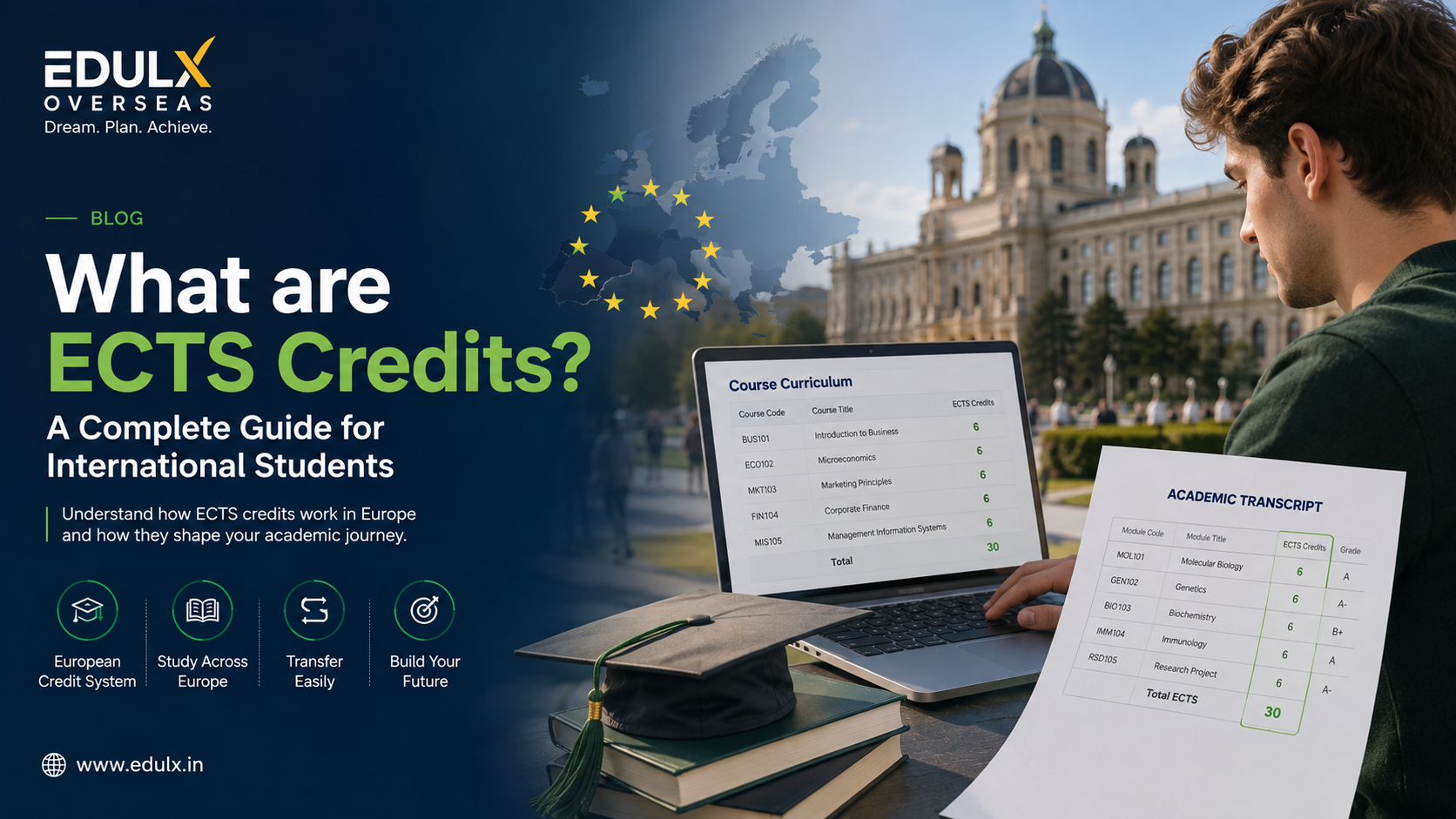
What Is ECTS and How Does It Work for International Students?
When students start researching universities in Europe, they often come across a term that appears on almost every university course page:
ECTS.
You may see programs described as:
- 180 ECTS Bachelor's degree
- 120 ECTS Master's degree
- 30 ECTS per semester
- 6 ECTS course
- Minimum 60 ECTS in a particular subject area
For students from India and other education systems, these numbers can initially be confusing.
What exactly does 60 ECTS mean?
Is one ECTS the same as one Indian university credit?
Does a 180 ECTS degree mean 180 subjects?
And why do universities mention ECTS when explaining admission requirements?
Understanding ECTS can make it much easier to compare European programs and determine whether your previous academic background meets a university's requirements.
This guide explains what ECTS means, how the system works, and what international students should check before applying to European universities.
What Does ECTS Stand For?
ECTS stands for European Credit Transfer and Accumulation System.
It is a credit system used across the European Higher Education Area to help make academic workloads and qualifications easier to understand and compare between institutions.
ECTS is particularly useful when students:
- Move between universities
- Study in another European country
- Transfer academic credits
- Apply for Master's programs
- Participate in exchange programs
- Compare degree structures
Instead of looking only at the number of subjects completed, universities can use ECTS to describe the overall academic workload associated with a program.
How Many ECTS Credits Are in a Degree?
A common full-time academic structure is:
60 ECTS = approximately one academic year
Therefore, a typical:
3-year Bachelor's degree = 180 ECTS
and
2-year Master's degree = 120 ECTS
A four-year Bachelor's degree may commonly correspond to:
240 ECTS
However, degree structures can vary depending on the country, institution, program, and qualification.
Students should always check the official program information rather than assuming that every degree follows exactly the same structure.
What Does One ECTS Credit Mean?
ECTS credits are designed to represent student workload, rather than simply the number of classroom hours.
Workload can include:
- Lectures
- Tutorials
- Laboratory sessions
- Assignments
- Projects
- Independent study
- Exam preparation
- Examinations
- Other academic activities
A commonly used ECTS framework associates 60 ECTS with the workload of one full-time academic year.
This means that ECTS should not be interpreted as:
1 ECTS = 1 subject
or
1 ECTS = 1 classroom hour.
Neither assumption is correct.
The number of ECTS attached to a course represents its expected workload within the overall academic program.
Why Do European Universities Use ECTS?
One of the biggest advantages of ECTS is comparability.
Imagine a student has completed undergraduate studies in India and wants to apply for a Master's program in Germany.
The German university may need to determine whether the student's previous education covers enough relevant academic content.
Instead of simply asking:
“How many subjects did you study?”
the university may also evaluate:
- Total credits
- Relevant credits
- Subject areas
- Academic level
- Course content
- Learning outcomes
- Duration of previous study
ECTS can therefore make academic qualifications easier to compare within European higher education.
ECTS and the European Bachelor's Degree
A typical European Bachelor's degree may consist of around:
180 ECTS
over three years.
A simplified structure could look like:
Year 1
60 ECTS
Year 2
60 ECTS
Year 3
60 ECTS
Total
180 ECTS
However, some Bachelor's programs may require more credits depending on the country's degree structure and the specific qualification.
For example, a four-year Bachelor's program may be structured around:
240 ECTS
Therefore, students should never judge a program only by its duration.
Check both:
Program duration + total ECTS
ECTS and Master's Degrees
Many European Master's programs are structured around:
90 ECTS or 120 ECTS
depending on the program and national education system.
A common two-year Master's structure is:
60 ECTS + 60 ECTS = 120 ECTS
These credits may include:
- Core modules
- Elective modules
- Projects
- Laboratory work
- Research
- Internship
- Thesis
The exact distribution differs between universities.
Some programs may place a significant number of credits on the Master's thesis, while others distribute credits across coursework, research projects, and practical components.
What Is a 6 ECTS Course?
You may see individual modules listed as:
- 3 ECTS
- 5 ECTS
- 6 ECTS
- 9 ECTS
- 12 ECTS
These numbers represent the relative academic workload of the module.
For example:
Course A — 6 ECTS
may involve more academic workload than:
Course B — 3 ECTS
But this does not necessarily mean Course A is twice as difficult.
ECTS primarily describes workload within the program structure.
Is ECTS the Same as Indian University Credits?
This is one of the most important questions for Indian students.
Not necessarily.
Indian universities and European universities may use different credit systems, definitions, workload calculations, and academic structures.
Therefore, students should not automatically assume that:
1 Indian credit = 1 ECTS
or that they can directly convert credits using one universal formula.
Universities may evaluate previous education using their own academic assessment procedures.
They may consider:
- Subject content
- Contact hours
- Credits
- Academic level
- Learning outcomes
- Degree duration
- Relevant coursework
- Official transcripts
The safest approach is to follow the specific university's stated admission requirements.
Why ECTS Matters for Master's Admission
ECTS becomes especially important when applying for a Master's degree.
A university may specify requirements such as:
“Applicants must have completed a Bachelor's degree with a certain number of credits in Computer Science.”
Or:
“Applicants must have a specified number of credits in mathematics.”
This means that having the required overall Bachelor's degree may not automatically make you eligible.
The university may examine subject-specific credits.
For example, an applicant may have:
- 180 total credits
- But insufficient mathematics credits
In that situation, the applicant may not satisfy the specific academic requirement.
This is why students should read the academic prerequisites, not just the minimum degree requirement.
ECTS Requirements in Course Prerequisites
Suppose a Master's program lists the following requirement:
Minimum 15 ECTS in Mathematics
This does not simply mean:
“You need a Bachelor's degree.”
The university is looking for evidence that your previous studies included sufficient mathematics-related coursework.
Your transcript may therefore be reviewed to determine whether subjects such as:
- Calculus
- Linear Algebra
- Probability
- Statistics
- Discrete Mathematics
- Numerical Methods
meet the university's definition of relevant mathematics coursework.
The exact interpretation depends on the university.
ECTS and Indian Students Applying to Germany
ECTS is particularly important for students researching German universities.
Many German universities describe Bachelor's and Master's programs using ECTS.
Admission requirements may include:
- Specific ECTS in a subject
- Minimum number of credits in a discipline
- Relevant Bachelor's coursework
- Specific modules
- Required academic background
Therefore, Indian students should compare their transcript and detailed course content against the university's requirements.
Do not look only at your total percentage or CGPA.
Why Your Transcript Is Important
Your academic transcript can become very important when a university evaluates your previous education.
A transcript may show:
- Subject names
- Grades
- Credits
- Semester information
- Course codes
- Academic year
- Practical/laboratory components
If the university requires a certain number of credits in a specific field, the admissions team may use your transcript to assess whether you meet the requirement.
This is one reason students should keep official academic documents properly organised before beginning applications.
What Is a Diploma Supplement?
Students in Europe may also come across the term Diploma Supplement.
A Diploma Supplement provides additional information about a higher education qualification, such as:
- Nature of the qualification
- Level of the qualification
- Academic context
- Content
- Results
- Status of the institution
It can make qualifications easier to understand internationally.
International students from outside Europe may not have a document with exactly the same format, but universities can still use transcripts, degree certificates, course descriptions, and other official academic documents to evaluate previous studies.
ECTS and Credit Transfer
ECTS is also useful when students move between academic institutions.
For example, a student studying at one European university may complete certain modules and later continue studies at another institution.
ECTS can help institutions understand:
What has the student already completed?
However, credit transfer is not automatic.
The receiving university decides whether previously completed coursework can be recognised toward the new qualification.
Students should therefore check the institution's credit-transfer policy.
Can You Transfer Indian Credits Into ECTS?
There is no universal conversion rule that applies to every Indian university and every European university.
A university may evaluate your previous credits based on its own criteria.
The assessment can consider:
- Credit system used by your institution
- Course workload
- Subject content
- Degree level
- Learning outcomes
- Academic duration
- Official documentation
Therefore, avoid relying on online “ECTS conversion calculators” when making an important application decision.
The university's official assessment is what ultimately matters for admission.
ECTS vs Course Duration
Students sometimes assume:
More ECTS = Longer course
This is not always how the system should be interpreted.
ECTS describes academic workload within a qualification.
Two programs with the same duration can have different structures.
For example:
Program A: 120 ECTS over 2 years
Program B: 90 ECTS over 2 years
Both may have two-year durations, but their academic structures can differ.
Always examine:
- Total ECTS
- Semester structure
- Core modules
- Electives
- Thesis
- Internship
- Practical training
ECTS and Master's Thesis
The Master's thesis can represent a significant portion of the total ECTS.
For example, a program could theoretically structure its 120 ECTS across:
- Coursework
- Research project
- Internship
- Thesis
The exact allocation varies.
A thesis carrying 30 ECTS, for example, represents a substantial part of a 120 ECTS Master's program.
This does not mean the thesis is “30 subjects.”
It represents the expected workload associated with the research and thesis component.
How to Check ECTS on a University Website
Before applying, follow these steps.
Step 1: Open the Official Program Page
Find the exact degree you want to study.
Step 2: Look for Program Structure
Search for terms such as:
- ECTS
- Credits
- Curriculum
- Study plan
- Modules
- Course structure
- Semester plan
Step 3: Check Total Credits
Confirm whether the program is:
- 180 ECTS
- 210 ECTS
- 240 ECTS
- 90 ECTS
- 120 ECTS
- Or another structure
Step 4: Check Admission Requirements
Look specifically for:
Required ECTS in particular subjects.
Step 5: Compare Your Transcript
Identify the subjects and credits from your previous qualification that may correspond to the requirement.
Step 6: Read the University's Definition
If the requirement is unclear, contact the university's admissions office.
Example: Understanding an ECTS Requirement
Imagine a Master's program states:
Bachelor's degree with at least 180 ECTS or equivalent
and additionally requires:
20 ECTS in Mathematics
and
15 ECTS in Programming
An applicant might have a Bachelor's degree that is academically relevant but only have:
- 12 ECTS Mathematics
- 10 ECTS Programming
Even though the overall Bachelor's degree may appear suitable, the student could still fail to meet the specific prerequisite.
This is why students should analyse both overall qualification requirements and subject-specific credit requirements.
Common ECTS Mistakes Students Make
Mistake 1: Assuming 1 Credit = 1 ECTS
Different education systems can define credits differently.
Mistake 2: Looking Only at Total Credits
A university may require specific credits in particular subjects.
Mistake 3: Ignoring Course Content
Two courses can have similar names but different academic content.
Mistake 4: Assuming Credit Conversion Is Automatic
The receiving university may conduct its own evaluation.
Mistake 5: Checking Only the Course Duration
A two-year program does not tell you everything about its academic structure.
Mistake 6: Relying on Third-Party Conversion Websites
Use the university's official admission requirements whenever possible.
ECTS Checklist for International Students
Before applying to a European university, check:
Total ECTS required for the degree
Duration of the program
Required Bachelor's qualification
Subject-specific ECTS requirements
Relevant prerequisite modules
Mathematics requirements
Programming requirements, if applicable
Laboratory/practical requirements, if applicable
Transcript requirements
Course description requirements
Credit-transfer rules
Official university interpretation of eligibility
Does More ECTS Mean a Better University?
No.
ECTS measures academic workload and helps structure qualifications.
It does not directly measure:
- University ranking
- Teaching quality
- Research reputation
- Graduate salaries
- Employability
- Campus quality
A 120 ECTS Master's degree is not automatically better than a 90 ECTS Master's degree.
Students should evaluate the complete program, including curriculum, university reputation, academic quality, career opportunities, location, costs, and suitability for their goals.
Why ECTS Is Important When Comparing European Universities
ECTS provides students with a common framework for understanding academic workload.
For example, when comparing programs, you can identify:
Program duration → Total ECTS → Module structure → Thesis credits → Internship credits
This can help you understand what you are actually studying rather than comparing programs only by their titles.
A Master's program called “Data Science” at one university may have a very different curriculum from another program with the same name.
ECTS alone will not tell you which one is better, but it helps you understand the overall academic structure.
How Edulx Can Help With Course and Eligibility Evaluation
Choosing a European university is not simply about finding a course with a suitable title.
Students should check whether their:
- Bachelor's degree
- Subjects
- Credits
- CGPA
- Academic background
- English-language qualification
- Relevant coursework
match the university's requirements.
At Edulx, students can receive guidance in understanding course requirements, comparing universities, shortlisting suitable programs, and preparing applications.
However, the final eligibility decision always rests with the university or relevant admissions authority.
Frequently Asked Questions
What is ECTS?
ECTS stands for European Credit Transfer and Accumulation System. It is used to describe academic workload and support credit transfer and comparison within European higher education.
How many ECTS is a Bachelor's degree?
A common three-year Bachelor's structure is 180 ECTS, while some four-year programs may use 240 ECTS. The exact structure depends on the program and country.
How many ECTS is a Master's degree?
Many European Master's programs use 90 or 120 ECTS, although structures vary between countries and institutions.
Is one ECTS equal to one Indian credit?
Not necessarily. Indian and European institutions may use different credit systems and workload calculations.
Do ECTS credits affect Master's admission?
They can. Some universities specify minimum overall or subject-specific credits as part of their admission requirements.
Can Indian students convert their credits into ECTS?
There is no single universal conversion formula. The receiving university may assess your previous education based on credits, workload, course content, academic level, and other factors.
Why do German universities mention ECTS?
ECTS is widely used in European higher education, including Germany, to describe program workload and academic requirements.
Does 60 ECTS mean 60 subjects?
No. ECTS represents academic workload. A single module can carry multiple ECTS credits.
Is a 120 ECTS Master's better than a 90 ECTS Master's?
Not automatically. Students should compare curriculum, academic content, duration, thesis, career opportunities, and other factors.
Final Takeaway
ECTS is more than just a number on a European university website.
For international students, understanding ECTS can help you:
- Compare European degree structures
- Understand program workload
- Check subject-specific prerequisites
- Evaluate Master's eligibility
- Understand credit requirements
- Compare different university curricula
- Prepare stronger applications
If you are applying to Europe, especially for a Master's degree, do not look only at your CGPA or overall Bachelor's degree.
Also check:
How many credits do you have?
How many relevant credits does the university require?
Which subjects are included in those credits?
Does your previous coursework satisfy the university's requirements?
Understanding these details before applying can help you avoid selecting programs for which you may not meet the academic prerequisites.
Verified by Edulx Germany Specialists
Have questions about your profile or APS verification? Book a free 1-on-1 session with our Pune counsellors.